Table of Content

Most iGaming localization guides tell you what players in a new region want - which games, which payment methods, which promotions. Fewer tell you how to actually build a platform that can deliver all of it without a rebuild every time you enter a new market. That second question is an engineering question, not a marketing one, and it's where most operators get stuck after the market research is done.
This guide covers the part that usually gets skipped: the technical architecture, payment integration work, and compliance-ready platform design that turn a localization plan into a platform operators can actually ship.
Problem: Localization Fails at the Engineering Layer
Translating a casino interface into Portuguese is a content task. Making that same platform load reliably on a 3G connection in a market where most players are on entry-level Android devices, accept Pix without a redesign, and pass a regulator's audit requirements - that's an architecture decision, made months before launch, not a settings change made the week before.
Operators who treat localization as a translation-and-marketing exercise tend to hit the same wall: the platform works in their home market, then degrades, breaks payment flows, or fails a compliance review the moment it's pointed at a new region. By then, the fix isn't a patch - it's a rebuild.
Industry Context
Resources like Slotegrator's 2026 localization guide do a genuinely useful job of mapping what players in each region actually want - game preferences, payment habits, retention expectations by market. That's valuable groundwork. But a market-preferences map and a buildable platform are two different documents. Knowing that Brazilian players expect Pix, or that Southeast Asian operators need fast-loading, simple-UI live casino tables, doesn't tell an engineering team how to build a payment layer that can add a new local rail in weeks instead of months, or a front end that stays fast on a $120 Android phone.
That's the gap this guide is written to close: not which markets to prioritize, but how to build a platform that doesn't need re-engineering every time you enter one.
Lightweight Architecture for Low-Bandwidth Markets
The foundation for all of this is the iGaming platform itself - specifically, whether it was built with regional performance in mind from day one.
A platform designed for 5G, high-end devices, and unlimited data plans will not perform the same way on a 3G connection - and in large parts of Africa, South and Southeast Asia, and LatAm, that's still the majority of real traffic.
What changes architecturally for these markets:
- Asset budgets, not just compression. Every image, font, and script needs a hard size ceiling per page, not just "compress what we have." A homepage that loads in 1.5 seconds on fiber can take 15+ seconds on 3G if nobody set a budget.
- Lazy-loading and critical-path CSS. Only what's visible above the fold should block the first render; everything else - game thumbnails, secondary promotions, footers - should load after.
- Caching at the edge, not just the origin. A CDN layer that serves cached game lobbies and static assets close to the player cuts the round-trip time that a server-side-only setup can't fix, regardless of how fast the backend is.
- A genuinely lightweight front-end stack, not a desktop-first framework with mobile styles bolted on. The difference shows up directly in load time and in how the platform behaves on the lower-spec devices common in these markets.
This isn't a one-time setup. It's an ongoing discipline - every new game, promotion, or widget added to a platform either respects the asset budget or erodes the performance the original build worked for.
Payment Rails Are an Integration Problem, Not a Checklist Item
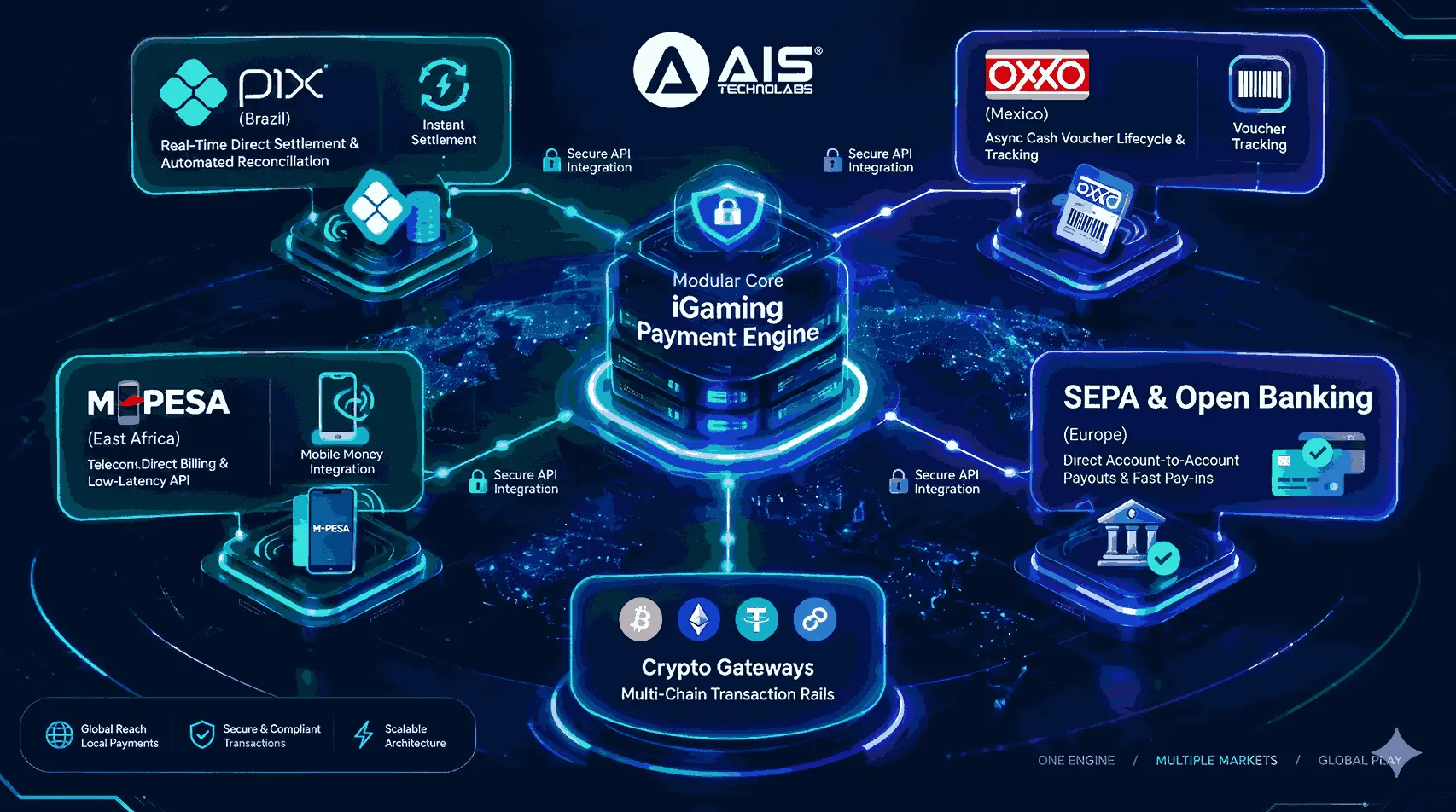
Most localization guides list the payment methods a market expects: Pix in Brazil, OXXO in Mexico, M-Pesa in Kenya, UPI in India, plus crypto rails for operators that support them. That list is accurate - and it's also the easy part. The harder part is what each of those rails actually requires once you move from "we know players want this" to "this is live in production":
- Pix (Brazil) settles differently than a card transaction - a platform's payment layer needs to handle instant settlement and reconciliation logic that a traditional gateway integration wasn't built for.
- OXXO (Mexico) is a cash-voucher system, not a direct transfer - the platform needs to generate and track vouchers, and handle the gap between "voucher issued" and "payment confirmed," which can be hours, not seconds.
- M-Pesa (Kenya and broader East Africa) is mobile-money, not card-based - integration means working with a telecom-run payment network, not a conventional payment processor.
- UPI (India) requires a different authentication and callback flow than card or wallet payments, and sits inside a regulatory environment that changes faster than most.
- Crypto rails, where an operator supports them, need to be built with the understanding that crypto capability is a payment feature - never a substitute for the licensing or regulatory approval a jurisdiction actually requires.
The practical implication: a platform's payment layer should be built so that adding a new regional rail is an integration project measured in weeks, not a re-architecture measured in months. That's the difference between a platform that can expand into a new market on schedule and one that can't.
Building for Compliance Before You Need It
Licensing and regulatory requirements vary by jurisdiction, change over time, and are ultimately a legal question - this guide isn't a substitute for qualified legal or licensing counsel, and no platform vendor can guarantee a license or regulatory approval. What a platform's architecture can do is avoid making compliance harder than it has to be.
In practice, that means building with the following in place from the start, rather than retrofitting them under deadline:
- KYC/AML hooks that can be configured per jurisdiction rather than hard-coded to one regulatory standard.
- Responsible-gambling tooling (deposit limits, self-exclusion, session reminders) built as configurable platform features, not one-off additions.
- Audit logging detailed enough to support a regulator's review without a separate reporting system bolted on afterward.
- Modular jurisdiction settings - tax handling, game-feature restrictions (some regulators restrict features like Buy Bonus or loot-box mechanics), and regional disclosures - that can be toggled per market instead of requiring a code change.
None of this replaces the legal and licensing process operators go through with regulators and counsel. It does mean the platform itself isn't the bottleneck when that process moves forward. Curacao remains a common starting point for new operators - see our Curacao gaming license acquisition guide for what that process actually involves.
Region-by-Region: Game Mechanics and Retention Architecture
Player preferences by region are genuinely well covered by existing market guides - what's less covered is how the retention mechanics behind those preferences actually get built. A few examples:
Africa. Crash and fast games dominate because they're simple to learn and perform well on limited connections - which loops back to the architecture point above: a crash game's retention value depends on it loading instantly and staying responsive, not just on the game design. Trust-building features (clear payout confirmation, visible withdrawal status) matter more here than loyalty-program complexity, because player trust in the platform itself is still being established in many of these markets.
Asia. Markets here split sharply - slots dominate in East Asia, live casino and table games (Teen Patti, Sic Bo, and similar local formats) carry Southeast and South Asia, and regulatory stances vary country to country within the same region. Gamification (daily missions, login rewards) tends to drive retention more than VIP tiers. Architecturally, that means a platform's promotions/gamification engine needs to be flexible enough to run region-specific campaigns without a custom build each time.
Europe. Slots lead, with regulatory spin-delay requirements (several hundred milliseconds to a few seconds, depending on jurisdiction) that need to be built into the game engine's pacing, not bolted on as a display delay. That puts real weight on slot game development that can accommodate region-specific pacing and regulatory requirements without a redesign. VIP ladders and tiered loyalty programs are the dominant retention pattern - which is a data and segmentation problem as much as a rewards one.
Latin America. National identity matters more here than regional generalization - a platform that treats "LatAm" as one market will underperform one built to differentiate Brazilian Portuguese from Mexican Spanish from Rioplatense Spanish, and local payment rails (Pix, OXXO, and cash-agent networks) aren't optional. Front-page prioritization matters: players in these markets are less likely to dig through deep navigation, so what's above the fold carries more conversion weight than in other regions.
North America. Regulated state-by-state in the US and provincially in Canada, which means a platform needs jurisdiction-level configuration, not just country-level. For operators building out that side of the business, the same configurability applies to sports betting software as it does to casino platforms. Retention here leans on tiered loyalty tied to real-world perks and land-based crossover, where that's part of an operator's model.
The AIS 15-Point Pre-Launch & Compliance Checklist
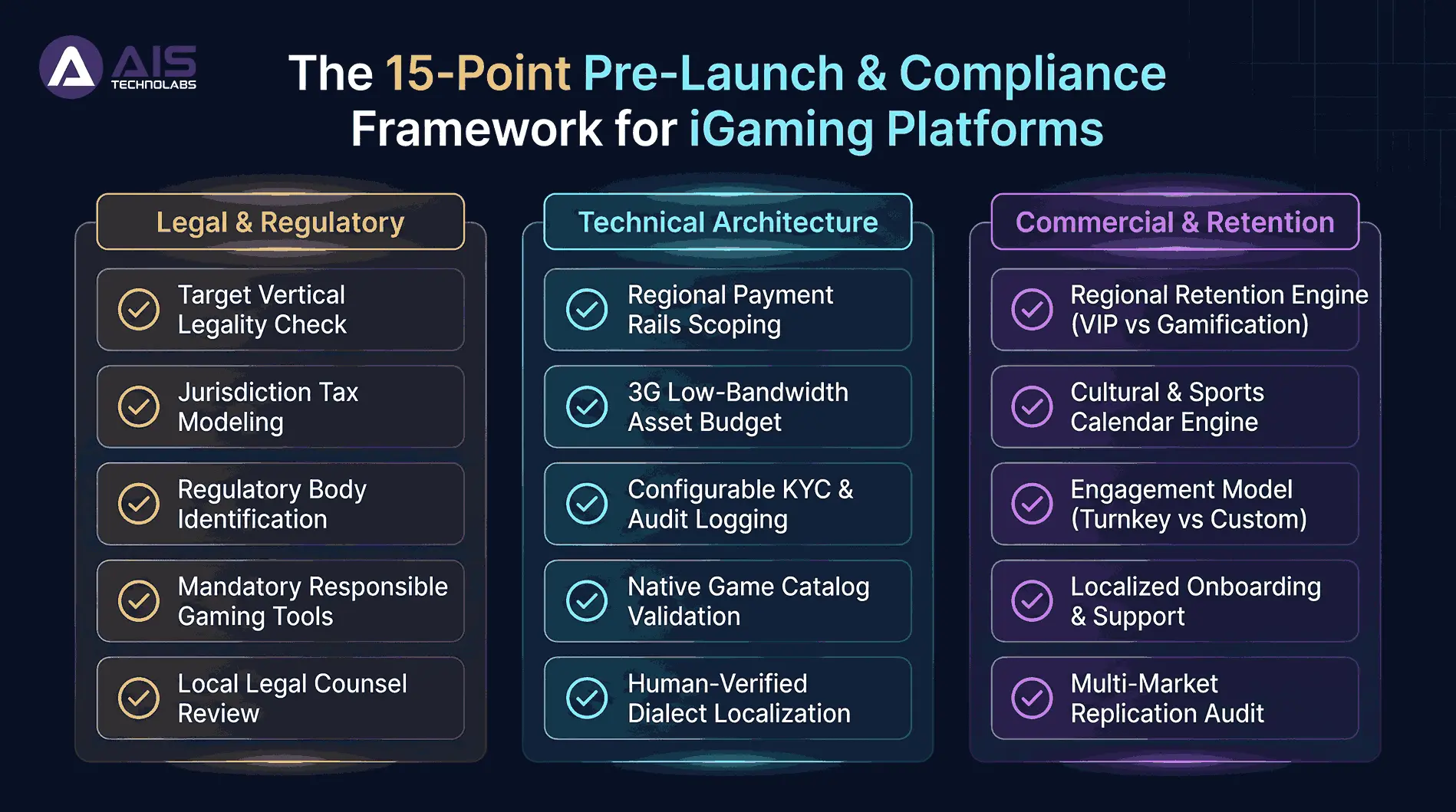
A localization checklist works better organized by who owns each decision - legal, engineering, or commercial - rather than as one flat list. Each track has five points:
Legal & Compliance
- Confirm which verticals are actually legal in the target jurisdiction (sports betting legality doesn't guarantee online casino legality, or vice versa).
- Understand the applicable tax structure before modeling margins.
- Identify the correct regulatory body - national or provincial/state-level, depending on the jurisdiction.
- Confirm responsible-gambling requirements specific to that market.
- Get qualified legal or licensing counsel involved before, not after, platform architecture decisions are made.
Technical
- Map every payment rail the market requires and scope the integration work for each - see the payment section above.
- Set a performance budget for 3G/entry-level-device load times if the market needs it.
- Build jurisdiction-level configuration into the platform (KYC rules, feature restrictions, audit logging) rather than one-off code.
- Validate the game catalog against regional preferences with local partners, not assumptions.
- Confirm the platform's localization covers human-translated copy and dialect precision - machine translation errors are one of the fastest ways to lose player trust.
Commercial
- Match the retention model to the region - gamification and daily engagement in Africa/Asia, VIP tiers in Europe/North America, national-identity-driven campaigns in LatAm.
- Build cultural and sporting calendar events into the promotions engine as a standing capability, not a one-time campaign.
- Decide whether a turnkey or custom casino software provider engagement model fits your launch timeline before committing to it.
- Plan customer support and onboarding flows appropriate to the market - agent-assisted onboarding in some Asian markets, warm/relational support in LatAm, self-service in mature European/North American markets.
- Revisit the checklist before every new market entry - a platform built right for one region doesn't automatically clear the bar for the next one.
What This Means in Practice
None of this changes the player-facing side of localization - the games, the promotions, the payment options players expect. What it changes is how much of that is a configuration decision versus a rebuild, every time an operator enters a new market. A platform built with the architecture above treats a new region as an integration project with a known scope. A platform that wasn't treats it as a re-engineering effort, discovered under launch-deadline pressure.
AIS Technolabs has spent 16 years building gambling and iGaming technology - platforms, casino and sportsbook software, and custom integration work - for operators across 39+ countries, with 8,500+ projects delivered. The architecture decisions above are the ones that show up, directly, in whether a platform expansion into a new region takes weeks or months.
Conclusion
Localization that stops at translation and a payment-methods list gets a platform into a new market. Localization built into the platform's architecture - payment integration, compliance-ready configuration, performance budgets, and region-aware retention mechanics - is what lets an operator keep expanding into new markets on a predictable timeline, instead of relearning the same lessons at every launch.
CTA
Ready to Expand Into a New Market?
Talk to an AIS Technolabs iGaming specialist about the payment rails, compliance configuration, and launch timeline for your next region.
Speak With an iGaming Expert →