Table of Content
(500 views)
Published:October 30, 2026 at 10:00 am
Last Updated:30 Oct 2026 , 10:00 am
Key Takeaways
- Setup fees for sweepstakes casino software commonly range from roughly $10,000 for a basic turnkey launch to $200,000+ for a fully custom build, based on a published 2026 industry pricing guide. Treat it as one data point, not an industry-wide average, and get your own scoped quote before budgeting.
- Ongoing costs are structured as revenue share (a % of GGR), a flat license fee, a fixed fee, or a combination. The model you're quoted changes your margin math as volume grows, not just your bill size.
- The real total cost of ownership usually includes payment processing fees, per-title game royalties, compliance tooling, and dual-currency ledger reporting. These often sit outside the headline setup number.
- The US sweepstakes casino market moved real money in 2025 and 2026. Gross gold-coin sales reached an estimated $14.3 billion in 2025, with net operator revenue closer to $4 to $5 billion after prize redemptions.
- No price in this article is an AIS Technolabs quote. AIS prices every engagement to the operator's actual scope.
Introduction
Most operators underestimate what it actually costs to launch a sweepstakes casino platform. Not because the setup fee is a mystery, but because the setup fee is only the first of five or six cost lines that show up before year one is over.
The US sweepstakes casino market isn't a niche experiment anymore. Gross consumer spending on sweepstakes-model "gold coin" packages reached an estimated $14.3 billion in 2025, with net operator revenue (after prize redemptions) closer to $4 to $5 billion, according to industry analysis from Eilers & Krejcik Gaming and H2 Gaming Capital reported by WalletInvestor.
That kind of volume is why providers now compete hard on this exact question. The honest answer is "it depends on five things," not a single number.
This guide breaks down what's actually reported in the market for setup and ongoing fees, the costs that don't show up on the first quote, and the questions that separate a usable number from a lowball one. If you want the full picture of what the build itself involves rather than just the cost, our sweepstakes casino software page covers the platform side in depth.
What Determines the Price of Sweepstakes Casino Software
Five things move the price more than anything else a provider puts on a rate card:
- Build model: turnkey, semi-custom, or fully custom.
- Game library size: how many titles and providers you launch with.
- Compliance scope: how many US states, and how deep your KYC/AML/geo-blocking needs to go.
- Back-office and admin depth: how much PAM, CRM, reporting and fraud tooling is included versus billed separately.
- Payment and hosting setup: how many payment methods, and what uptime/support SLA you need.
Turnkey vs. semi-custom vs. fully custom
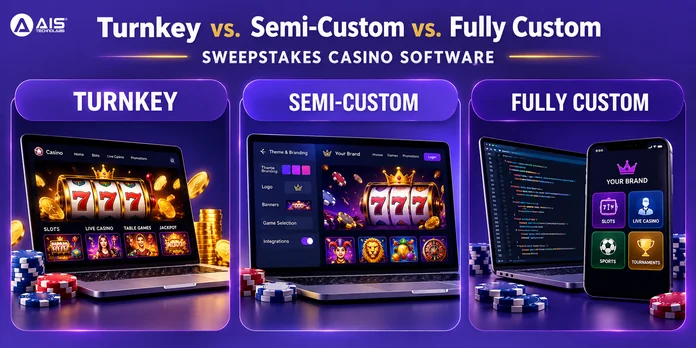
The biggest single driver is which build model you choose. It's worth understanding all three on their own before you look at a single price range.
A turnkey platform is licensed and configured rather than built from scratch. You're essentially renting a working platform, branding it, and launching.
This costs the least up front and typically launches in weeks. It also comes with compliance tooling, payments, and a game library pre-integrated.
The trade-off is limited flexibility. You're working within the provider's architecture, and deep customization usually isn't available or costs extra.
A semi-custom build starts from an existing codebase and modifies specific modules: the wallet logic, the promotional engine, the front-end UI. This sits in the middle on price, timeline (typically a few months), and flexibility.
You get real differentiation where it matters most without paying for a ground-up rebuild of everything else.
A fully custom platform is built to your exact specification with no shared codebase at all. It takes the longest, commonly six months to a year or more, and costs the most.
In exchange, you get full IP ownership and no shared-platform constraints. This is the right call when your product vision, scale, or proprietary integrations don't fit any existing platform.
| Model | Starting point | Typical timeline | Best fit |
|---|---|---|---|
| Turnkey | Existing platform, licensed and configured | Weeks | Fast, lower-cost market entry; standard feature set is enough |
| Semi-custom | Existing codebase, specific modules rebuilt | A few months | Real differentiation (wallet, promo engine, UI) without a full rebuild |
| Fully custom | Built to spec, no shared codebase | 6 to 12+ months | Unique product requirements, long-term IP ownership, proprietary integrations |
This comparison and the cost table further down cover the decision on their own. If you want to talk through which model fits your scope, our sweepstakes casino software page is the place to start that conversation.
Game library size and provider integrations
Every additional game studio you integrate adds API work, QA, and a royalty or revenue-share line to your ongoing costs. A launch with a handful of in-house or single-provider games costs meaningfully less to set up than a library aggregating slots, table games, and jackpots from five or six separate content providers.
For example, launching with one in-house studio providing 10 to 15 titles keeps integration work contained to a single API and a single testing cycle. Moving to a game-aggregation model that pulls in several hundred titles from six or seven providers multiplies the integration and QA surface several times over.
The aggregator itself absorbs some of the connection work on your behalf. But each provider relationship still tends to carry its own royalty or revenue-share term, layered on top of whatever the platform provider charges.
So a bigger game library isn't just a bigger catalog to the player. It's a bigger number of separate commercial relationships for you to manage and reconcile.
Aggregation reduces the per-studio integration burden. It usually carries its own fee layer on top, so it moves where the cost sits rather than removing it.
Compliance scope (state coverage, KYC/AML depth)
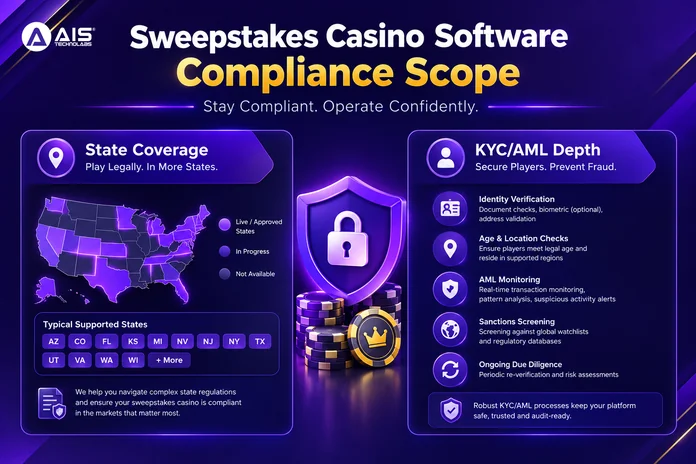
US sweepstakes gaming operates under a patchwork of state-level rules. The number of states you plan to serve directly affects what your platform needs to do out of the box: geo-blocking logic, identity-verification depth, AML monitoring, and dual-currency accounting.
A platform scoped for a handful of states costs less to configure than one built to cover most of the country from day one.
For example, a platform scoped to launch in 8 to 10 states where the sweepstakes model is well established typically needs a narrower geo-blocking rule set and a lighter identity-verification tier. A platform scoped to cover 35-plus states needs more, since several of those states carry different age-verification, identity-proofing, or responsible-gaming disclosure requirements.
Every additional state isn't just a flag in a configuration file. It can mean a separate legal review, a different verification flow, and ongoing monitoring as that state's own rules change.
This is also one of the more volatile cost inputs in the whole budget. Several states tightened or reconsidered their treatment of the sweepstakes model during 2025 and 2026, which is why compliance scope is worth revisiting periodically even after launch.
Setup Fees: What Operators Report Paying
Costs here vary mainly by platform type, feature depth, the integrations you need, and your compliance requirements. The ranges below are illustrative examples from a published industry pricing guide, not an AIS Technolabs quote and not a guarantee of what you will pay.
| Build model / feature tier | Published range (USD) |
|---|---|
| Basic feature set (template UI, single game type, basic admin) | $10,000 to $30,000 |
| Turnkey, ready-to-launch platform | $50,000 to $80,000 |
| Standard feature set (multiple games, branded UI, basic analytics) | $30,000 to $80,000 |
| Fully custom / advanced feature set (live dealer, mobile apps, AI personalization) | $80,000 to $200,000+ |
Two things worth noticing in that table. The ranges overlap, because build model and feature depth are two different axes that both move price.
A cheap build model with a heavy feature list can cost the same as an expensive build model with a light one. That's exactly why a provider needs your actual scope, not just a model name, to give you a real number.
Ongoing Costs After Launch
Setup is only the first bill. Every sweepstakes platform carries an ongoing cost structure, and which model you're on changes your margin math for as long as you operate.
| Model | How it works | Watch for |
|---|---|---|
| Revenue share (GGR) | Provider takes a percentage of gross gaming revenue: what players spend minus what's paid back | Scales with your growth. Low early risk, but your largest line item grows as you do |
| Flat monthly/annual license | Fixed fee regardless of volume | Predictable, but you pay it even in a slow month. Can beat revenue-share once volume is high |
| Fixed fee, no revenue share | One flat ongoing fee, no % of GGR at all | Usually paired with a higher setup fee. Suits high-volume, high-margin operators who want cost certainty |
Some providers combine a smaller license fee with a lower revenue-share percentage rather than choosing one model exclusively. Always ask which structure, or combination, you're actually being quoted.
The Hidden Cost Most Operators Miss
Why the cheapest setup quote isn't always the cheapest platform over 3 years
Here's a simplified, hypothetical example to illustrate the mechanic. It is not a projection of real costs, and the numbers are chosen only to make the math easy to follow.
Assume two platforms process the same monthly gross gaming revenue (GGR), and that GGR grows steadily over time. Platform A charges a $40,000 setup fee and a 15% revenue share. Platform B charges an $80,000 setup fee and a 6% revenue share.
At low monthly GGR, Platform A is cheaper overall. Its setup fee was $40,000 less, and the revenue-share gap hasn't had time to add up.
As monthly GGR grows, the 9-percentage-point gap between the two revenue-share rates applies to a bigger number every month. At some point, the extra amount Platform A charges every month because of its higher rate outweighs the $40,000 it saved upfront.
From that point forward, Platform B becomes the cheaper platform overall, for as long as volume stays at or above that level. The provider with the lower sticker price isn't automatically the lower-cost platform once your revenue scales.
Before comparing quotes, model total cost of ownership across a realistic 12 and 36-month volume projection, not just the fee on page one.
Payment gateway markups and content royalties
Payment processing for sweepstakes platforms often carries its own markup on top of the base processor rate. This isn't incidental.
Major processors treat sweepstakes and casino-style gaming as a pre-approval risk category, not standard commerce. PayPal's own Acceptable Use Policy, for example, lists "casino games... other ventures that facilitate gambling, games of skill... and sweepstakes" together under activities requiring pre-approval.
That is exactly why sweepstakes-specific payment processing tends to carry higher fees and more underwriting than a standard e-commerce integration. Pre-approval status typically means a longer underwriting process, a rolling reserve held back from your settlements, and a higher effective processing rate than a standard online retailer would pay.
That's all before you look at the platform provider's own markup on top of the base rate. Game content from third-party studios typically adds its own per-title or revenue-based royalty on top of that.
Ask any provider to itemize payment processing, platform markup, and content royalties separately. A true all-in figure should name each of them rather than folding all three into one number.
Compliance and Integration Costs That Aren't in the Base Quote
Dual-currency ledger architecture
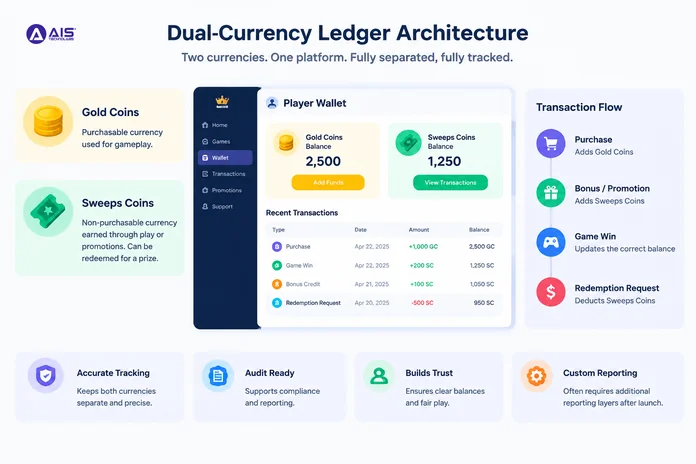
Sweepstakes platforms run on a two-currency model: a purchasable virtual currency used for play, and a separate sweepstakes-entry currency that can potentially be redeemed. Building and auditing a ledger that keeps these two currencies cleanly separated, with accurate reporting on each, is non-trivial engineering work.
Concretely, the ledger has to track at least two parallel balances per player. A purchasable currency, commonly branded as Gold Coins, funds gameplay.
A separate, non-purchasable promotional currency, commonly branded as Sweeps Coins, is earned through play or promotions and can potentially be redeemed for a cash-equivalent prize. Every transaction, whether a purchase, a bonus credit, a game win, or a redemption request, has to post to the correct balance.
It has to stay auditable after the fact and reconcile against the platform's own reported numbers. Get this wrong and you have either a compliance problem, if purchasable and promotional funds become indistinguishable, or a player-trust problem, if balances don't reconcile.
A turnkey quote often includes the licensed ledger itself but not a custom reporting layer on top of it. That gap is typically where this cost surfaces after launch, not before, which is why it's worth asking about explicitly during the quoting stage.
KYC/AML and geo-blocking tooling
Identity verification, anti-money-laundering monitoring, and state-by-state geo-blocking aren't optional add-ons for a US-facing sweepstakes platform. They're part of the compliance scope that determines your setup fee in the first place.
How many states, and how strict the verification tier, is one of the first things an honest provider asks before giving you a number. It moves the price more than almost anything else on this list.
It also matters because the regulatory picture keeps moving. Some market forecasts point to a contraction in US sweepstakes revenue in 2026 as operators exit states that have tightened or closed the model, per the same WalletInvestor reporting cited above.
That's one more reason to scope compliance deliberately rather than as an afterthought.
Questions to Ask a Provider About Total Cost
Before you compare two quotes, make sure they're quoting the same thing:
- Is this setup fee all-in, or are payment gateway fees, content royalties, and compliance tooling itemized separately?
- Is the ongoing cost revenue-share, flat license, fixed fee, or a combination, and what's the exact percentage or amount?
- How many states does this quote cover for compliance, and what does adding more states cost later?
- How is the dual-currency ledger reported, and is that reporting included or a separate build item?
- What happens to pricing if my game library grows after launch? Is each new integration a separate cost?
- Can you show a real client's total cost over 12 months, not just the setup fee?
A provider who answers all six without hedging is giving you a usable number. One who can only quote the setup fee is giving you half the picture.
Conclusion
Setup fee is just the headline number. What determines your real cost is the build model you choose, how big your game library is, how many states you cover, and whether your ongoing fees are revenue share, a flat license, or both.
The costs that catch operators off guard are rarely the ones in the first quote. Payment processing markups, game royalties, and dual-currency ledger reporting tend to surface after launch, not before.
The best way to protect your budget is to ask every provider the six questions above, and to model total cost of ownership over 12 and 36 months rather than comparing setup fees alone.
If you're ready to move past market ranges and get a number scoped to your actual requirements, talk to AIS Technolabs about your sweepstakes casino platform. And if you're still comparing vendors first, see how the major providers stack up in our guide to sweepstakes software providers.
Disclaimer:
Pricing figures in this article are illustrative examples drawn from published industry sources and general market ranges as of 2026. They are not quotes, and actual cost depends on your scope, jurisdiction, and chosen provider. This article is for general informational purposes only and is not legal, financial, or compliance advice. Sweepstakes gaming regulations vary by state and change over time, so confirm current requirements with qualified legal counsel before launching. Software capability does not constitute legal authorization to operate in any jurisdiction.
We believe sweepstakes gaming should be operated responsibly. Operators remain responsible for building responsible-gaming safeguards, such as spending limits, self-exclusion tools, and age verification, into their platform regardless of the build model chosen.
FAQs
Ans.
Generally yes, at the entry stage. Sweepstakes platforms avoid the state-by-state gambling licensing process a real-money operation requires, which removes a significant layer of upfront legal and regulatory cost. Platform software costs themselves are broadly comparable between the two models. The gap is mainly in licensing and compliance overhead, not the software. Where the two models can end up closer than expected is on the ongoing side. Payment processing, compliance tooling, and game content royalties apply to both, so the gap narrows once a platform is live and operating at volume. Total cost of ownership should still be compared model-to-model rather than assumed from the setup fee alone.
Ans.
Not always. It depends on the provider. Some charge revenue share only, some a flat license fee only, and some combine a smaller license fee with a lower revenue-share percentage. That effectively splits the risk between a predictable baseline and a growth-linked component. Ask explicitly which structure you're being quoted, and at what revenue tier, if any, the rate changes. "License fee" and "revenue share" get used loosely and inconsistently across providers, and sometimes mean different things from one quote to the next.
Ans.
A turnkey or white-label platform generally launches fastest, commonly a matter of weeks rather than months, since the core platform already exists and the work is configuration, branding, and compliance setup rather than ground-up development. A fully custom build takes substantially longer, often six months to a year or more, because every module, including the wallet, game library, admin tools, and compliance layer, is built rather than configured. Semi-custom sits between the two on both timeline and cost. If timeline is your primary constraint, that's a strong signal toward turnkey or semi-custom over fully custom. If long-term IP ownership and a unique feature set matter more than speed, that trade-off runs the other way.

Mary Smith
Mary Smith excels in crafting technical and non-technical content, demonstrating precision and clarity. With careful attention to detail and a love for clear communication, she skillfully handles difficult topics, making them into interesting stories. Mary's versatility and expertise shine through her ability to produce compelling content across various domains, ensuring impactful storytelling that resonates with diverse audiences.
 ASIA PACIFIC