Table of Content
(505 views)
Published:March 10, 2026 at 8:37 am
Last Updated:5 Jun 2026 , 10:01 am

Key Takeaways:
Introduction to Online Poker Tournaments
Online poker tournaments are structured competitions where players pay an entry fee, receive tournament chips, and compete until one player wins all the chips. These tournaments are hosted on digital platforms powered by advanced systems such as White Label Poker Software, allowing operators, clubs, and businesses to run professional poker environments without developing technology from scratch.
Over the past decade, online poker tournaments have grown dramatically in popularity. From casual home games to professional online poker networks, tournament formats create excitement, competition, and community among players. Players can participate from anywhere while experiencing the same thrill as live poker tournaments.
Tournament formats matter because they influence gameplay style, strategy, and player engagement. Some players prefer long, competitive tournaments with large prize pools, while others enjoy shorter matches that start quickly and end within an hour.
The rise of digital poker platforms has also encouraged entrepreneurs and gaming operators to launch their own poker ecosystems. By using a white label poker software platform, operators can offer multi-table tournaments, Sit & Go events, and cash tables with built-in security, payment integration, and tournament automation.
As the online gaming industry continues to expand, tournament-based poker remains one of the most engaging and scalable forms of digital entertainment.
What Are Online Poker Tournaments?
Online poker tournaments are competitive poker events where players start with equal chip stacks and compete against each other until only one player remains. Unlike cash games, where chips represent real money, tournament chips only determine a player's position within the tournament.
These tournaments create a structured environment where skill, strategy, patience, and risk management play key roles. With the help of white label online poker software, operators can automate registration, manage tables, track chip stacks, and distribute prizes without manual intervention.
Core Structure of Poker Tournaments
Poker tournaments follow a structured format designed to ensure fairness and competitive balance.
Players enter the tournament by paying a buy-in. Once the event begins, each participant receives the same number of chips and sits at a virtual poker table with other players. As the game progresses, players who lose all their chips are eliminated from the tournament.
When players are eliminated, tables are automatically balanced by the system. This ensures that each table maintains an equal number of participants.
As the number of players decreases, the tournament eventually reaches the final table, where the remaining players compete for the top prizes. Modern turnkey poker software platforms automate the entire tournament lifecycle, making it easy for operators to host multiple events simultaneously.
How Tournament Buy-Ins and Prize Pools Work
The buy-in is the fee players pay to enter a poker tournament. This entry fee contributes to the overall prize pool, which is distributed among the top finishing players.
For example, if 100 players each pay a $20 buy-in, the prize pool becomes $2,000. The poker platform may take a small percentage as a service fee or rake.
The prize pool is then distributed based on the tournament payout structure. Typically, the top 10–20% of players receive prizes, with the largest payouts reserved for the final table.
Platforms powered by ready-made poker software automatically calculate prize pools, adjust payouts, and distribute winnings to players instantly after the tournament ends.
Blind Levels and Increasing Stakes
Blind levels are an essential component of tournament gameplay. Blinds are mandatory bets posted by players before each hand begins.
At the start of the tournament, blinds are relatively small. However, they increase at regular intervals, usually every 5–15 minutes. This gradual increase forces players to take action rather than waiting indefinitely for strong hands.
For example, a tournament might begin with blinds of 10/20 chips and increase to 20/40 after ten minutes. As blinds rise, players must manage their chip stacks carefully to avoid elimination.
Automated blind level systems within scalable poker software platforms ensure tournaments progress smoothly and maintain competitive pressure.
Multi-Table Tournaments (MTT) Explained
Multi-Table Tournaments (MTTs) are large-scale poker competitions involving multiple tables and many players. These tournaments often attract hundreds or thousands of participants competing for substantial prize pools.
MTTs are one of the most popular formats in online poker because they combine accessibility with the potential for massive rewards. Many operators rely on white label poker solutions to host these tournaments due to the complex infrastructure required to manage large player pools.
What Is an MTT in Online Poker?
An MTT begins with players seated across multiple tables. Each participant receives an equal number of chips and competes until they lose all their chips.
As players are eliminated, the poker platform redistributes remaining players to maintain balanced tables. Eventually, only a small number of players remain, forming the final table where the biggest prizes are decided.
MTTs are popular because they allow players to enter with relatively small buy-ins while competing for large prize pools.
How MTT Poker Tournaments Work
MTT tournaments progress through several stages.
In the early stage, the tournament includes many tables and relatively slow blind levels. Players focus on building chip stacks while avoiding unnecessary risks.
The middle stage occurs when the field begins shrinking and blinds increase significantly. Players must adjust strategies to survive.
In the late stage, only a few tables remain, and the pressure increases dramatically. The tournament concludes with the final table where the top prizes are awarded.
Platforms using poker software white label technology automate player movement, chip tracking, and blind adjustments throughout the tournament.
Prize Pool Distribution in MTT Events
MTT tournaments are known for their large prize pools because they scale with the number of participants.
For example, a tournament with 5,000 players paying $10 each creates a prize pool of $50,000. The prize pool is distributed among the highest-ranking players.
A typical payout structure might look like this:
1st place – 25–30% of prize pool
2nd place – 15–20%
3rd place – 10–12%
Lower finishing positions receive progressively smaller amounts.
These calculations are automatically handled by turnkey poker software, ensuring transparency and accuracy.
Advantages and Challenges of MTT Poker
MTT tournaments offer significant advantages. Players can win large prizes from relatively small buy-ins, making the format appealing to both casual and professional players.
However, MTTs also require patience and endurance. Some tournaments last several hours or even an entire day.
Players must adapt to changing blind levels, shifting table dynamics, and increasing pressure as the tournament progresses.
Sit & Go Poker Tournaments Explained
Sit & Go tournaments are smaller poker competitions that start as soon as a predetermined number of players register. Unlike scheduled tournaments, they do not have a fixed start time.
These tournaments are widely available on platforms built with white label poker app technology because they provide continuous gameplay and fast player turnover.
What are Sit & Go Tournaments?
Sit & Go tournaments typically involve a single table of players, often six or nine participants.
Once all seats are filled, the tournament begins automatically. The players compete until one person holds all the chips.
Because they start immediately, Sit & Go tournaments are ideal for players who want a quick game without waiting for a scheduled event.
Single Table vs Multi-Table Sit & Go
Sit & Go tournaments come in two main variations.
Single-table Sit & Go tournaments include only one table of players. These tournaments are fast-paced and usually finish within an hour.
Multi-table Sit & Go tournaments include several tables and more participants, but they still start as soon as all seats are filled.
Many online poker software solutions allow operators to run both formats simultaneously to maintain constant player activity.
How Sit & Go Payout Structures Work
Sit & Go tournaments generally have simple payout structures.
For example, in a nine-player Sit & Go tournament, the top three players typically receive prizes.
A common payout structure might be:
1st place – 50%
2nd place – 30%
3rd place – 20%
This straightforward system makes Sit & Go tournaments easy to manage using ready-made poker software.
Why Sit & Go is Popular Among Casual Players
Sit & Go tournaments appeal to casual players because they are quick and easy to join.
Players do not need to wait for scheduled tournaments. They can simply register, start playing, and finish a game within a short period.
For private poker clubs and social gaming communities, Sit & Go tournaments provide a steady flow of activity.
Cash Games in Online Poker
Cash games are the most flexible form of online poker. In this format, players use real money chips instead of tournament chips, and they can join or leave the table at any time.
Most white label poker software providers include both tournament modes and cash tables within their platforms to accommodate different player preferences.
How Cash Games Differ from Tournaments
The biggest difference between cash games and tournaments is that chips represent real money.
Players buy in with actual funds and can cash out whenever they choose. There is no elimination structure or final winner.
This flexibility allows players to control session length and risk levels.
Real Money Value of Chips
In cash games, chip values correspond directly to real money.
For example, a $1/$2 table means the small blind is $1 and the big blind is $2. A player buying in for $200 is effectively placing $200 on the table.
This structure creates a more realistic poker experience similar to live casino games.
Table Limits and Buy-In Rules
Cash tables operate with specific buy-in limits to maintain balanced gameplay.
A table may allow buy-ins between $50 and $200, depending on the stakes.
These limits prevent extremely large stacks from dominating the table.
Why Professional Players Prefer Cash Games
Professional players often prefer cash games because they provide steady earning opportunities.
Unlike tournaments where players may play for hours without cashing, cash games allow players to leave whenever they reach their profit target.
Key Differences Between MTT, Sit & Go, and Cash Games
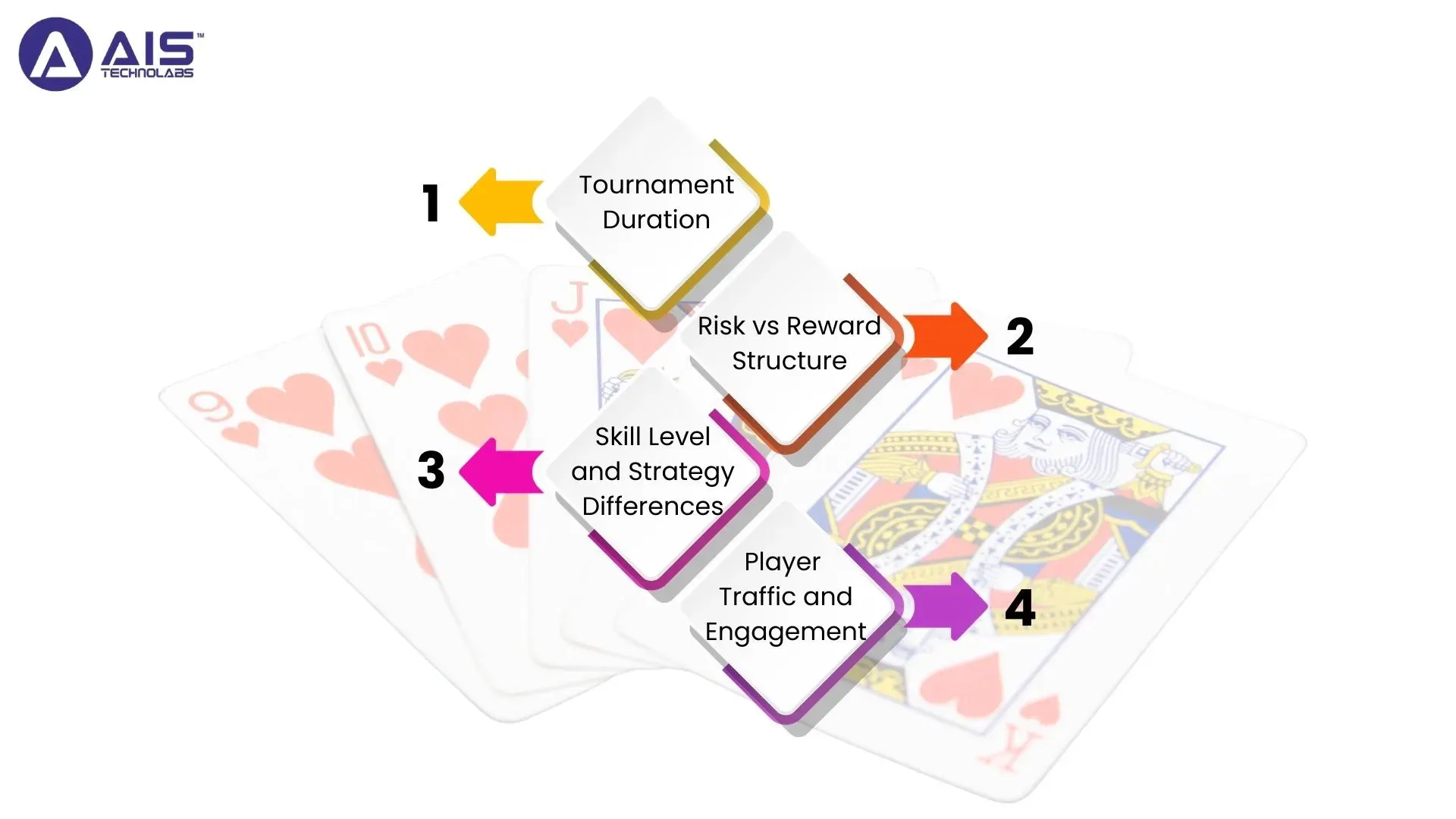
Understanding the differences between MTT tournaments, Sit & Go events, and cash games helps players choose the format that best fits their playing style, time availability, and risk tolerance. Each format offers a unique experience in terms of duration, prize potential, and strategy.
Modern poker platforms powered by White Label Poker Software allow operators to offer all three formats within a single ecosystem. This flexibility ensures players can switch between tournament modes and cash tables depending on their preferences and skill levels.
Tournament Duration
One of the biggest differences between poker formats is how long a game lasts.
Multi-Table Tournaments (MTTs) are the longest format. These tournaments may involve hundreds or thousands of players and can last several hours. Some major events even span multiple days.
Sit & Go tournaments are shorter and more predictable. They begin as soon as the required number of players register and typically last between 30 minutes and one hour.
Cash games have no fixed duration. Players can join or leave the table whenever they want. This flexibility makes them ideal for players who prefer shorter sessions.
Poker platforms built with white label poker software platforms allow operators to schedule both short and long-format games to maintain player engagement throughout the day.
Risk vs Reward Structure
Each poker format carries a different balance of risk and reward.
MTT tournaments offer the highest potential rewards relative to the entry fee. A small buy-in can lead to a significant payout if a player reaches the final table. However, the majority of players may leave the tournament without winning anything.
Sit & Go tournaments offer a more moderate risk level. Because fewer players participate, the probability of finishing in a prize position is higher.
Cash games provide consistent opportunities to win or lose smaller amounts of money over time. Since chips represent real money, players can control their risk by choosing table limits and buy-in sizes.
These varied reward structures are easily managed using turnkey poker software, which automatically handles buy-ins, prize calculations, and chip values.
Skill Level and Strategy Differences
Different poker formats require different strategic approaches.
MTT tournaments emphasize patience, endurance, and chip management. Players must survive multiple stages while adapting their strategy as blinds increase.
Sit & Go tournaments require quicker decision-making. Since only a small number of players are involved, aggressive play and early chip accumulation often lead to better results.
Cash games focus heavily on deep-stack strategy and psychological gameplay. Because players can rebuy chips, the strategy revolves around long-term profitability rather than tournament survival.
A well-designed white label poker solution supports these formats with customizable table settings, blind structures, and gameplay rules.
Player Traffic and Engagement
Player traffic varies significantly between tournament formats.
MTTs attract large groups of players simultaneously, making them ideal for major poker events and promotional tournaments.
Sit & Go tournaments generate continuous activity because new games start whenever seats are filled.
Cash games maintain steady traffic because players can join tables at any time without waiting for a tournament to start.
Operators using poker software white label platforms often combine all three formats to keep the poker ecosystem active 24/7.
Strategies for Playing Different Poker Formats
Winning in poker requires adapting strategies based on the format being played. While the core rules remain the same, successful players understand that tournament structures influence betting patterns, risk tolerance, and timing.
Online poker platforms built with scalable poker software platforms provide analytics and statistics that help players refine their strategies over time.
Winning Strategy for MTT Poker
Multi-Table Tournament strategy revolves around survival and timing.
In the early stages, players should avoid unnecessary risks and focus on building their chip stack gradually. Because the blinds are relatively small at the start, patience is a valuable asset.
As the tournament progresses and blinds increase, players must become more aggressive. Stealing blinds and identifying weaker opponents becomes crucial.
In the late stages, short stacks must push all-in strategically, while larger stacks can apply pressure on other players.
Understanding stack size, position, and blind levels is critical for long-term success in MTT tournaments.
Sit & Go Tactical Tips
Sit & Go tournaments require faster strategic adjustments because the field is smaller and the game progresses quickly.
Players should aim to accumulate chips early by taking calculated risks against weaker opponents. Since payouts usually go to only the top few players, maintaining a competitive chip stack is essential.
Position also plays a key role. Aggressive play from late positions can help players steal blinds and control the pace of the game.
Because Sit & Go tournaments typically involve fewer players, reading opponents' playing styles becomes an important advantage.
Cash Game Strategy Basics
Cash game strategy differs significantly from tournament play.
Players should focus on disciplined bankroll management and avoid chasing losses. Because chips represent real money, every decision has immediate financial consequences.
Successful cash game players prioritize strong starting hands and position-based play. Bluffing can be effective, but it should be used selectively.
Another key aspect is table selection. Choosing the right table with favorable opponents can greatly improve profitability over time.
Players who develop patience and emotional control often perform best in cash game environments.
How Online Poker Platforms Host and Manage Tournaments
Running online poker tournaments requires sophisticated software infrastructure capable of managing thousands of players simultaneously. Modern poker platforms rely on White Label Poker Software to automate the entire tournament lifecycle, from player registration to prize distribution.
These platforms provide operators with the tools needed to host professional poker tournaments without developing custom software from scratch.
Tournament Scheduling Systems
Tournament scheduling systems allow operators to create events in advance and manage multiple tournaments simultaneously.
Players can view upcoming tournaments, register early, and receive notifications before the event begins. Scheduled tournaments help build anticipation and attract larger player pools.
Operators can configure buy-ins, blind levels, prize structures, and registration deadlines directly within the platform.
Advanced online poker software solutions allow tournaments to run automatically once registration closes.
Player Matching and Table Balancing
Player distribution is a critical aspect of tournament management.
Poker platforms automatically assign players to tables and rebalance tables as participants are eliminated. This ensures fairness and maintains an equal number of players at each table.
As the tournament progresses and the number of participants decreases, players are gradually moved toward fewer tables until the final table is formed.
Advanced poker platform for operators systems ensure smooth transitions without interrupting gameplay.
Anti-Collusion and Fair Play Systems
Fairness is essential for maintaining player trust in online poker platforms.
Modern systems use advanced monitoring tools to detect suspicious activity such as collusion, chip dumping, or bot usage.
Most professional platforms also use RNG certified poker software to guarantee random card distribution. These systems are regularly audited by independent testing agencies.
Security frameworks also incorporate KYC verification, AML compliance, and responsible gaming tools to ensure safe gameplay.
Payment and Prize Distribution Automation
One of the most important components of online poker platforms is automated payment processing.
Once a tournament ends, the system calculates final standings and distributes prizes instantly based on the predefined payout structure.
Modern platforms integrate multiple payment gateways, allowing players to deposit and withdraw funds securely.
Solutions built using ready-made poker software often include PCI DSS compliant payment systems and GDPR-compliant data security protocols.
Choosing the Right Poker Format for Your Playing Style
Selecting the right poker format depends on a player's experience level, available time, and competitive goals. Different formats cater to different types of players, from casual participants to professional grinders.
Modern poker ecosystems powered by white label poker software platforms allow players to switch between formats seamlessly.
For Beginners
Beginners should start with Sit & Go tournaments or low-stakes cash games.
Sit & Go tournaments are ideal because they involve fewer players and shorter sessions. This allows new players to learn the game without committing several hours to a large tournament.
Low-stakes cash games also provide a controlled environment where beginners can practice basic strategies while managing risk.
Starting with smaller buy-ins helps players build confidence and experience.
For Competitive Players
Players who enjoy competition and strategic depth often prefer Multi-Table Tournaments.
MTTs offer the excitement of large prize pools and the challenge of competing against hundreds of opponents. The structure rewards patience, skill, and adaptability.
Competitive players often focus on mastering tournament strategy, including chip stack management and late-stage aggression.
Many online poker platforms host daily or weekly MTT events to keep competitive players engaged.
For High-Volume Professionals
Professional players typically prefer cash games or high-frequency Sit & Go tournaments.
Cash games allow professionals to control their session length and play multiple tables simultaneously. This flexibility helps them maximize long-term profits.
High-volume Sit & Go tournaments also provide consistent opportunities to generate income through frequent gameplay.
Platforms offering scalable poker software platforms often include multi-table functionality, allowing professional players to participate in several games at once.
The Future of Online Poker Tournaments
Online poker continues to evolve as technology transforms the gaming industry. Advances in software development, mobile gaming, and artificial intelligence are reshaping how tournaments are organized and played.
Modern White Label Poker Software solutions are leading this transformation by integrating new technologies that improve gameplay, security, and player engagement.
AI-Driven Player Matching
Artificial intelligence is increasingly being used to improve matchmaking systems.
AI algorithms analyze player behavior, skill levels, and historical data to create balanced tables. This ensures fair competition and improves player retention.
AI tools can also detect suspicious activity, helping operators maintain secure gaming environments.
Mobile-First Tournament Platforms
Mobile gaming has become the dominant way players access online poker.
Modern platforms prioritize responsive design and mobile optimization, allowing players to join tournaments from smartphones and tablets.
Mobile-first platforms also include push notifications, quick registration systems, and simplified user interfaces.
These innovations make poker tournaments more accessible to a global audience.
Real-Time Analytics and Leaderboards
Data analytics is becoming a major part of the poker experience.
Advanced poker platforms provide real-time statistics, leaderboards, and performance insights. Players can track their win rates, tournament results, and gameplay patterns.
For operators, analytics tools help identify player trends, optimize tournament structures, and improve engagement strategies.
As poker technology continues to evolve, data-driven insights will play an increasingly important role in shaping the future of online tournaments.
Conclusion
Online poker tournaments offer a dynamic and competitive environment where players can test their skills against others around the world. Formats such as MTT tournaments, Sit & Go events, and cash games provide unique gameplay experiences suited for different types of players.
Behind these experiences lies powerful gaming technology. Advanced White Label Poker Software enables operators to build scalable, secure poker platforms with automated tournament management, fair-play monitoring, and integrated payment systems.
For businesses, gaming communities, and entrepreneurs looking to launch an online poker platform, partnering with an experienced provider is essential.
AIS Technolabs delivers robust white label poker software platforms designed for performance, security, and scalability. Organizations looking to start an online poker business or expand their iGaming offerings can contact us to explore customized poker solutions.
Disclaimer:
This blog is intended for informational and educational purposes only. We do not promote or facilitate gambling activities in any country where it is considered illegal. Our content is focused solely on providing knowledge about legal and regulated markets. We only work with operators and platforms that are licensed and comply with the laws of jurisdictions where casino gaming is permitted. We do not operate or endorse any form of gambling in restricted regions. In countries where only skill-based games are allowed, our involvement is strictly limited to those games.
We believe gambling should be an entertaining and responsible activity. Our goal is to ensure that the platforms we review uphold the highest standards of fairness, transparency, and player safety.
FAQs
Ans.
MTT tournaments involve many players competing across multiple tables and usually start at scheduled times. Sit & Go tournaments begin automatically once a fixed number of players join and typically involve a single table, making them faster and more accessible.
Ans.
The duration depends on the format. Multi-table tournaments can last several hours, while Sit & Go tournaments usually finish within 30 to 60 minutes. Cash games have no time limit because players can join or leave the table whenever they want.
Ans.
Cash games can be easier for beginners because players can leave at any time and rebuy chips if needed. However, Sit & Go tournaments are also beginner-friendly because they have shorter durations and simpler payout structures.
Ans.
Tournament prize pools are created from player buy-ins. The top 10–20% of players usually receive payouts, with the largest share going to the final table participants. Prize distribution is handled automatically by the poker platform.
Ans.
Many experienced players prefer cash games because they provide consistent profit opportunities and flexible playing sessions. However, some professionals specialize in MTT tournaments due to the possibility of winning large prize pools.

Mary Smith
Mary Smith excels in crafting technical and non-technical content, demonstrating precision and clarity. With careful attention to detail and a love for clear communication, she skillfully handles difficult topics, making them into interesting stories. Mary's versatility and expertise shine through her ability to produce compelling content across various domains, ensuring impactful storytelling that resonates with diverse audiences.
 ASIA PACIFIC