Table of Content
Key Takeaways
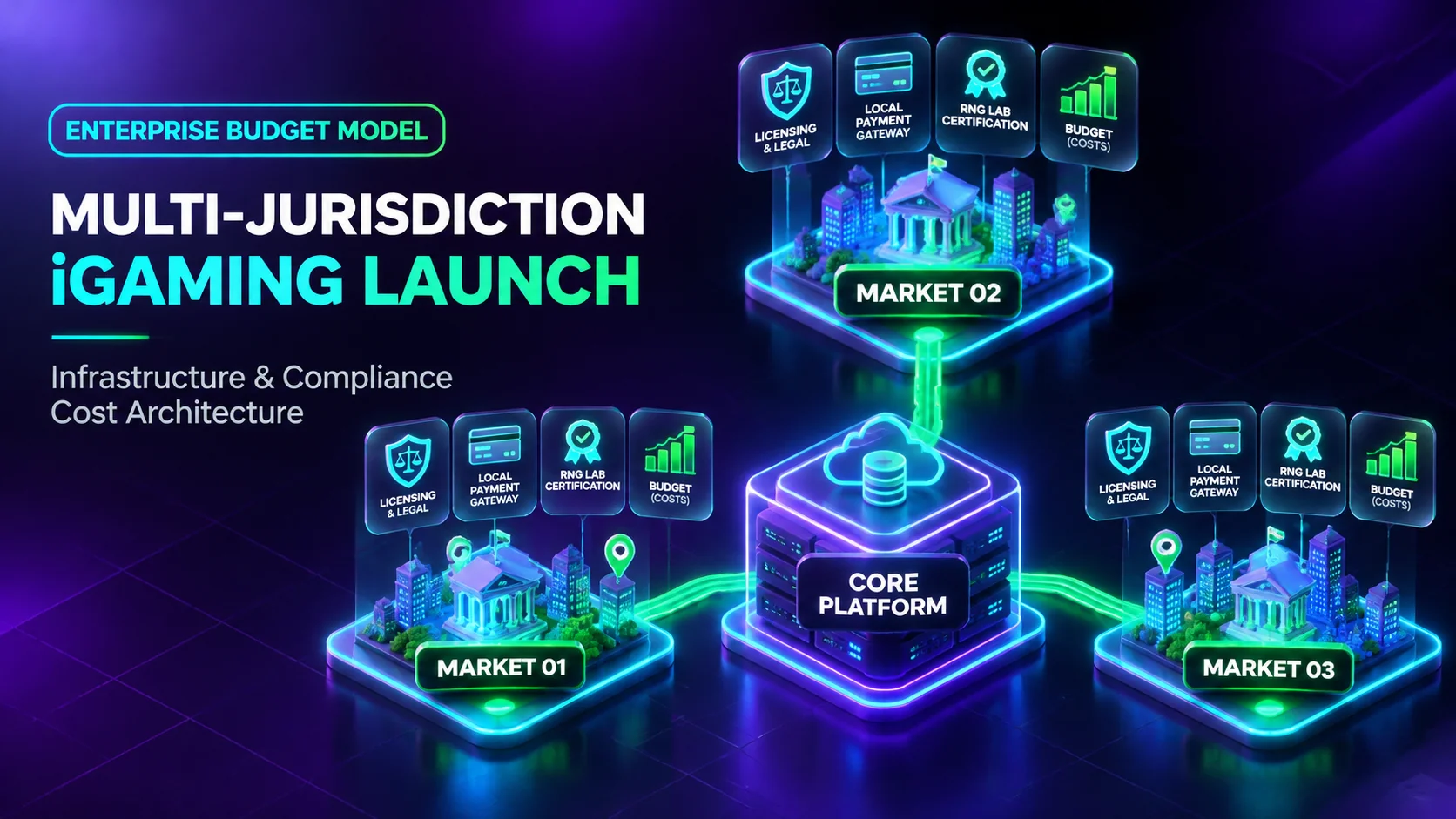
- A board approving "launch in 3 markets" and finance getting "one number" is where multi-market budgets go wrong: each market carries its own licensing, payment, certification, localization and marketing cost line, and they don't average out.
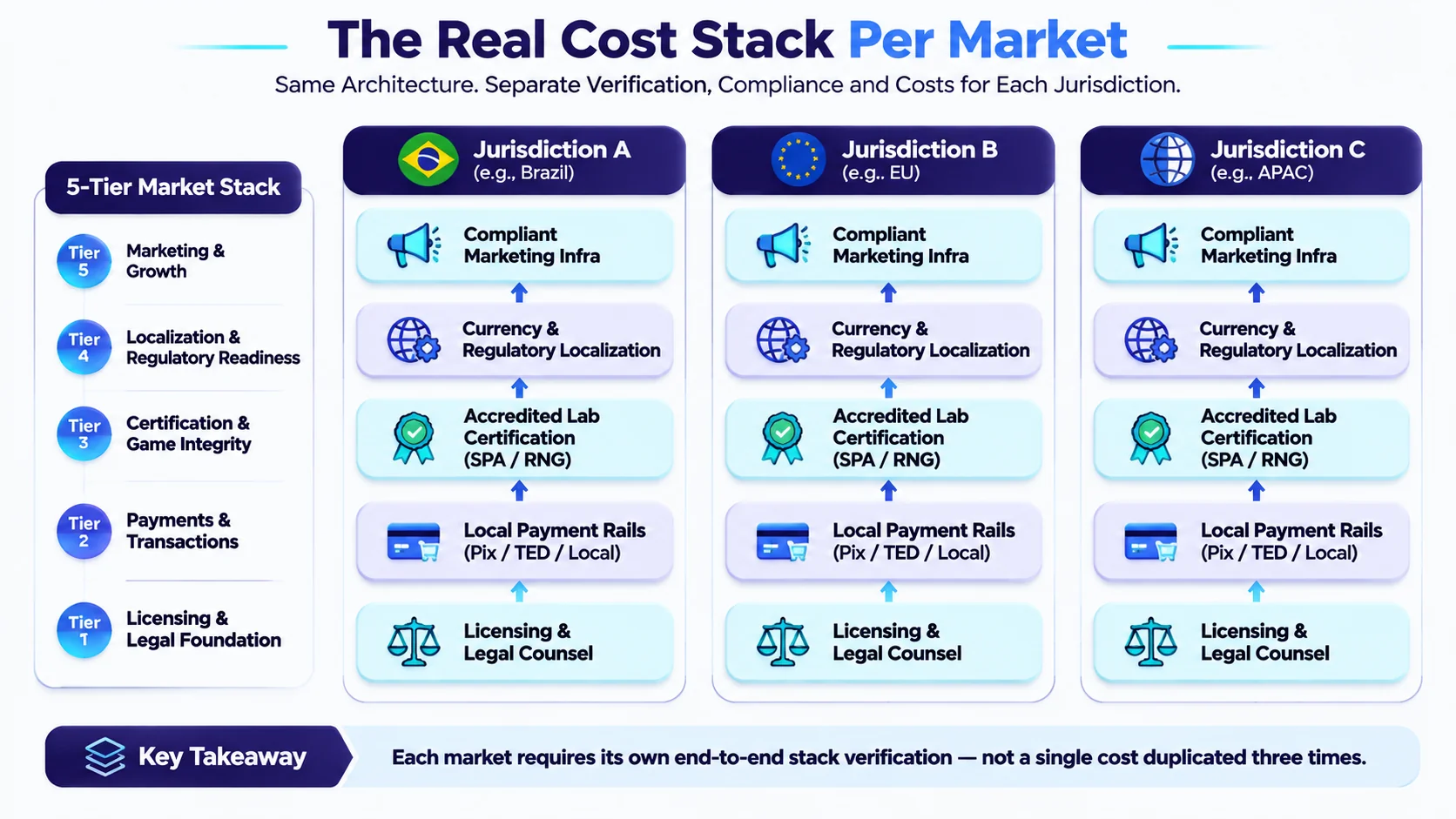
- The cost stack repeats per market: licensing & legal, local payment integration, content/game certification, localization, and marketing infrastructure. Treat each as its own line item, not a rounding error on the first market's budget.
- Markets that share compliance infrastructure (payment rails, regulatory frameworks, language) can be sequenced together to cut duplicate spend: launching Brazil and Mexico back-to-back is not the same cost problem as launching Brazil and the Philippines back-to-back.
- The platform decision underneath all of this changes the math more than any single market's fee schedule: a platform that treats a new jurisdiction as configuration costs a fraction of one that needs a parallel build per market.
- This is a cost-framework, not a quote. AIS Technolabs doesn't hold or guarantee licenses in any jurisdiction; licensing is assist-only, and every number here needs confirming against current local requirements before it goes into a real budget.
Introduction
If you've ever tried to turn "launch in three new markets" into a single budget line, you already know it doesn't hold up. A license fee in one market, a payment integration in another, and a certification requirement in a third don't add up to one number, they add up to three separate decisions with three separate risk profiles, and most finance teams only discover that once the first invoice lands.
This guide walks through what a multi-jurisdiction iGaming launch actually costs: the five cost categories that repeat in every market, why some markets are cheaper to launch together than others, how the underlying platform decision changes the math, and a worksheet to run before a board signs off on a single combined number.
Why Multi-Market Budgets Break
A board approves "launch in three new markets this year." Finance asks for one number. That's where the budget breaks: a multi-jurisdiction iGaming launch is not one project with three regions attached, it's three regulatory environments, three payment landscapes, and often three certification regimes stacked on top of one platform decision.
The "one license, one cost" assumption holds for a single-market launch: you price the license, the integration, the marketing spend, and you have your number. At two markets it gets harder but survives. At three or more, it collapses, because the categories that scaled linearly at first (payment integration, certification, localization) start interacting: a payment rail that works in one market doesn't carry to the next, a certification that satisfies one regulator says nothing about another, and a marketing campaign built for one audience needs a full localization pass, not a translation, for the next.
Existing jurisdiction content online tends to answer a narrower question than this one. Most of it is either "how do I choose a license," useful but written for a single-market decision, or a generic platform fee guide that treats market expansion as a line-item add-on. Neither models what actually happens to a budget when three markets are approved for the same fiscal year, which is the real planning problem operators and finance teams are solving for.
The Real Cost Stack Per Market
Each market an operator enters carries its own version of five cost categories. None of them shrink just because a neighboring market already absorbed the "first-time" cost: a second payment integration is still an integration, a second certification is still a certification.
Licensing & Legal
Licensing requirements, timelines and ongoing compliance obligations are set by each market's regulator, and they don't transfer between jurisdictions. AIS Technolabs works across a defined set of markets it actively serves, including the United States, Canada, the United Kingdom, Australia, Germany, France, Spain, Italy, Brazil and Mexico, and markets it is actively growing into, including Japan, South Korea, the Philippines, parts of Africa, and Latin America more broadly. Entering a market outside that footprint, or one that sits in a gray or restricted regulatory zone, changes the legal cost line significantly before a single line of platform code is touched.
Two jurisdiction-specific notes worth budgeting around explicitly:
- Mexico: AIS Technolabs supplies the software layer; it does not hold or supply the SEGOB permit itself. That permit is a separate legal line item with its own counsel and timeline.
- Licensing support from a technology vendor is, by design, assist-only. No technology provider, AIS included, can guarantee a license, a regulatory approval, or the legal right to operate in any market. Budget legal counsel as its own line, not a vendor deliverable.
Local Payment Integration
A payment stack that clears transactions cleanly in one market can be close to useless in the next, because the rails themselves are local. Brazil is the clearest example on AIS's own serve list: a Brazil-facing launch needs Pix and TED payment support specifically, the dominant local rails, not just a card-processing integration ported over from a US or UK build. Budget local payment integration per market, not once per platform.
Content & Game Certification
RNG and game-fairness certification is granted by accredited labs, and a certification accepted by one regulator does not automatically transfer to another. Brazil again illustrates the point concretely: a Brazil launch requires certification through an SPA-accredited lab specifically, independent of whatever certification the same game content already holds elsewhere. This is also the category where live-dealer content gets expensive fastest: table availability and studio licensing shift market to market, so a live-dealer catalog that's "ready" in one jurisdiction may need a fresh studio-licensing pass in the next.
Localization
Localization is more than translated copy. Currency display, payment-method naming, regulatory disclosures, and cultural reference points in marketing creative all need a market-specific pass. Treating this as a one-time translation cost, rather than a recurring line per market, is one of the more common places a "stacked" budget quietly overruns.
Marketing Infrastructure
Advertising and marketing rules for gambling products are regulator-specific and frequently stricter than general consumer-marketing law: what's permitted creative, claims, and channels in one market can be restricted or outright prohibited in the next. Marketing infrastructure (compliant creative, local channel access, compliant claims review) needs its own per-market line, sized against that market's actual rules, not inherited from the first market's playbook.
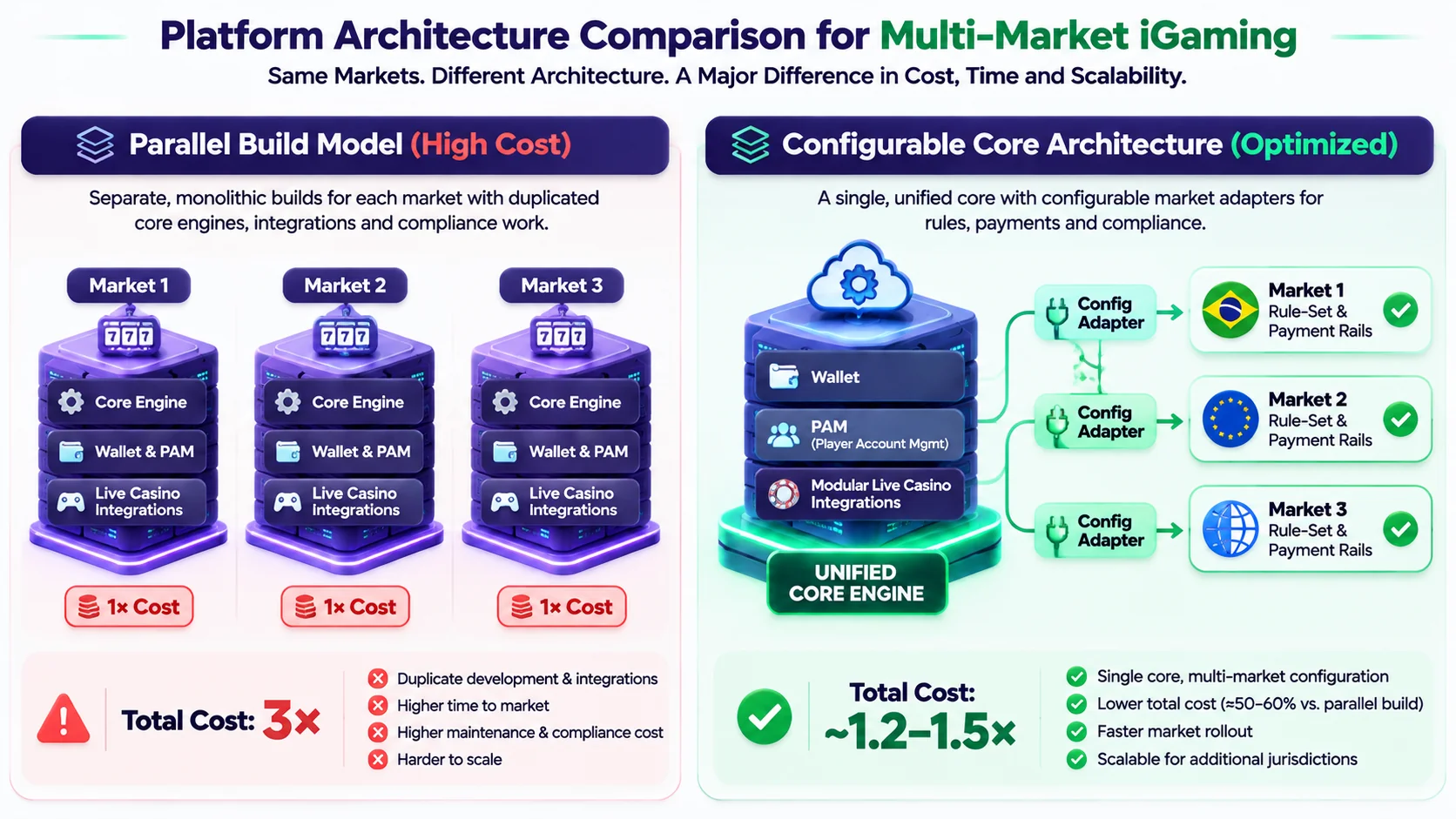
A platform built to add new regulatory rule-sets and payment rails per market without a parallel codebase, the model most casino software providers now ship as configuration, not custom build, is what keeps this kind of rollout from becoming three separate projects.
Sequencing Markets to De-Risk Spend
Not every market combination costs the same to launch together. The lever most multi-market budgets miss is sequencing: grouping markets that share compliance infrastructure so the second and third markets cost less than the first, instead of repeating the first market's cost in full.
Some groupings that genuinely share infrastructure, based on AIS's own served and growth markets:
- Regional payment-rail overlap: markets in the same region often share more payment infrastructure with each other than with a market on a different continent, even if their licensing regimes differ.
- Shared regulatory vocabulary: Western European markets AIS serves (Germany, France, Spain, Italy) sit inside overlapping EU-level frameworks even where national licensing specifics differ, which can shorten the legal-review cycle for the second and third market in that group.
- Shared certification labs: if two target markets' regulators both accept certification from the same accredited lab, that certification cost is closer to a one-time cost across both markets rather than a repeat cost.
Sequencing markets this way doesn't remove any category from the cost stack above. It reduces how many times the most expensive categories (legal, certification) get paid for in full, by grouping markets where the second pass is genuinely lighter than the first.
Platform Choices That Change the Math
The single platform decision that moves this budget more than any individual market's fee schedule is whether the platform treats a new jurisdiction as configuration or as a parallel build.
A platform architected so that adding a market means configuring a new ruleset, payment rail and certification profile onto shared infrastructure, rather than standing up a second implementation, turns the third and fourth market's technology cost into a fraction of the first. This is the same architectural principle behind running multiple brands on one platform rather than cloning it per brand: shared core services, market-specific (or brand-specific) configuration on top.
Live-dealer content is usually the most jurisdiction-sensitive line item in this budget, since table availability and studio licensing shift market to market, a live casino software stack with modular studio integrations keeps that cost predictable instead of a surprise per market.
How a platform is commercially acquired also changes which costs are upfront versus ongoing. AIS Technolabs' own engagement models illustrate the range:
- Buy (full ownership, source code and custom builds): higher upfront cost, no ongoing rent, suited to operators planning a long multi-market runway who want full control over how fast new markets get added.
- Rent: lower upfront commitment, suited to operators who need to validate a market before committing capital to it, a useful fit for the "grow" markets on a sequencing plan, where demand is less proven than the core served markets.
- Rent-to-own: a hybrid where rental payments credit toward ownership over a defined term, useful for operators sequencing markets over multiple years who want the option to convert to ownership once a market proves out, without the full upfront cost on day one.
None of this replaces per-market legal, payment, certification, localization or marketing spend. It changes how much of the platform cost is upfront versus spread across the rollout.
Budget Worksheet
Rather than a single number, a multi-market launch budget is best built as a worksheet with one column per market and one row per cost category. For each market under consideration, fill in:
- Licensing & legal: regulator, estimated timeline, counsel retained, any market-specific caveat (e.g., a permit the operator must hold separately, not the technology vendor).
- Local payment integration: which local rails are required (not just "card processing"), and whether an existing integration partner already covers them.
- Content & certification: which accredited lab(s) that market's regulator accepts, and whether a current certification already satisfies it or a fresh pass is required.
- Localization: language, currency display, regulatory disclosure text, and a market-specific pass on marketing creative (not a translation of the first market's assets).
- Marketing infrastructure: that market's advertising rules, permitted channels and claims review process.
- Sequencing position: which other markets on the list this one shares infrastructure with, and whether launching it before or after a related market changes any of the rows above.
- Platform cost model: buy, rent or rent-to-own, and how that choice shifts this market's cost between upfront and ongoing.
Run this worksheet before the board approves a single combined number. It's the difference between budgeting three markets accurately and discovering the real cost mid-rollout.
Regulatory Compliance Disclaimer
Licensing, payment-provider requirements and advertising/marketing rules vary by jurisdiction and regulator, and change over time. This article describes a cost-category framework for budgeting a multi-market iGaming launch; it is not legal or financial advice, and nothing here guarantees a license, regulatory approval or the legal right to operate in any market. Confirm current requirements for every jurisdiction you plan to enter with your licensing counsel, payment partners and the relevant regulator(s) before finalizing a launch budget or sequence.
FAQs

Mary Smith excels in crafting technical and non-technical content, demonstrating precision and clarity. With careful attention to detail and a love for clear communication, she skillfully handles difficult topics, making them into interesting stories. Mary's versatility and expertise shine through her ability to produce compelling content across various domains, ensuring impactful storytelling that resonates with diverse audiences.
Keep going
Explore Our iGaming Insights

Don't Just Plan Your Gaming Business. Build It.
Get the right technology to build and grow your iGaming business.
- Custom-Built Solutions
- Complete Technical Support
- Secure Architecture
Share your project requirements and discover the right iGaming solution for your business.
Connect with Our Experts ASIA PACIFIC