Table of Content
Key Takeaways
- Sub-second recalculation is the baseline. Micro-betting odds engines reprice every 200–500ms per play, roughly an order of magnitude faster than standard live betting.
- Feed latency becomes a risk, not a nuisance. At that recalculation speed, a few hundred milliseconds of feed lag is enough for a price to be exploitable, which is why automatic failover to a secondary feed matters.
- Peak load is the real sizing target. SOFTSWISS has publicly benchmarked 10,000 bets per minute for major 2026 events, far beyond what a match-level settlement design was built to carry.
- Five components carry the extra load. The odds/pricing engine, event-data ingestion, bet-slip/execution, settlement and ledger, and the risk/liability engine all need to run at play-level cadence.
- Hybrid is the practical path for most operators. Launch on an existing white-label sportsbook, then add a custom micro-betting layer once volume justifies the build, without re-integrating data feeds or payment vendors.
Introduction
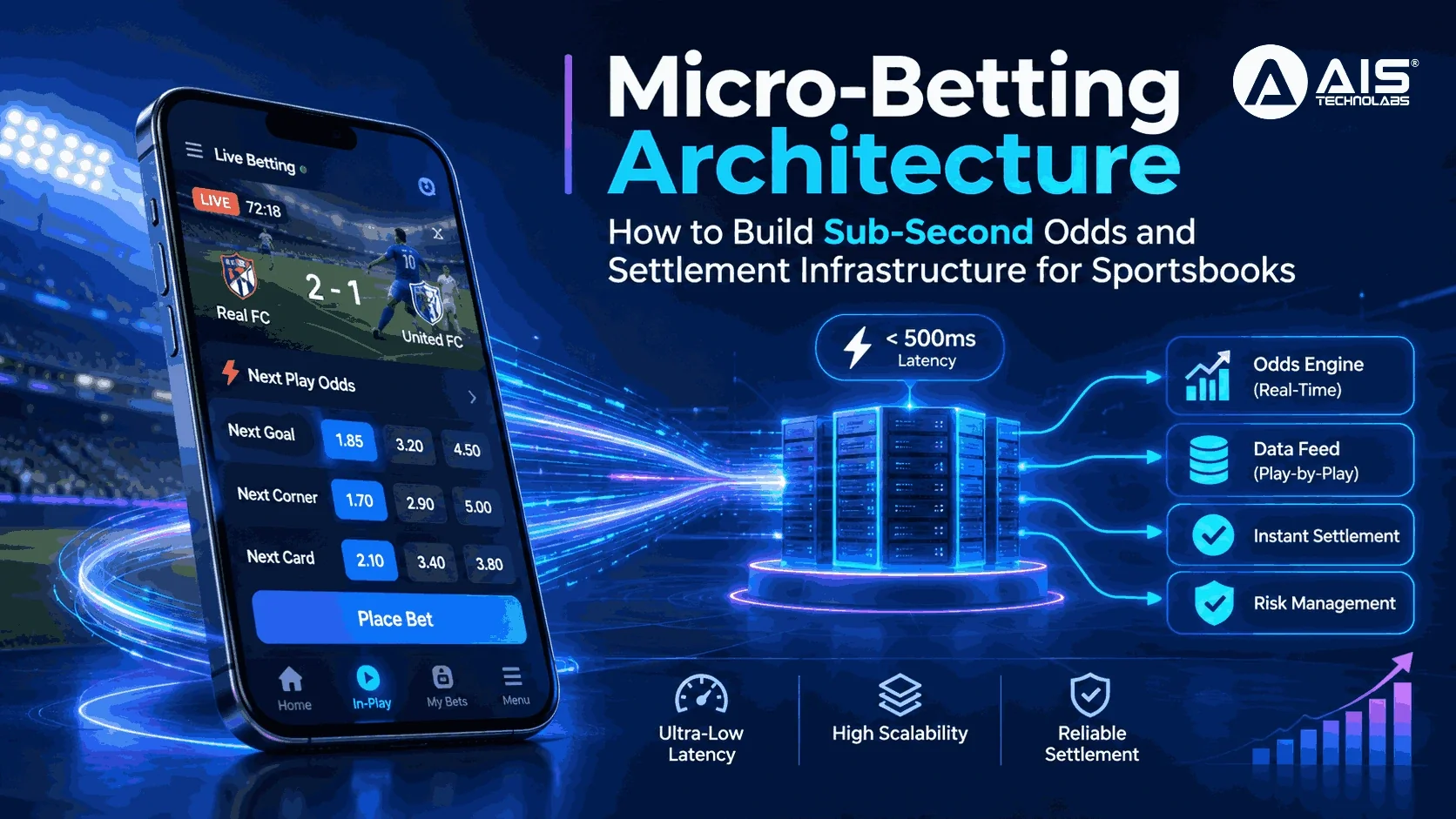
Micro-betting architecture is the set of odds, data-feed and settlement systems that let a sportsbook take bets on a single play, such as the next pitch, the next point, or the next corner, instead of only match-level outcomes. It's one of the most-named trends in sportsbook software for 2026, and one of the least forgiving to build badly: an odds engine sized for pre-match markets cannot recalculate fast enough for a point-by-point market, and a settlement layer sized for a handful of outcomes per game cannot absorb the bet volume a single live event now generates. This breaks down what a micro-betting build actually requires, including the latency numbers competitors are already publishing, the five components that carry the load, and the real build-vs-license trade-off, rather than stopping at naming the trend, which is where most sportsbook content ends.
The Technical Bar Micro-Betting Sets
Micro-betting's technical bar comes down to three numbers: how often the odds have to recalculate, how much latency the data feed can tolerate, and how fast a bet has to settle once the outcome is known.
Recalculation Interval
SOFTSWISS has publicly described odds engines recalculating every 200–500 milliseconds for single-ball, point-by-point markets, which is an order of magnitude faster than a pre-match line or even a standard live-betting market, where a price can hold for seconds or minutes between updates.
Feed Latency Tolerance
At a 200–500ms recalculation rate, a few hundred milliseconds of feed lag is the difference between a price that's accurate and one a sharp bettor can exploit against the book before it updates.
Settlement Volume
SOFTSWISS's own internal benchmark targets sustaining 10,000 bets per minute through high-volume events such as the 2026 World Cup, a volume that a match-level settlement design was never sized to carry, because it's settling outcomes per play instead of per match.
Both BetConstruct and sportsbook-trade press name micro-betting as a defining 2026 trend on their own blogs, but neither publishes the architecture needed to hit these numbers. That's the gap this piece is written to close.
Core Architecture Components
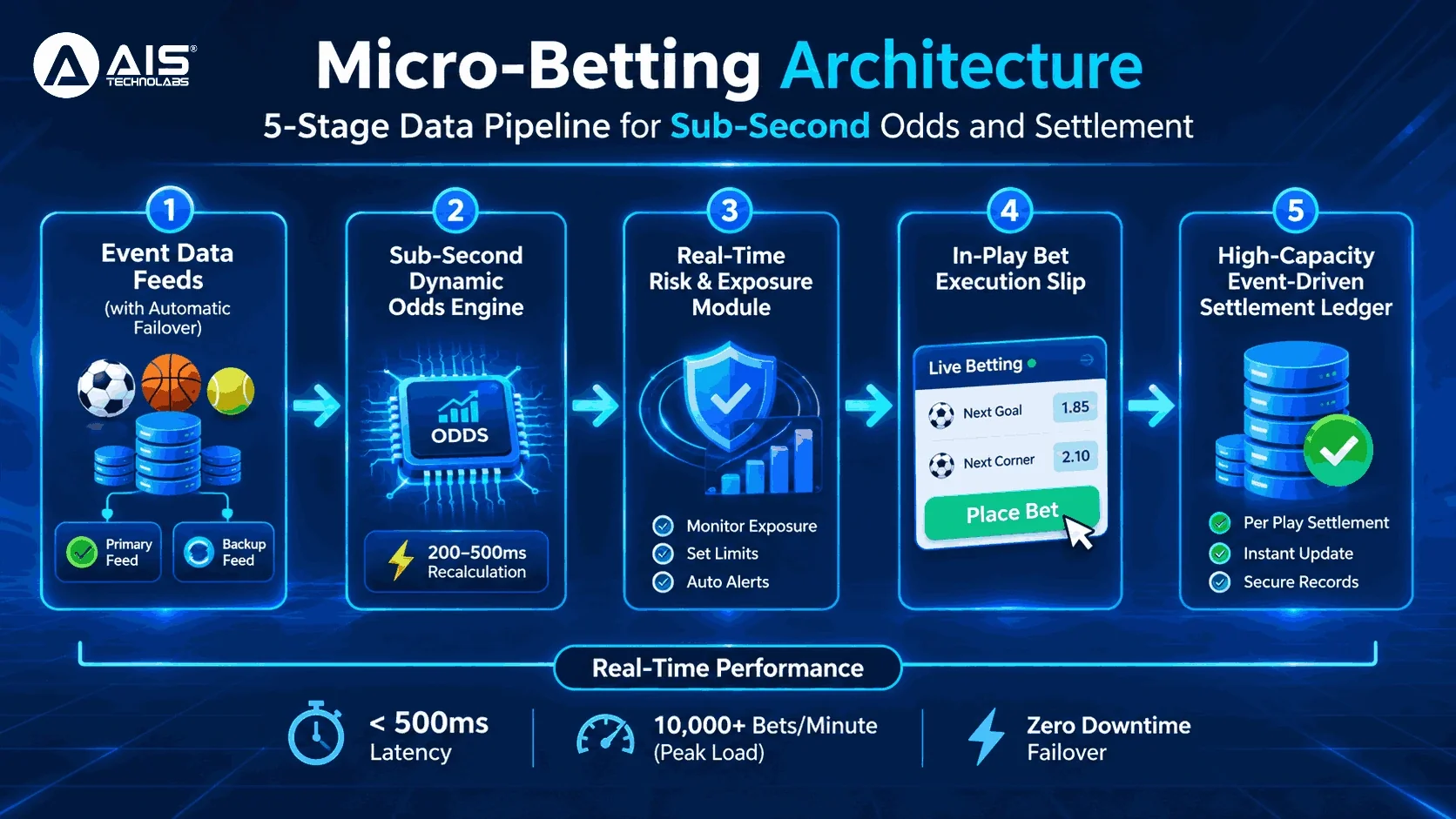
A micro-betting build adds load to five components a standard sportsbook platform doesn't run at this intensity: the odds/pricing engine, event-data ingestion, the bet-slip/execution layer, settlement and ledger, and the risk/liability engine.
Odds/Pricing Engine
It has to reprice on every play, not on every match-state change, which means running as an independently scalable service rather than inside the main platform's request cycle.
Event-Data Ingestion
This needs a feed built for play-by-play granularity, with automatic failover to a secondary source if the primary drops. This is the same zero-downtime failover principle sportsbook platforms already apply to match-level feeds (AIS Technolabs' own sportsbook platform integrates match-level odds and data feeds from providers including Sportradar, BetGenius, IMG Arena and Betradar, with automatic failover to a secondary feed built in), extended down to play-level granularity for micro markets.
Bet-Slip/Execution
A bet has to be priced, accepted or rejected within the same window the odds engine recalculates in; there is no room for the slip to lag the price.
Settlement & Ledger
Outcomes post per play, not per match. This is the layer the 10,000-bets-per-minute benchmark stresses hardest, since every play that resolves triggers a settlement event rather than one event per game.
Risk/Liability Engine
Exposure limits need to update every play, not every match. This is a finer-grained version of the liability-limit, automated-alert, and margin-rule controls already built into a mature sportsbook's risk module (configurable per sport, market type and player tier), run at play-level resolution instead of match-level.
Micro-Betting vs. Traditional Live Betting
| Dimension | Traditional live betting | Micro-betting |
|---|---|---|
| Odds recalculation | Seconds to minutes, on match-state change | Every 200–500ms, on every play |
| Feed latency tolerance | A few seconds' lag is low-stakes | A few hundred ms of lag is exploitable |
| Settlement cadence | Per match / per major outcome | Per play |
| Peak infra load | Hundreds of bets/minute per event | Benchmarked at 10,000 bets/minute for major events (SOFTSWISS) |
| Risk control granularity | Per match, per market | Per play, per market, per player tier |
| UX update cadence | Periodic odds refresh | Continuous, real-time |
Build vs. License vs. Hybrid
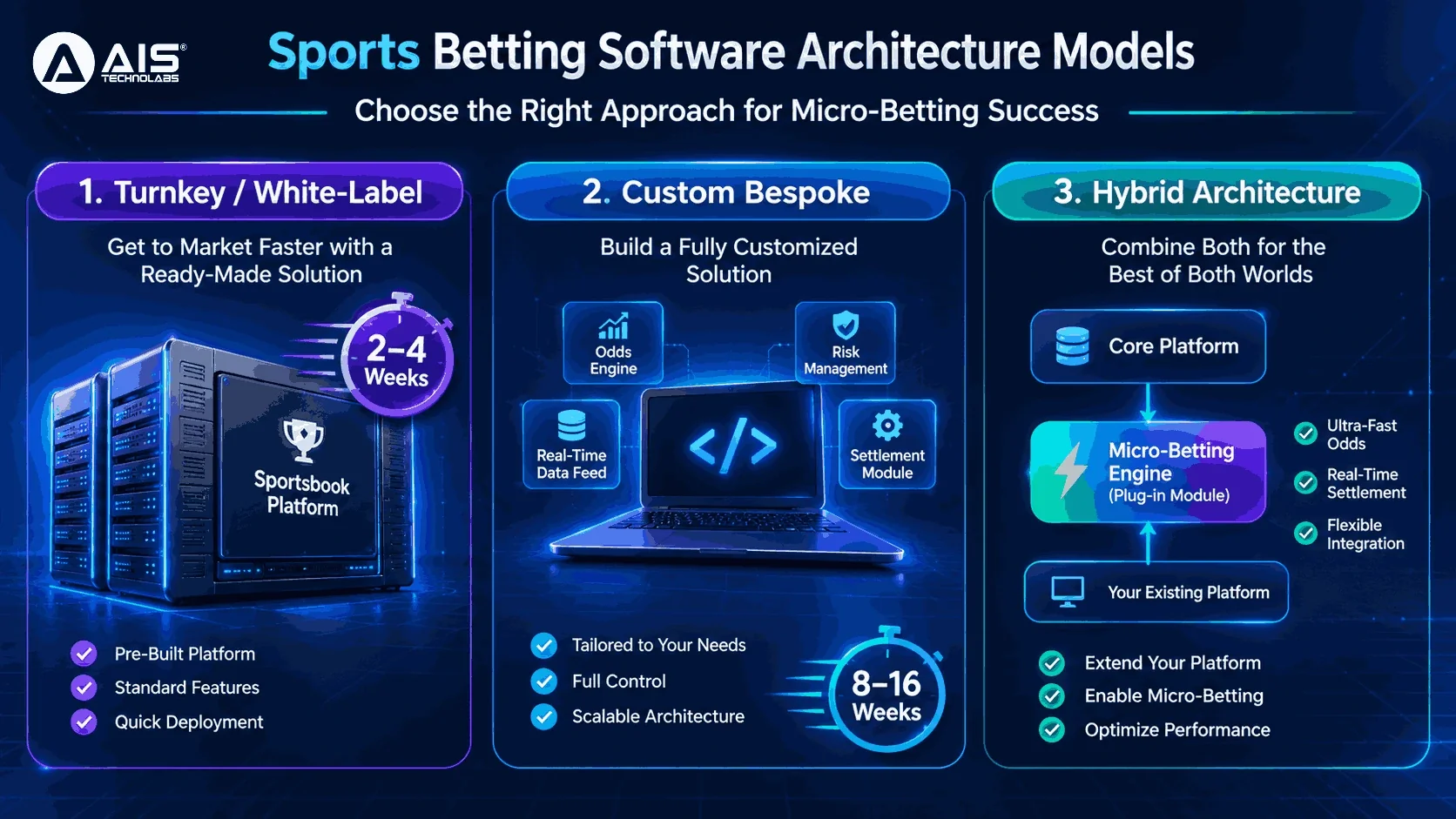
Most operators don't build micro-betting from zero. They extend an existing sportsbook platform's odds and risk layers, and the fastest route is usually the same white-label-to-custom path operators already use for sportsbook software providers generally.
White-Label
Fastest and lowest cost, but the odds and risk layer is whatever the vendor ships. This works if the vendor's feed and risk engine already operate at play-level granularity. It doesn't if they only support match-level markets.
Custom
Full control over recalculation interval, feed selection and risk-engine granularity. It is the only route if a specific data provider or a bespoke liability model is required. It's also the slower, costlier path: a custom sportsbook build typically runs 8–16 weeks depending on scope and integrations, against 2–4 weeks for a white-label deployment.
Hybrid
Go live on a white-label sportsbook base, then add a custom micro-betting layer once volume justifies the build, without switching data-feed or payment vendors in the process. This is the same path most operators already follow for sports betting software generally: start white-label to get live fast, then build custom features on top of the same platform as the business matures.
Architecture Stack Decision Matrix
| Component | Build custom | License via turnkey | Hybrid |
|---|---|---|---|
| Odds/pricing engine | Full control of recalculation interval | Fixed to the vendor's refresh rate | Vendor base + custom play-level overlay |
| Event-data feed | Choose or combine any provider | Locked to the vendor's feed contracts | Vendor feed now, custom feed later |
| Bet-slip/execution | Built to your latency budget | Vendor's existing flow | Vendor flow, custom path for micro markets only |
| Settlement & ledger | Sized to your volume target | Vendor's existing capacity | Vendor ledger, custom overflow handling |
| Risk/liability engine | Bespoke limits, any granularity | Vendor's default rule set | Vendor base + custom per-play limits |
| Typical timeline | 8–16 weeks | 2–4 weeks | 2–4 weeks live, then phased custom additions |
Scaling for Peak Events
Micro-betting's load isn't steady. It spikes hardest exactly when the most money is on the table, which is why peak-event capacity, not average load, is the number that matters when scoping the build.
That means sizing the odds engine to scale horizontally under a short, sharp spike rather than a sustained average. It means the same feed-failover principle covered above matters more during a final than during a routine fixture, because there's no good moment during a live final to be running on one feed with no backup. And it means testing against a benchmark close to the one competitors are already citing in public, specifically SOFTSWISS's 10,000-bets-per-minute target for major 2026 events, rather than against a typical weekday's traffic. A platform that only gets load-tested at average volume will find its actual limit live, during the one event it can least afford to.
Scope Your Micro-Betting Build
If you're scoping a micro-betting build, whether as a custom addition to an existing sportsbook or as part of a new platform, AIS Technolabs builds both white-label and fully custom sportsbook software providers, including the odds-feed integrations and risk-management layer a micro-betting build extends. Talk to our sports betting software team about scoping yours.
FAQs

Mary Smith excels in crafting technical and non-technical content, demonstrating precision and clarity. With careful attention to detail and a love for clear communication, she skillfully handles difficult topics, making them into interesting stories. Mary's versatility and expertise shine through her ability to produce compelling content across various domains, ensuring impactful storytelling that resonates with diverse audiences.



Don't Just Plan Your Gaming Business. Build It.
Get the right technology to build and grow your iGaming business.
- Custom-Built Solutions
- Complete Technical Support
- Secure Architecture
Share your project requirements and discover the right iGaming solution for your business.
Connect with Our Experts ASIA PACIFIC