Table of Content
Key Takeaways
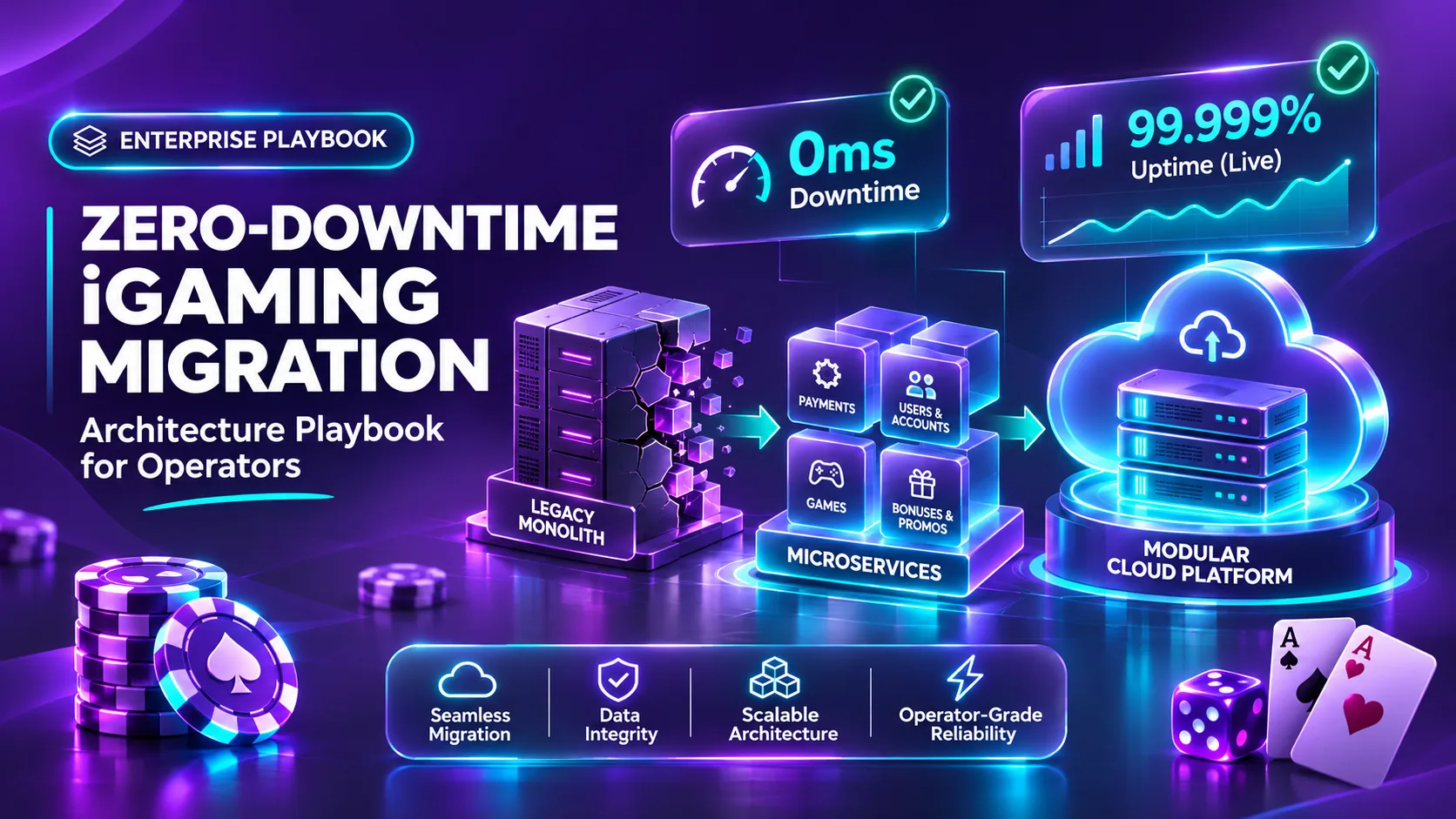
- A "big bang" cutover puts every player session, wallet balance and open bet on one changeover window — if anything goes wrong, there's no old platform left to fall back to.
- The strangler-fig pattern lets the new platform grow up around the old one, taking over one function at a time, so each slice is proven under real traffic before the next one moves.
- A single source of truth for the ledger, idempotent transaction events, and session continuity at the routing layer keep player wallets and sessions from drifting during dual-run.
- RNG and game-fairness certification is typically tied to the specific implementation, not the operator's license — a new platform component generating outcomes usually needs its own certification before it can take live traffic.
- A canary rollout moves a small, low-stakes cohort of real players first, expanding only once wallet and session data matches expectations across multiple full business cycles.
Introduction: The Real Cost of Technical Debt
A legacy casino platform doesn't fail loudly. It fails as a slow leak: a payment integration that takes three extra weeks every time a new method launches, a game-aggregation layer that can't add a studio without a vendor change request, a codebase few engineers on the team actually understand anymore. None of that shows up as downtime. All of it shows up as margin.
The reason most operators delay a migration isn't indecision: it's that the obvious way to do it is also the riskiest way to do it. A "big bang" cutover (freeze the old platform, move everything at once, switch the DNS) puts every player session, every wallet balance and every open bet on one changeover window. If anything in that window goes wrong, there's no old platform left to fall back to. That risk, more than the cost of the new platform itself, is what keeps aging infrastructure in production years past its useful life.
It doesn't have to be a single bet. The architecture pattern enterprise software teams use to retire a live system without an outage, the strangler-fig pattern, applies directly to a casino platform, with a few gambling-specific complications layered on: player wallets that must balance to the cent, RNG and game-fairness certifications tied to a specific jurisdiction, and an audit trail regulators expect to be unbroken. This playbook works through that pattern end to end: how to run old and new in parallel, how to keep wallets and sessions in sync while you do it, what compliance continuity actually requires, and how to shift real player traffic over in stages instead of one switch.
Core Architecture Breakdown
The Strangler-Fig / Dual-Run Cutover Pattern
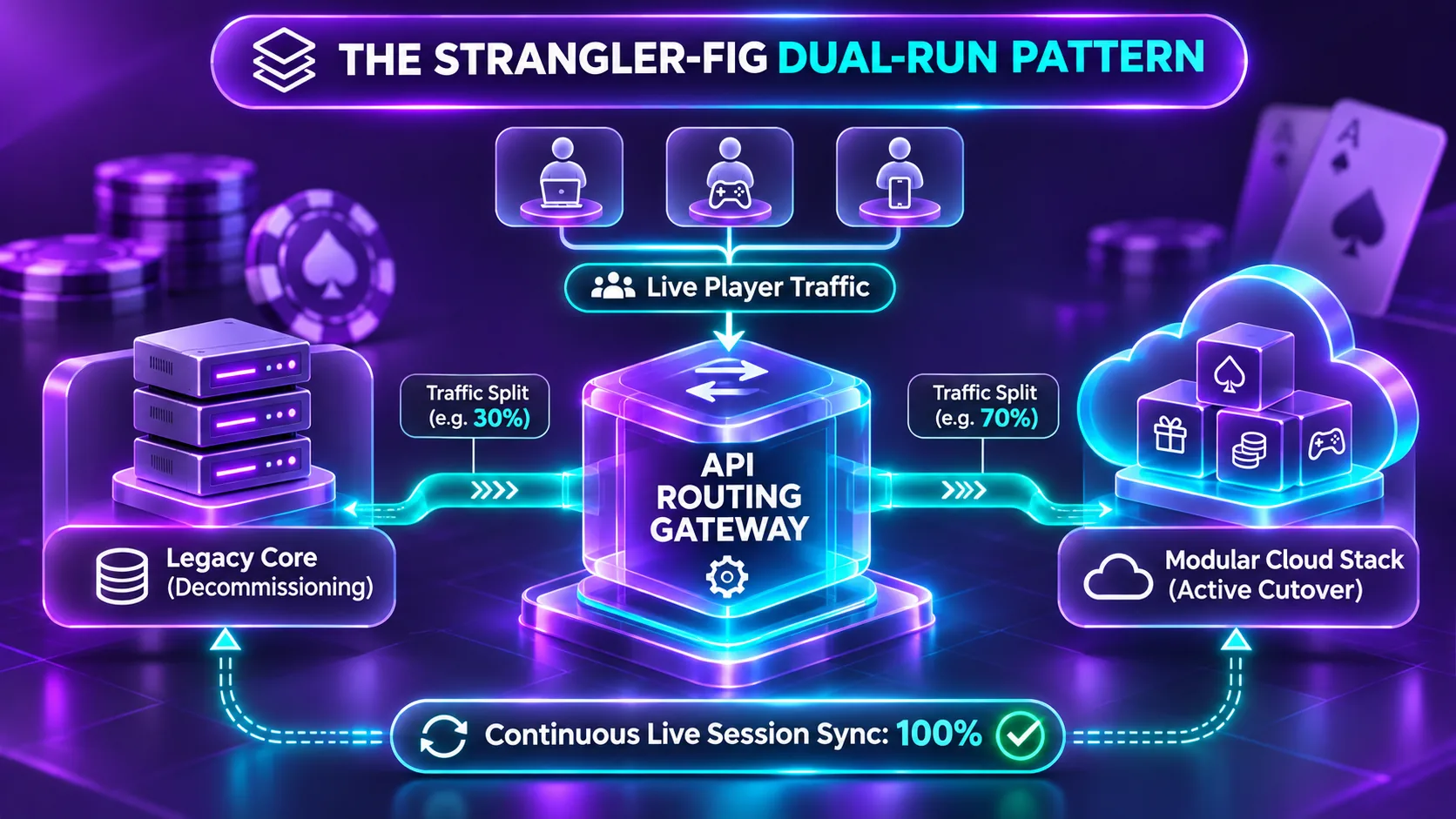
The strangler-fig pattern takes its name from the strangler fig tree, which grows around a host tree and gradually replaces it rather than cutting it down first. Applied to a casino platform, the idea is the same: the new platform grows up around the old one, taking over one function at a time, until the legacy system has nothing left to do.
In practice, that means introducing a routing layer (an API gateway or reverse proxy) in front of both platforms. Traffic for a given function, say, the lobby and game catalog, routes to the new platform; everything else still routes to the legacy system. As each function is rebuilt and verified on the new side, the routing layer is updated to send it there instead. The legacy platform keeps running the functions that haven't moved yet, which means there is never a moment where the whole platform is "the new one, untested, live": each slice has already been proven under real traffic before the next slice moves.
A good first slice to peel off is usually the piece with the clearest boundary and the least shared state. For many operators, that's live-dealer content: a live-dealer integration is largely self-contained, so proving the new architecture there, on live casino software built to handle high-volume concurrent tables, validates the routing layer, the monitoring, and the rollback path under real load, before the harder, more state-heavy pieces (wallet, KYC, bonusing) move across.
Player Wallet, Ledger & Session State Synchronization
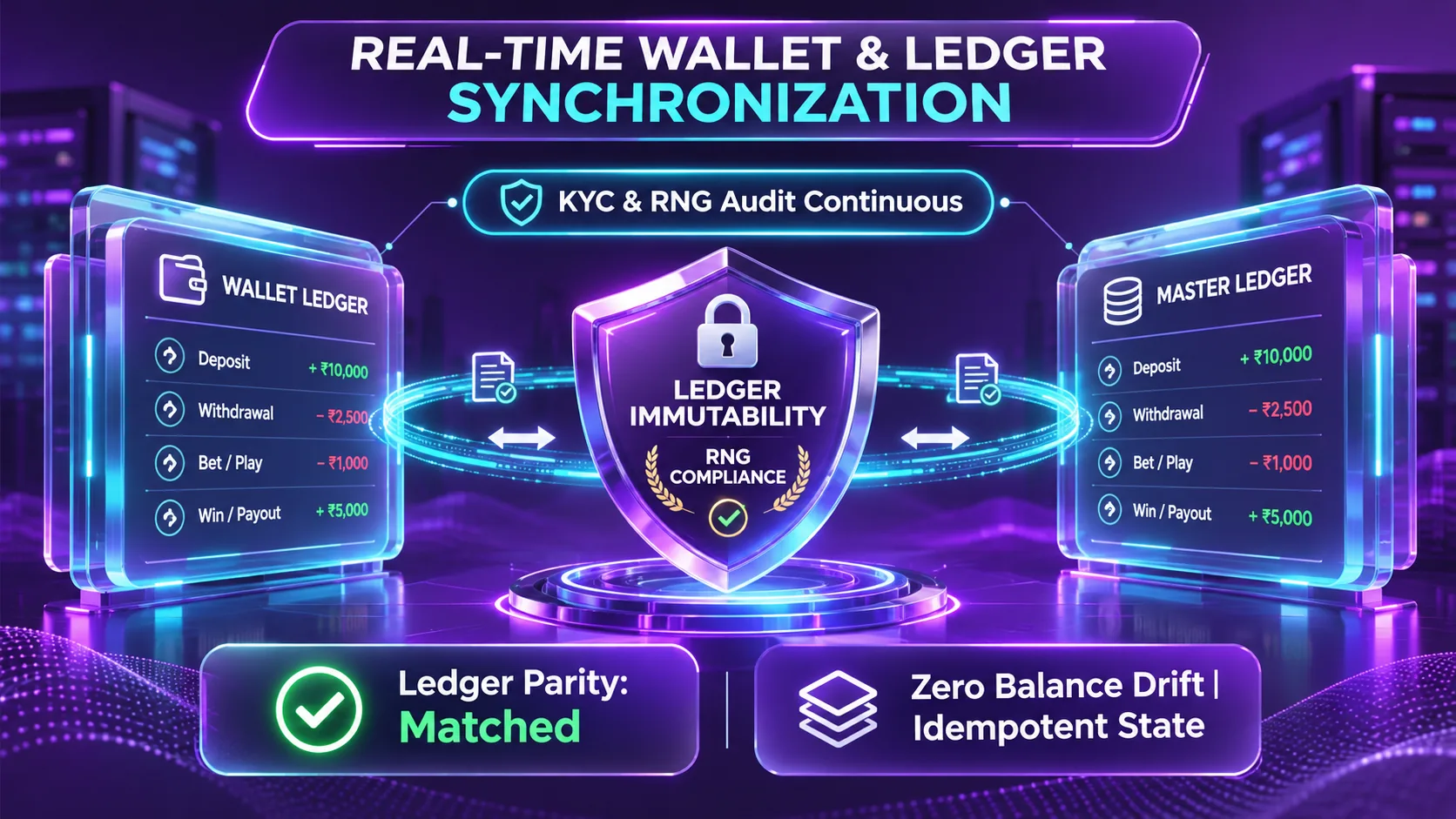
This is where most "we tried to migrate once and stopped" stories start. A player's wallet balance, open sessions and in-progress bets can't simply be copied over at a point in time: real money is moving on the old platform for every minute the migration is in progress, and the new platform has to agree on the exact same number.
Three practices keep that from drifting:
- A single source of truth for the ledger during dual-run. Rather than two systems each tracking balances independently, the new platform's wallet service treats the legacy ledger as authoritative until a player's traffic has fully moved, and writes through to it, not around it, for any transaction that still touches legacy-side functions.
- Idempotent, replayable transaction events. Every wallet-affecting event (a bet, a win, a deposit) carries a unique transaction ID, so if a network blip causes a retry, the second attempt is recognized and dropped rather than applied twice. This matters far more during a migration, when more components are talking to each other than usual.
- Session continuity at the routing layer, not at the application layer. A player mid-session should never see a forced logout because their traffic moved from the old platform to the new one: the routing layer carries session state forward so the switch is invisible to the player, even if it's a significant change on the back end.
Get this layer wrong and the symptom isn't a crash: it's a support ticket about a wallet balance that doesn't match, which is a far worse failure mode for player trust than planned downtime would have been.
Compliance, Audit Trail & RNG Re-Certification Continuity
A casino platform migration isn't only a technical project: it's a regulatory one. Most licensing regimes require RNG and game-fairness certification for the systems actually generating outcomes, and an unbroken audit trail for transactions and player activity. Both have direct implications for how a migration is sequenced.
RNG and game-fairness certification typically attaches to the specific RNG implementation and the platform serving it, not to the operator's license in the abstract, which means a new platform component generating outcomes (a new slots or table-game integration, for instance) generally needs its own certification before it can take live traffic, even if the legacy platform's RNG was already certified. Build certification lead time into the migration schedule for any component that changes how outcomes are generated or settled; it is routinely the longest pole in the schedule, not the engineering work itself.
Audit trail continuity means the transaction and activity history has to read as one continuous record across the cutover, not two disconnected systems a regulator or auditor has to reconcile by hand. In practice that means the new platform's logging schema is mapped to the legacy schema (or both are mapped to a common format) before any traffic moves, not after: reconciling two incompatible audit formats retroactively is far harder than designing for it up front.
KYC and AML records need the same continuity: a player's verification status and risk tier should carry forward with them, not reset or re-trigger a repeat KYC check simply because their session moved to a new platform component.
Phased Traffic Shift & Canary Player Cohorts
Even with a sound dual-run architecture, shifting 100% of traffic to a newly built component on day one is still a big bet: it's just a smaller, more contained one than a full-platform cutover. A canary rollout reduces that further: a small, defined cohort of real players is routed to the new component first, with the rest of the player base still on the proven path.
A workable sequence looks like this:
- Internal and synthetic traffic first: test accounts and automated transaction flows exercise the new component with no real money at risk.
- A small, low-stakes canary cohort: a defined percentage of real players, often selected for lower average bet size, moves over with wallet reconciliation checked after every session, not just at the end of the day.
- Expand by cohort, not by percentage alone: widen to higher-value players and higher-volume markets only once the canary cohort's wallet and session data has matched expectations across multiple full business cycles (including a weekend, where traffic patterns differ).
- Full cutover with the legacy path kept warm: once the new component is carrying all live traffic, keep the legacy path deployed and able to receive traffic for an agreed rollback window before it's decommissioned.
The point of staging traffic this way isn't caution for its own sake: it's that a wallet or session discrepancy affecting 2% of players for an hour is a support queue; the same discrepancy affecting 100% of players is an incident.
Pre-Migration Readiness Checklist
Before committing to a migration timeline, confirm:
- A documented routing/gateway layer design exists that can direct traffic per function, not just per platform.
- Wallet reconciliation tooling is in place to compare legacy and new-platform balances continuously during dual-run, not only at cutover.
- RNG/game-fairness re-certification timelines are confirmed with the relevant regulator(s) for every component whose outcome generation changes, and built into the project schedule, not assumed to run in parallel for free.
- Audit trail schema mapping between legacy and new systems is designed and tested before any player traffic moves, not reverse-engineered afterward.
- KYC/AML record continuity is confirmed end to end, including risk-tier and verification-status fields, not just identity data.
- A canary cohort and rollback plan are defined in writing, with explicit criteria for what triggers a rollback and who has the authority to call it.
- The receiving platform itself has been evaluated with the same rigor as the migration plan. Moving off one piece of legacy technology onto another vendor's version of the same constraint doesn't solve the underlying problem: vet whichever casino software provider will run the new platform on its own architecture, update cadence and integration model, not just its feature list.
Strategic Conclusion
A legacy platform migration fails for predictable reasons: a cutover with no fallback, a wallet reconciliation process invented after the fact, or a compliance timeline nobody built into the schedule. None of those are hard problems individually: they're ordinary engineering and project-management failures that happen to carry unusually high stakes on a live casino platform.
The strangler-fig pattern, applied with real wallet-synchronization discipline, planned compliance continuity, and a staged, canary-first traffic shift, turns a single high-risk cutover into a series of smaller, recoverable ones. That's a longer project plan than a weekend migration, and a far shorter list of ways it can go publicly wrong.
The next step for most operators isn't picking a cutover date. It's an architecture review: map the current platform's functions against the dual-run pattern above, identify which slice has the cleanest boundary to move first, and confirm RNG and licensing re-certification timelines with your regulator before the engineering schedule is locked in.
Regulatory Compliance Disclaimer
Licensing, RNG/game-fairness certification and audit-trail requirements vary by jurisdiction and regulator, and change over time. This article describes common architecture patterns for managing continuity during a platform migration; it is not legal, compliance or licensing advice. Confirm current requirements for every jurisdiction you operate in with your licensing counsel and the relevant regulator(s) before finalizing a migration plan or timeline.
FAQs

Mary Smith excels in crafting technical and non-technical content, demonstrating precision and clarity. With careful attention to detail and a love for clear communication, she skillfully handles difficult topics, making them into interesting stories. Mary's versatility and expertise shine through her ability to produce compelling content across various domains, ensuring impactful storytelling that resonates with diverse audiences.
Keep going
Explore Our iGaming Insights


Don't Just Plan Your Gaming Business. Build It.
Get the right technology to build and grow your iGaming business.
- Custom-Built Solutions
- Complete Technical Support
- Secure Architecture
Share your project requirements and discover the right iGaming solution for your business.
Connect with Our Experts ASIA PACIFIC