Table of Content
(500 views)
Published:October 31, 2026 at 10:00 am
Last Updated:31 Oct 2026 , 10:00 am
Key Takeaways
- Turnkey and white-label sweepstakes platforms typically launch in weeks to a few months; fully custom builds typically take several months to a year, depending on scope.
- Turnkey/white-label usually costs less upfront and may carry an ongoing licence fee or revenue share; custom costs more upfront but keeps 100% of ongoing revenue and, typically, the source code.
- Source-code ownership and revenue-share terms differ by provider and by contract on both models, so get the specifics in writing before you sign, not after.
- Licensing and compliance obligations sit with the operator, not the software: as of October 2026, at least 14 US states have a statutory ban on sweepstakes casinos, and the list has grown through the year (The Lines, updated Oct 20, 2026).
- The global social casino market (the broader category sweepstakes-model casinos sit in) was valued at an estimated $10.2B in 2026 and is projected to reach $14.3B by 2030 (Grand View Research, updated July 2026).
- Custom software projects average roughly 13 months and $132K+ industry-wide (Clutch.co, updated September 2026), a useful outside-gambling benchmark for why sweepstakes custom builds land in the same months-to-a-year range.
- No cost, timeline, or revenue-share figure in this article is an AIS Technolabs quote.
Introduction
A sweepstakes casino operator who picks the wrong build model doesn't usually find out for months. By then they've either burned a budget on custom features nobody asked for, or hit a ceiling a shared platform was never going to let them past.
Choosing between turnkey and custom sweepstakes casino software comes down to four trade-offs: how fast you need to launch, how much platform ownership you want, what you can spend upfront, and how far you plan to scale.
The decision is also happening in a market that's shifting under operators' feet. At least 14 US states now have a statutory ban on sweepstakes casinos, a number that kept climbing through 2026, even as the broader social casino category it sits in keeps growing globally: Grand View Research puts that market at $10.2B in 2026, heading toward $14.3B by 2030.
None of that changes with your build model, but it changes how much margin for error you have, which is exactly why the model you pick matters more now than it did two years ago.
This guide breaks down what turnkey, white-label, and custom development each actually give you, what they cost, and how to decide, without assuming one is universally "better."
What "Turnkey," "White-Label," and "Custom" Actually Mean
These three terms get used loosely in sweepstakes marketing, but they describe genuinely different products. The difference is how much of the platform is pre-built versus built for you, and it's worth being precise about it before a contract uses one term to mean another.
Turnkey / ready-made platforms
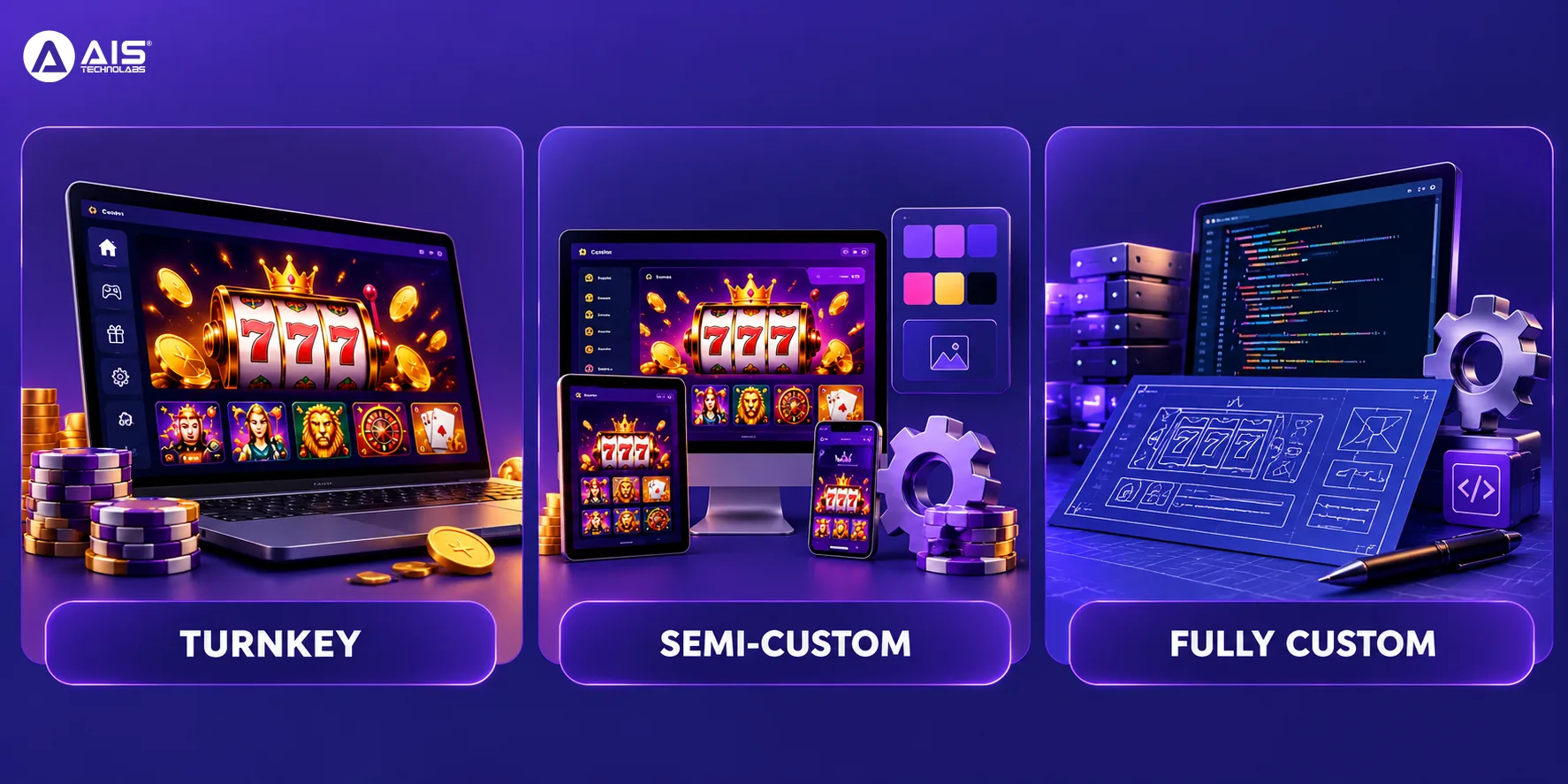
A turnkey platform is a ready-made sweepstakes casino software built on a shared, pre-existing codebase that the provider configures for a new operator rather than building from scratch. You get the core engine, game integrations, wallet and sweepstakes-credit logic, KYC and age/location checks, and admin tools already working, often alongside an existing payment-processor relationship you can plug into rather than negotiate from zero.
Your setup is mostly configuration, branding, and content, not engineering: picking a game library, setting your sweepstakes-credit rules, and connecting your own domain and support channels. Because the engine has already been through other operators' launches, most of the rough edges a brand-new build would hit have already been found and fixed before you ever touch it.
White-label (branded turnkey)
White-label is a turnkey platform with a stronger branding layer: your logo, color scheme, domain, and often custom front-end templates and mobile apps sit on top of the same underlying engine other operators use. It sits between bare turnkey and fully custom on the spectrum: you get more say over how the brand looks and feels than a plain turnkey deployment allows, but the wallet logic, game integrations, and admin tooling underneath are still the provider's shared codebase, just with more surface-level customization layered on top.
Two operators running the same white-label provider can look completely different to a player, different color palettes, different game lineups, different loyalty messaging, while sharing nearly all of their backend logic and most of their compliance tooling.
Fully custom development
Custom development means the platform, or the specific modules you need, is designed and built around your business rules, integrations, and player experience from the ground up. Nothing is inherited from another operator's build; every feature exists because your requirements called for it, which is the right call when the thing you need doesn't exist anywhere off the shelf: a proprietary loyalty mechanic, a payment flow tied to a specific processor relationship, or a game engine built around rules no turnkey provider offers.
It also means every feature is your responsibility to specify correctly the first time, since there's no existing user base on a shared platform that already stress-tested it for you; a requirements gap that other operators on a turnkey platform would have already surfaced becomes a bug you discover after launch instead.
Development Time: How Fast Each Model Gets You Live
Development time is the first filter most operators apply, because it directly affects how soon the business starts generating revenue.
Turnkey: weeks to a few months
Because the core platform already exists, a turnkey or white-label launch is mostly configuration, integration testing, and compliance review, typically weeks to a couple of months depending on how much branding and customization you add on top. The work breaks down into a handful of parallel tracks: finalizing branding assets and game selection, onboarding your payment processor, setting up sweepstakes-credit and alternative-entry mechanics correctly, and running your own compliance review before you go live in each state you plan to operate in.
The bottleneck is rarely the software itself; it's usually how fast those other tracks move, especially payment-provider onboarding and legal sign-off, both of which sit on your timeline and your counsel's, not the platform vendor's.
Custom: several months to a year, depending on scope
Custom builds start from requirements discovery and system architecture before a single feature ships, then move through design, development, integration, and QA before compliance review even begins, so the sweepstakes software development timeline is measured in several months to a year for a full platform. That range isn't specific to gambling, either: Clutch.co's pricing survey puts the average custom software project industry-wide at roughly 13 months and $132,480, a useful outside benchmark for how long ground-up software generally takes to get right.
Scope is the main driver in sweepstakes builds specifically: a few custom modules layered onto an existing base (a new rewards mechanic, say, or a specific payment integration) move far faster than a ground-up rebuild of every system, wallet, game engine, admin tools, and compliance layer, at once.
What You Own vs. What You Rent
Ownership is where turnkey and custom genuinely diverge, and it is worth understanding before you sign anything, not after you've already built a brand on top of someone else's platform.
Platform ownership and source code
With most turnkey and white-label arrangements, the provider keeps ownership of the core source code; you are licensing the use of a branded instance, not buying the underlying engine outright. Custom development is typically structured the other way: the code built for your specific requirements is yours under the agreement, usually with an IP-assignment clause that transfers ownership on delivery or on final payment.
Exact ownership and source-code terms differ by provider and by contract on both models, so this is a point to confirm in writing in the commercial agreement, specifically what happens to source code, documentation, and any third-party licenses if the relationship ends, and whether delivery is staged or held until the full project is paid. Never assume full source-code ownership on either model without seeing those terms stated in black and white.
Dependency on the provider's roadmap
A turnkey platform's features, updates, and game catalog move on the provider's release schedule, not yours. If a capability you need isn't on their roadmap, you generally cannot add it yourself, and you're waiting alongside every other operator on that platform.
Custom development removes that third-party platform dependency because your development path is set by your own priorities, not someone else's product calendar. That independence is also why custom typically carries a higher ongoing maintenance responsibility on your side, since there's no shared provider team patching it for you between releases.
This is also where exit cost belongs in the conversation, not just launch cost. If you ever need to leave a turnkey or white-label provider (a pricing dispute, a feature you can't get, a jurisdiction they won't support), ask upfront how player data, wallet balances, and game history move with you, and what it costs to migrate them.
A provider that can't answer that clearly is telling you something about how portable your business actually is.
Cost at a Glance: Turnkey vs. Custom
Cost comparisons across sweepstakes software models get misleading fast if they ignore the ongoing side of the bill, not just the upfront quote: see the full cost breakdown for a detailed look at setup fees and ongoing charges; the table below is the model-level summary.
| Factor | Turnkey / white-label | Custom development |
|---|---|---|
| Upfront cost | Lower: you're licensing an existing platform, not funding its build | Higher: you're funding design, architecture, and development from scratch |
| Ongoing commercial structure | Often a licensing fee, and in some arrangements an ongoing revenue share; terms vary by provider and by product, so get the specific structure in writing rather than assuming a standard rate | Typically a fixed development cost plus your own hosting/maintenance; the operator keeps the revenue the platform generates |
| Time to first revenue | Faster: shorter build time means revenue starts sooner | Slower: longer build time delays first revenue, offset over time by full retention |
| Budget predictability | High upfront predictability; ongoing costs depend on the commercial model agreed | Lower upfront predictability (scope can shift); ongoing cost is mostly within your control |
Turnkey and white-label: lower upfront cost, ongoing revenue share
Turnkey and white-label software are priced to get you live without funding a full build, which is why the upfront number is usually the lower of the two models. In exchange, many providers structure part of their return as an ongoing fee or a share of revenue rather than a single one-time purchase price, but that is not a universal figure, and it varies by provider and by the specific product and agreement.
Treat any revenue-share percentage you're quoted as specific to that deal, not an industry standard, and have it reviewed before you sign.
Custom development: higher upfront cost, full revenue retention
Custom development asks you to fund the build itself, which is why the upfront investment is higher than licensing an existing platform. The trade-off is that the platform is yours: once it's live, there is no ongoing revenue share built into the model, and you keep what the platform generates (minus your own hosting, payment processing, and operational costs).
Over a long enough runway, that retained revenue is often what makes the larger upfront number worth it.
Not sure which structure fits your budget? Talk to the AIS Technolabs team about your numbers before you commit to either model.
Advantages and Limitations, Side by Side
Neither model is objectively better; each one solves a different problem well and creates a different limitation.
| Turnkey / white-label | Custom development | |
|---|---|---|
| Advantage | Fast to launch; lower upfront cost; proven, already-tested engine | Full ownership; built around your exact requirements; no third-party roadmap dependency |
| Limitation | Limited to the provider's feature set and release schedule; less differentiation from other operators on the same base | Longer timeline; higher upfront cost; you carry more responsibility for ongoing maintenance |
When turnkey wins
Turnkey and white-label make sense when speed to market matters more than platform differentiation. That covers a wider range of operators than it sounds: a founder testing a new sweepstakes concept before raising more capital, an existing operator entering a new state quickly while a competitor is still building, or a team launching on a limited budget that can't fund a year-long custom project before any revenue starts coming in.
In all three cases, the cost of being slightly less differentiated than a fully custom competitor is smaller than the cost of not being live at all while you wait on a build. Turnkey buys you the data to decide whether a bigger investment is actually justified.
When custom wins
Custom development wins when your business model depends on something a shared platform can't offer: a specific integration, a unique player experience, proprietary game logic, or scale that outgrows a provider's shared infrastructure. That instinct isn't unique to gambling: across software generally, 35% of enterprise teams have already replaced at least one off-the-shelf tool with a custom build, and 78% expect to build more custom tools in 2026 (Retool's 2026 Build vs. Buy Report).
The same logic applies to a scaling sweepstakes operator: once the shared platform's limitations start costing more in lost flexibility than a custom build would cost to create, the calculation flips.
Which Model Fits Your Business Stage
The right model usually tracks where the business is, not just what the spreadsheet says about cost.
First-time operators testing the market

If you haven't proven demand yet, turnkey or white-label lets you test the concept without the cost and timeline risk of a custom build you might need to change based on what you learn in the first few months. For example, an operator unsure whether a particular game mix or loyalty mechanic will land with players is better off testing it on a shared platform than paying to have it custom-built first; if the concept doesn't resonate, you've lost weeks and a licensing fee, not months and a six-figure development budget.
The data you gather at this stage, which games get played, which promotions drive deposits, is also exactly what a later custom build should be designed around, rather than guessed at from scratch.
Scaling operators with proven demand
Once demand is proven and you're running into the limits of a shared platform, that's usually the point custom development starts to pay for itself. The signals tend to be concrete rather than vague: feature requests the provider won't prioritize because they don't benefit other operators on the same platform, integrations (a specific payment processor, a loyalty or CRM tool) they don't support, or a revenue scale where the ongoing licence fee or revenue share costs more over a year than a custom build's amortized upfront cost would.
None of those show up on day one; they show up after a few quarters of real volume, which is why this decision is usually revisited rather than made once and left alone.
Multi-brand or multi-jurisdiction operators
Running multiple brands or operating across jurisdictions with different rules often pushes operators toward custom development, because a shared turnkey codebase is harder to adapt per-brand or per-jurisdiction than a platform built with that flexibility in mind from the start. Running two or three brands on the same turnkey engine usually means the same core rules and the same compliance configuration across all of them, which breaks down fast the moment one state requires something another doesn't.
A custom platform can be built with jurisdiction-specific rule sets and per-brand configuration from day one, so adding a brand or entering a new state is a configuration change, not a renegotiation with a third-party vendor. This matters more every year the state-by-state legal map keeps changing: a rigid shared platform is a liability in a market this unsettled.
Compliance Stays the Same, Whatever You Build
This is the part of the decision that has nothing to do with which model you choose, and it's the part operators most often get wrong.
Licensing and regulatory requirements apply to both models
Sweepstakes licensing and regulatory requirements attach to the operator and the business model, not to the software underneath it. Choosing custom development does not reduce what you need to register, disclose, or comply with, and choosing turnkey does not add extra requirements; the legal obligations are the same either way.
This is not a static list: as of October 2026, at least 14 US states have a statutory ban on sweepstakes casinos, with bans taking effect as recently as November 2026 in some states (The Lines). Sweepstakes requirements can also vary by jurisdiction and by business model, so what applies to one operator may not apply to another.
Why "turnkey" doesn't mean compliance is handled for you
A turnkey provider can give you a platform that's technically capable of supporting sweepstakes mechanics correctly (official rules pages, alternative-entry methods, age and location checks), but capability is not the same as compliance. Whether your specific operation is legally compliant depends on how you configure those tools, how you disclose terms to players, and how your business is structured, not on whether the software came off the shelf or was built for you.
No software provider, turnkey or custom, can guarantee that your specific operation is legally compliant in a given jurisdiction; that guarantee doesn't exist for anyone in this space. It's worth confirming with qualified legal counsel before launch, and again whenever a state changes its rules, since the pace of change in 2026 means that review needs to be ongoing, not a one-time checkbox.
How to Decide: A Quick Framework
Work through these questions in order; the first one you answer "yes, that's the priority" usually points to your model.
| If your priority is... | The build model that usually fits is... |
|---|---|
| Launching in weeks, not months | Turnkey or white-label |
| Keeping upfront cost as low as possible | Turnkey or white-label |
| Owning the platform outright | Custom development |
| A feature or integration no shared platform offers | Custom development |
| Running multiple brands or jurisdictions on one flexible base | Custom development |
| Testing demand before committing to a bigger build | Turnkey or white-label, with a path to custom later |
If you're still weighing providers rather than just the build model, compare sweepstakes software providers is the natural next step once you know which model you want.
AIS Technolabs builds sweepstakes casino software on both models, including a turnkey sweepstakes script for operators who want to launch fast, and custom development for operators who need a platform built around specific requirements. Get in touch to talk through which fits your launch before you commit to either.
Conclusion
There's no universally "right" build model; there's only the one that matches where your business actually is. Turnkey and white-label get you live fast and keep the upfront number low; custom gives you ownership, flexibility, and full revenue retention at the cost of time and budget.
What doesn't change between the two is your compliance obligation: the legal map for sweepstakes casinos has kept moving through 2026, and neither model buys you an exemption from tracking it.
If you're ready to talk specifics, AIS Technolabs builds both turnkey and custom sweepstakes casino software and can walk through which one fits your timeline, budget, and growth plans. Reach out here.
Disclaimer:
The cost structures, timelines, and ownership descriptions in this article are general industry patterns, not a quote for any specific project or a guarantee of terms from any provider, including AIS Technolabs; commercial terms (pricing, revenue share, ownership, support) vary by provider and by agreement and should be confirmed in writing before you sign. Market and regulatory figures are cited from the named third-party sources as of the dates shown and may have changed since publication.
This article is not legal, compliance, or financial advice; sweepstakes licensing and regulatory requirements vary by jurisdiction and business model, and you should confirm current requirements with qualified legal counsel. Whichever build model you choose, you (the operator) remain responsible for the sweepstakes mechanics, player protections, and responsible-gaming safeguards your jurisdiction requires.
Share this article: If you are currently weighing a sweepstakes casino launch, this comparison is worth sending to whoever else is in that decision with you.
FAQs
Ans.
Yes. Starting turnkey or white-label and migrating to custom development later is a common path, especially for operators who want to prove demand before committing to a bigger build.
The usual trigger points are a feature or integration the provider won't prioritize, revenue that's reached a scale where the ongoing fee outweighs a custom build's cost, or an expansion plan the shared platform can't flex to support. The migration itself takes planning: player accounts, wallet balances, and game-provider integrations all need a deliberate transition plan, not a one-weekend switch.
Treat it as its own project with its own timeline, not an afterthought once you decide to move.
Ans.
No. Compliance depends on how the operator configures, discloses, and runs the sweepstakes mechanics and business model, not on whether the underlying software is turnkey or custom.
Neither build model is inherently more or less compliant; both require the operator to meet the same jurisdiction-specific legal requirements, and both can be configured well or badly. A custom platform doesn't come with built-in legal authorization any more than a turnkey one does, and a turnkey platform isn't automatically risky just because you didn't build it.
What actually determines compliance is whether age and location checks, official rules disclosures, and alternative-entry methods are configured correctly, something that's the operator's job on either model, usually in consultation with legal counsel rather than the software vendor.
Ans.
Yes. AIS Technolabs builds sweepstakes casino software on both a turnkey, ready-made script for faster launches and fully custom development for operators who need a platform built around specific requirements.
The right fit depends on your timeline, budget, and how much platform ownership you want, which is exactly why it's worth a conversation rather than picking blind: an operator testing a new market usually starts turnkey, while one with a proprietary game mechanic or multi-brand plan usually starts custom. AIS Technolabs can walk through your specific requirements and point you to whichever model actually fits, rather than defaulting to whichever one is easier to sell.

Mary Smith
Mary Smith excels in crafting technical and non-technical content, demonstrating precision and clarity. With careful attention to detail and a love for clear communication, she skillfully handles difficult topics, making them into interesting stories. Mary's versatility and expertise shine through her ability to produce compelling content across various domains, ensuring impactful storytelling that resonates with diverse audiences.



Don't Just Plan Your Gaming Business. Build It.
Get the right technology to build and grow your iGaming business.
- Custom-Built Solutions
- Complete Technical Support
- Secure Architecture
Share your project requirements and discover the right iGaming solution for your business.
Connect with Our Experts ASIA PACIFIC