Table of Content
(505 views)
Published:June 17, 2025 at 11:14 am
Last Updated:3 Jun 2026 , 1:11 pm
Key Takeaways:
- iGaming (interactive gaming) refers to online gambling activities such as casino games, sports betting, poker, esports betting, and lotteries.
- The industry has evolved from early online gambling platforms in the mid-1990s to a multi-billion-dollar, mobile-first global ecosystem.
- Key growth drivers include mobile technology, AI-driven personalization, blockchain payments, and immersive gaming experiences.
- The sector is highly regulated, with licensing frameworks and compliance requirements varying across regions to ensure fair play and player protection.
- The future of iGaming is expected to focus on stronger regulation, advanced technology integration, responsible gaming, and continued global market expansion.
Introduction
It's midday in mid-2025, and Jamal, a Toronto-based software programmer, reaches for his phone. Two clicks later, he's placing a live bet on a game of tennis—when games are still in progress.
Meanwhile, half a world away in Manila, Lara is exploring an internet casino, stopping by a real-time roulette table facilitated by 5G. These are not science fiction fantasies—they're the gritty, mundane reality of iGaming, which is now a global entertainment phenomenon.
This blog entry investigates what exactly iGaming is, examines its most widely popular types, follows its history, considers the trends of today, emphasizes the main challenges, cracks the codes of regulation, and looks to the future as far as 2026.
Central to this entire ecosystem is iGaming software, which powers everything from gameplay to transaction management, offering a seamless and secure user experience.
What Does iGaming Mean?
At its core, iGaming—short for interactive gaming—is the umbrella term for all online gambling activities conducted via the internet. This encompasses:
- Online casinos (slots, blackjack, roulette, live dealer)
- Sports betting (pre‑match & in‑play)
- Online poker
- Lottery & bingo games
- Esports betting
- Virtual sports
It's a move away from classic gambling—taking wagering to your fingertips through the smartphone, tablet, or computer. It's no longer books and betting shops; iGaming is built on real-time interaction, 24/7 availability, and everywhere play.
The Most Popular Types Of iGaming You Should Know
Let’s unpack the main categories:
Online Casinos
- Titles vary from slots, blackjack, and roulette to baccarat and live-dealer equivalents of all.
- The international online casino market reached $17.13 billion in 2023, set to nearly double to $38 billion by 2030.
- Slots, especially mobile-optimized titles, tend to contribute most revenues.
Sports Betting
- From football and basketball to tennis and MMA.
- Dynamic odds and live (in-play) wagering during events are enabled by live betting.
- Global sports betting hit $83.65 billion in 2022 with projected growth to $182 billion by 2030; digital sports betting alone was about $36.5 billion in 2022 and is projected to grow at ~14.2% CAGR through 2032.
Online Poker
- A multiplayer card gaming classic, with variations like Texas Hold'em.
- Backed by sites such as PokerStars and massive tournaments like WSOP Online.
- Not separated in revenue figures, but is a foundational revenue column in established markets.
Esports Betting
- Betting on competitive PC games like LoL, CS:GO, etc., Dota 2.
- Market reached $12 billion in 2023, to $24 billion by 2028, at ~13.7% CAGR.
Lottery & Bingo Games
- Digitized versions of traditional formats.
- Online lottery valued at $7.8 billion in 2022, forecast at $14.5 billion by 2030.
Virtual Sports
- RNG-driven sports simulations.
- Advantages are round-the-clock availability, instant results, and growing popularity.
Traditional casino games, sports, poker, esports, lottery, and virtual sports all have varying user bases—making iGaming a very diversified industry.
A Brief History Of iGaming
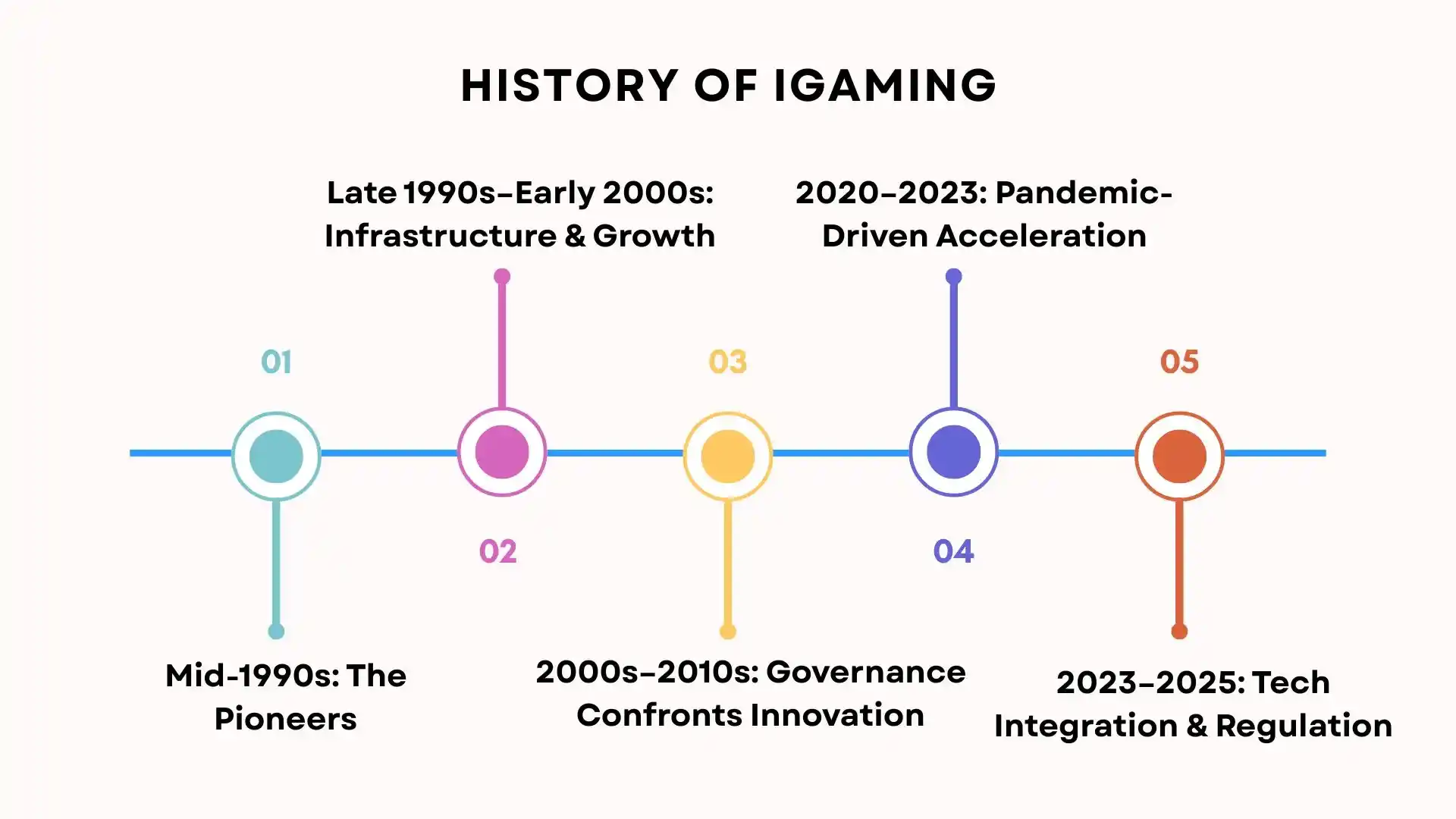
Mid-1990s: The Pioneers
- First online gambling platform: 1994 Liechtenstein lottery ticketing.
- Same year: Microgaming launched the first real-money online casino according to Antigua's Free Trade & Processing Act.
Late 1990s–Early 2000s: Infrastructure & Growth
- Establishment of licensing authorities like the Kahnawake commission and UKGC.
- Pioneered first poker rooms; skill-game bills contentious (e.g., 1999 U.S. gambling legislation).
- Growing users: ~8 million online gamblers by 2001.
2000s–2010s: Governance Confronts Innovation
- Interactive Gambling Act (Australia, 2001), Gambling Act 2005 (UK), diversified internationally.
- Built quality players like Bet365, PokerStars, and first esports betting websites.
- 2010 smartphone boom rendered mobile-first design necessity.
2020–2023: Pandemic-Driven Acceleration
- COVID‑19 lockdowns caused mass online migrations. In Q1 2025, online iGaming revenue in the U.S. increased 15.3% to $6.19 billion, representing 32.8% of total gaming revenue.
- Introduction of virtual sports and esports as substitutes for paused live events.
2023–2026: Tech Integration & Regulation
- Global iGaming value jumped to $85.6 billion in 2023, projected at $97 billion in 2024 (~13.3% growth).
- Usage of mobile devices accounts for over 70% of user spend.
- Blockchain, provably fair gaming, and NFTs start reshaping models.
The Current State Of The iGaming Industry
Market Size & Growth
- Global value projected at $85.6 billion in 2023.
- Forecasted: $97 billion in 2024; $103 billion in 2025; and reaching $169 billion by 2030 (10.4% CAGR 2025‑2030).
Within that:
- Online casino hit $17.1 billion.
- Sports betting and esports swell.
- Platforms & software (e.g., Playtech, BetConstruct) valued at $15.4 billion in 2025 and growing fast.
Regional Hotspots
- Europe — ~€38.2 billion online GGR in 2022 (35% of €108 billion total).
- North America — U.S. iGaming surged; Q1 2025 online revenue was $6.19 billion.
- Asia‑Pacific — Mobile-first expansion, particularly in India, China, Japan.
- Latin America & Africa — Regulatory changes opening new markets.
Key Trends
- Mobile first: 70%+ revenue via mobile devices.
- Live dealer experience: rising demand for immersive, real-time game formats.
- Cryptocurrency: BTC, ETH accepted by platforms like Stake.com, BC.Game.
- AI & personalization, data-driven UX, fraud detection.
Major Obstacles Hindering iGaming Growth
Regulatory Complexity
- Varies drastically by country or even state (in U.S. and India).
- U.S. state patchwork: only some allow iGaming; others restrict sports betting.
- India: fantasy sports legal in many states but gambling laws varied.
Payment Barriers
- Historic banking tends to limit gambling transactions.
- Crypto provides substitute, but regulatory challenges and instability persist.
Customer Acquisition & Competition
- Over-saturated markets (e.g., UK, some parts of EU) necessitate high marketing expenses and intense promotion battles.
Responsible Gaming & Public Health
- Increases in problem gambling promote stricter controls (e.g., self-exclusion, deposit limits).
Cybersecurity & Trust
- Online platforms face hacking risks and fraud.
- Trust-critical: ~91.5% of players consider RNG fairness essential.
The Regulatory Landscape of iGaming
Europe
- UK Gambling Commission—rigorous licensing and player protection.
- Malta/Gibraltar—key licensing hubs.
- EGBA promotes regulatory standards and safer gambling.
United States
- Legal status varies by state: New Jersey, Pennsylvania, Michigan are regulated; others aren’t.
- 2024 saw record $72 billion commercial gaming revenue in the U.S.—a 7.5% yearly increase.
Asia
- Mixed landscape: stringent in China & India at national level, but allowances for skill games or fantasy sports .
- Philippines is a regulatory flagbearer.
Latin America & Africa
- Growing regulation: Brazil, Colombia are liberalizing; Argentina’s Córdoba region issuing online licenses.
Operators must typically undergo KYC, AML, implement responsible gaming tools, and follow national gaming authority protocols.
The Future of iGaming
AI & Data-Driven Personalization
- Real-time personalization: game suggestions, dynamic odds.
- Smart fraud & risk detection, plus AI customer support.
Blockchain, Crypto & Provably Fair Games
- Transparency breeds trust—smart contracts and decentralized platforms gain traction.
- Crypto betting platform usage is growing (e.g., Stake).
Immersive Experiences with VR/AR
- VR casinos with realistic environments and avatars.
- Augmented reality betting overlays enrich live-sports viewing.
New Markets & Demographics
- Regulatory liberalization in LATAM, Africa, Asia.
- Global reach into underpenetrated demographics.
Responsible Gaming Advances
- AI monitors player behavior—flags problematic trends, triggers early interventions.
- Industry-wide responsibility standards evolving.
Platform Integration & Ecosystems
- Operators forging partnerships with payment, sports, entertainment brands.
- Cross-platform services combine social media, games, and finance for frictionless experiences.
Final Thoughts
From the pioneering, innovative lottery websites of the mid‑1990s to today's rich, data-rich iGaming landscapes—mashing up mobile, AI, blockchain, and global interactivity—the industry has grown into a multibillion-dollar giant. Navigating 2026, escalating iGaming software demand is the overriding driver of change.
These platforms are not just running the games but are also processing secure payments, guaranteeing equal play, and providing the immersive moments that players demand. A critical component of this evolution is iGaming Payments Software, which ensures seamless and secure financial transactions, making it easier for players to deposit, withdraw, and play confidently.
As global valuations increased from $70 billion in 2022 to more than $103 billion by 2025, and are expected to reach $169 billion by 2030, the path is set: exponential expansion, more profound tech entrenchment, and broader geographic coverage. The demand for trusted and advanced iGaming software solutions will keep increasing, particularly as operators work towards providing the most fluid, engaging, and secure player experiences.
But with growth, comes responsibility. For operators, the future requires intelligent regulatory maneuvering, security and fair play investments, and responsible interaction with users. For regulators, the tension between protection and innovation will be center stage.
If you are an operator, gamer, tech innovator, investor, or policymaker, iGaming is a real part of the digital entertainment landscape—a vibrant, dynamic ecosystem that has gained legitimacy as we head into 2026 and beyond.
Disclaimer:
This blog is intended for informational and educational purposes only. We do not promote or facilitate gambling activities in any country where it is considered illegal. Our content is focused solely on providing knowledge about legal and regulated markets. We only work with operators and platforms that are licensed and comply with the laws of jurisdictions where casino gaming is permitted. We do not operate or endorse any form of gambling in restricted regions. In countries where only skill-based games are allowed, our involvement is strictly limited to those games.
We believe gambling should be an entertaining and responsible activity. Our goal is to ensure that the platforms we review uphold the highest standards of fairness, transparency, and player safety.
FAQs
Ans.
It depends. Legality differs greatly—Europe and licensed U.S. states allow it, but others prohibit it or have it available only for skill-based sites. India has skill games (permitted) and pure gambling (usually prohibited).
Ans.
"Betting" encompasses all gambling, including casinos on land and sports. "iGaming" only deals with internet-based betting like online sports betting, online casinos, poker, esports, etc. .
Ans.
Yes—most sites take Bitcoin and Ethereum. But acceptance is jurisdiction-dependent and site-dependent, and things like crypto volatility and regulation come into play.

Mary Smith
Mary Smith excels in crafting technical and non-technical content, demonstrating precision and clarity. With careful attention to detail and a love for clear communication, she skillfully handles difficult topics, making them into interesting stories. Mary's versatility and expertise shine through her ability to produce compelling content across various domains, ensuring impactful storytelling that resonates with diverse audiences.


Don't Just Plan Your Gaming Business. Build It.
Get the right technology to build and grow your iGaming business.
- Custom-Built Solutions
- Complete Technical Support
- Secure Architecture
Share your project requirements and discover the right iGaming solution for your business.
Connect with Our Experts ASIA PACIFIC