Table of Content
(509 views)
Published:February 21, 2026 at 7:29 am
Last Updated:25 May 2026 , 12:35 pm

Key Takeaways:
- Learn how to launch a crypto casino fast with white label casino software, reducing development costs, technical complexity, and time to market.
- Discover key features like multi-crypto wallet integration, provably fair gaming, blockchain security, and automated crypto payment processing.
- Explore how Bitcoin, Ethereum, stablecoins, and low-fee blockchain networks power scalable and future-ready crypto casino platforms.
- Understand the real cost structure, licensing requirements, compliance strategies, and ROI potential of white label crypto casino solutions.
- Find out how AI-driven fraud detection, Web3 integrations, NFTs, and decentralized casino models are shaping the future of crypto gambling.
- A complete step-by-step guide for casino startups, investors, and iGaming businesses planning to build secure, scalable, and compliant crypto casinos globally.
Introduction to White Label Casino Software for Crypto Casinos
White label casino software has become one of the fastest and most efficient ways to enter the crypto gambling market. For business owners and operators, it offers a ready-made foundation that reduces risk, cost, and time to market while enabling global scalability. As cryptocurrencies reshape online gambling, white label solutions are increasingly viewed as a strategic entry point rather than a compromise.
Why Crypto Casinos Are Rapidly Adopting White Label Solutions
Crypto casinos operate in a fast-moving environment where speed, security, and compliance are critical. White label casino software allows operators to launch online casino platforms quickly without building complex blockchain, wallet, and gaming infrastructure from scratch. With built-in crypto payment support, RNG-certified games, and compliance-ready frameworks, these platforms align well with the decentralized nature of modern gambling.
Who Should Read This Guide and What You’ll Learn
This guide is designed for business owners, investors, gaming startups, operators, affiliates, and regional authorities evaluating crypto casino models. You’ll gain a clear understanding of how white label casino platforms work, what they cost, how secure they are, and whether they fit your casino business model in a global iGaming market.
Understanding White Label Casino Software in the Crypto Gambling Ecosystem
White label casino software refers to a fully developed online casino platform offered under your own brand. In crypto gambling, it combines blockchain payments, gaming engines, and compliance tools into a single turnkey casino software solution.
What White Label Casino Software Means for Crypto Operators
For crypto operators, white label gambling software acts as a complete iGaming business solution. It includes casino game integration, payment gateway integration, multi-currency support, and a centralized casino admin dashboard. Operators focus on branding, marketing, and player acquisition while the technology stack is handled by an experienced online casino platform provider.
How White Label Crypto Casino Platforms Differ from Custom Development
Custom casino development offers full control but requires high casino software development cost, long timelines, and technical risk. White label online casino software, by contrast, uses proven infrastructure, tested security layers, and pre-integrated features. This makes it ideal for operators prioritizing faster ROI, scalability, and operational stability.
How White Label Crypto Casino Software Works
White label crypto casino software operates on a modular architecture that connects gaming content, blockchain payments, and backend management systems into a unified platform designed for high availability and regulatory readiness.
Platform Architecture and Backend Infrastructure
At the core is a scalable backend that manages games, wallets, player accounts, reporting, and risk tools. The platform supports multi-language casino environments and region-agnostic deployment, enabling international casino operators to serve players across jurisdictions without rebuilding systems.
Player Journey From Crypto Deposit to Withdrawal
Players register, deposit cryptocurrency, play RNG-certified or provably fair games, and withdraw winnings directly to their wallets. Automated processes reduce friction while ensuring transaction transparency, responsible gaming enforcement, and fair play certification across the platform.
Role of Blockchain Technology in White Label Casino Platforms
Blockchain ensures transaction immutability, verifiable fairness, and faster settlements. White label casino platforms leverage blockchain networks to support transparent payouts, reduce chargebacks, and improve player trust in crypto-first gambling environments.
Core Features of White Label Casino Software for Crypto Casinos
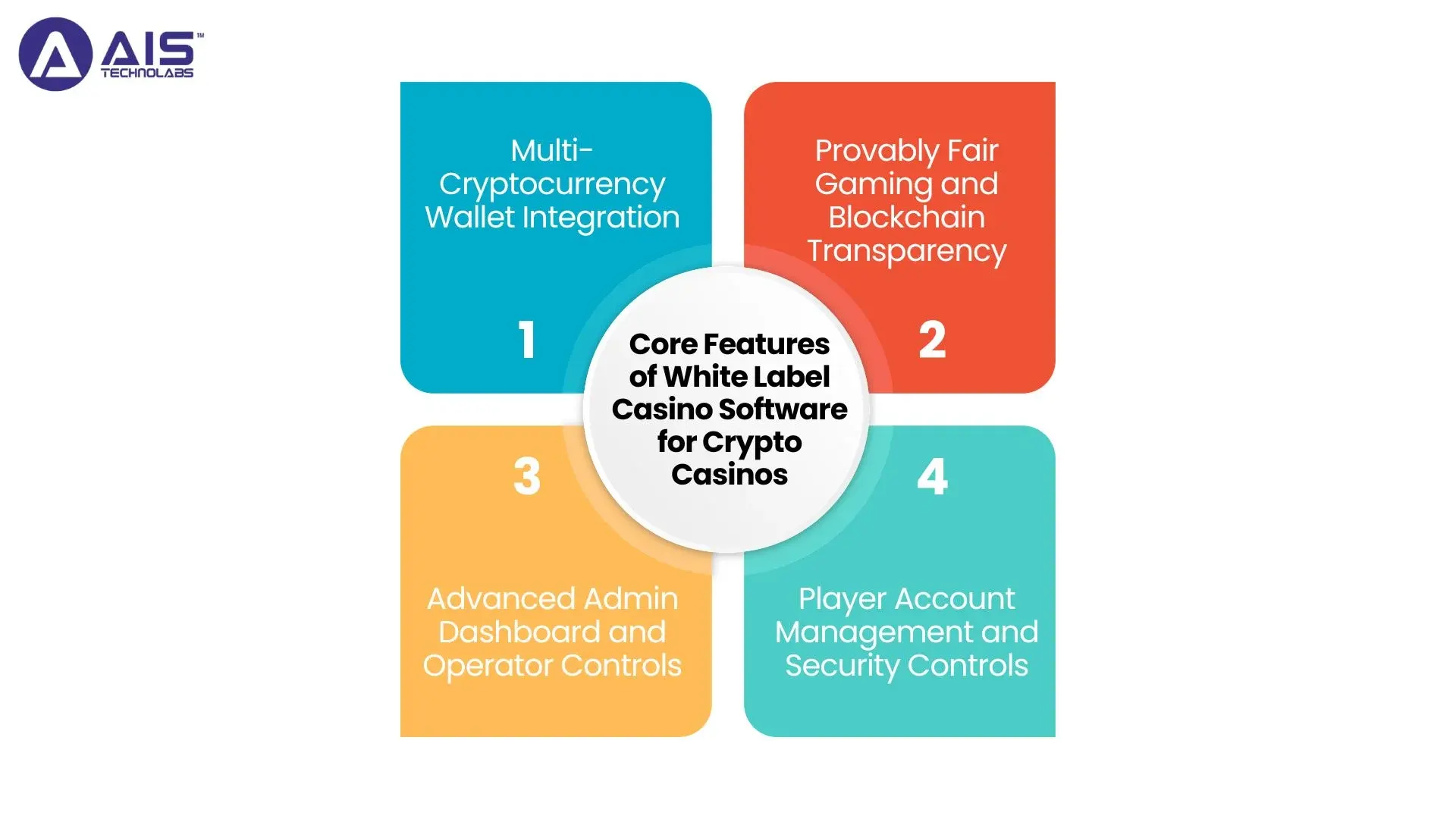
White label casino software for crypto casinos is built with feature-rich infrastructure that balances player experience, operational control, and regulatory readiness. These features are designed to support fast transactions, transparent gameplay, and scalable casino operations across global markets.
Multi-Cryptocurrency Wallet Integration
Multi-cryptocurrency wallet integration allows crypto casinos to accept, manage, and process multiple digital assets within a single platform. White label casino software typically supports popular cryptocurrencies and stablecoins while offering seamless deposit and withdrawal experiences for players. From an operator perspective, this feature simplifies fund management, improves liquidity handling, and enables multi-currency support without relying on external payment layers.
This integration is essential for attracting international players who prefer different crypto assets and for maintaining competitiveness in the evolving global iGaming market.
Provably Fair Gaming and Blockchain Transparency
Provably fair gaming is a core trust-building feature in crypto casinos. White label casino platforms use cryptographic algorithms that allow players to independently verify game outcomes. Combined with blockchain transparency, this ensures that results are not manipulated and that every wager follows verifiable logic.
For operators, provably fair systems reduce disputes, improve player confidence, and align with fair play certification requirements. This transparency also supports long-term brand credibility and regulatory acceptance in crypto-friendly jurisdictions.
Advanced Admin Dashboard and Operator Controls
An advanced casino admin dashboard gives operators full visibility and control over platform performance. White label casino software includes real-time reporting, player activity tracking, game analytics, and revenue monitoring tools. Operators can manage bonuses, limits, and game availability without technical intervention.
This centralized control system allows businesses to optimize operations, respond quickly to market trends, and maintain compliance while scaling the casino platform across multiple regions.
Player Account Management and Security Controls
Player account management systems handle registration, verification, transaction history, and responsible gaming limits. White label casino software integrates security controls such as two-factor authentication, session monitoring, and account risk profiling.
These features protect player data, prevent unauthorized access, and support KYC and AML requirements. Strong account management not only enhances security but also improves user trust and platform reliability.
Supported Cryptocurrencies and Blockchain Networks
Supported cryptocurrencies and blockchain networks determine how flexible and future-ready a crypto casino platform can be. White label casino software is designed to be region-agnostic, allowing operators to serve diverse markets with varying blockchain preferences.
Bitcoin, Ethereum, and Stablecoin Support
Bitcoin and Ethereum remain foundational assets for crypto casinos due to their liquidity, adoption, and trust. White label casino platforms also support stablecoins, which reduce volatility and simplify balance management for players and operators alike.
This combination ensures accessibility for both experienced crypto users and newcomers while enabling predictable transaction values and smoother financial operations.
Layer-2 and Low-Fee Blockchain Compatibility
Layer-2 solutions and low-fee blockchains play a critical role in improving transaction speed and reducing costs. White label casino software increasingly integrates these networks to support micro-transactions, faster confirmations, and lower gas fees.
For operators targeting emerging markets or high-volume gameplay, this compatibility directly improves user experience and operational efficiency without compromising security.
Cross-Chain and Multi-Network Transaction Handling
Cross-chain functionality allows players to interact with the casino platform using different blockchain networks without friction. White label casino software supports multi-network transaction handling by abstracting complexity at the backend while keeping the player experience simple.
This flexibility enables operators to expand into new regions, adopt emerging blockchain ecosystems, and future-proof their casino business against rapid technological change.
Crypto Payment Processing and Wallet Integration
Crypto payment processing is the operational backbone of any crypto casino. White label casino software is designed to handle high transaction volumes, maintain transparency, and ensure fast fund movement while meeting compliance and security expectations across global markets.
Custodial and Non-Custodial Wallet Models
White label crypto casino platforms support both custodial and non-custodial wallet models to suit different business strategies. Custodial wallets allow operators to manage player funds internally, offering greater control, streamlined compliance, and simplified user experience. This model is often preferred in regulated environments where KYC and AML enforcement is mandatory.
Non-custodial wallets give players direct control over their assets by connecting external wallets. This approach aligns with decentralization principles and appeals to privacy-focused users, while still allowing operators to enforce platform-level security and transaction rules.
Instant Crypto Deposits and Automated Withdrawals
Instant deposits and automated withdrawals are critical for player satisfaction in crypto casinos. White label casino software integrates blockchain payment gateways that enable near real-time fund transfers without manual approval delays. Players can deposit crypto and start playing immediately, which significantly improves engagement and retention.
Automated withdrawals reduce operational overhead for operators while minimizing errors and disputes. This efficiency also supports scalability as transaction volumes grow across international markets.
Transaction Monitoring and On-Chain Verification
Transaction monitoring tools track deposits, withdrawals, and wallet activity in real time. White label casino platforms use on-chain verification to ensure that every transaction is traceable, immutable, and verifiable on the blockchain.
These systems support AML compliance, fraud prevention, and financial transparency. For operators, this means reduced risk exposure and stronger trust with regulators, partners, and players.
Casino Games Available in White Label Crypto Casino Software
Game diversity plays a major role in player acquisition and long-term revenue growth. White label casino software offers a broad portfolio of games optimized for crypto payments and global player preferences.
Slots, Table Games, and Live Dealer Casinos
White label crypto casino platforms support a wide range of slots, table games, and live dealer casinos. Slots offer high engagement and scalability, while classic table games appeal to experienced players seeking strategic gameplay. Live dealer casinos combine real-time interaction with blockchain payments, delivering a premium and immersive experience.
These games are optimized for multi-currency play and international audiences, ensuring consistent performance across regions.
Crash Games and Provably Fair Game Mechanics
Crash games have become a defining feature of crypto casinos due to their fast-paced mechanics and transparent outcomes. White label casino software integrates provably fair systems that allow players to verify each result using cryptographic methods.
This transparency strengthens trust, reduces disputes, and aligns with the expectations of crypto-native users who value fairness and verifiability over traditional opaque gaming systems.
Third-Party Game Provider Integrations
Third-party game provider integration allows operators to expand their game libraries quickly without additional development. White label casino platforms come pre-integrated or ready to integrate with leading game studios, offering access to thousands of certified games.
This flexibility enables operators to refresh content regularly, cater to regional preferences, and stay competitive without increasing casino software development cost.
Security Framework in White Label Crypto Casino Platforms
Security is a foundational requirement for crypto casinos, not an optional feature. White label casino software is built with multi-layered security frameworks that protect player funds, transactional integrity, and platform data while meeting regulatory and operational risk standards across global markets.
Blockchain Security Measures and Smart Contract Audits
Blockchain-based security ensures that transactions, balances, and gameplay outcomes remain tamper-proof. White label crypto casino platforms rely on immutable ledgers and cryptographic validation to protect financial flows and game logic. Smart contracts used for payments, bonuses, or provably fair games are audited to identify vulnerabilities before deployment.
Regular audits reduce the risk of exploits, strengthen platform credibility, and reassure operators, investors, and regulators that the casino infrastructure follows industry best practices.
Anti-Fraud, AML, and Risk Management Systems
Anti-fraud systems continuously monitor player behavior, transaction patterns, and wallet activity to detect anomalies in real time. White label casino software integrates AML tools that flag suspicious activity, enforce thresholds, and generate compliance-ready reports for regulatory review.
Risk management systems allow operators to control exposure by setting limits on deposits, withdrawals, and gameplay behavior. This proactive approach reduces financial losses, supports responsible operations, and aligns with global compliance expectations.
Cold Wallet Storage and Data Encryption Standards
Cold wallet storage is used to protect the majority of crypto assets by keeping them offline and inaccessible to external threats. White label casino platforms combine cold storage with hot wallets for operational liquidity, ensuring both security and efficiency.
Data encryption standards protect sensitive player information, transaction records, and backend systems. Encryption at rest and in transit, combined with secure access controls, ensures compliance with data protection regulations and strengthens overall platform trust.
Licensing and Regulatory Compliance for Crypto Casinos
Licensing and regulatory compliance determine where and how a crypto casino can legally operate. White label casino software is designed with compliance-ready frameworks that help operators adapt to varying legal requirements across jurisdictions without rebuilding their platform.
Crypto Gambling Laws Across Different Jurisdictions
Crypto gambling laws vary widely depending on region, regulator, and licensing authority. Some jurisdictions recognize cryptocurrency as a valid payment method for online gambling, while others impose restrictions or additional oversight.
White label casino platforms are built to be jurisdiction-flexible, allowing operators to configure payment methods, verification levels, and responsible gaming tools based on local legal frameworks. This adaptability is critical for international casino operators targeting multiple markets.
KYC, AML, and Responsible Gaming Compliance
KYC and AML integration is essential for operating legally and sustainably. White label casino software includes identity verification workflows, transaction monitoring, and reporting tools that support regulatory compliance without disrupting player experience.
Responsible gaming features such as deposit limits, self-exclusion, and session controls help protect players and demonstrate ethical operation. These tools are increasingly required by regulators and contribute to long-term platform legitimacy.
Managing Legal Risks in Global Crypto Casino Operations
Operating a crypto casino across borders introduces legal complexity and ongoing compliance risk. White label casino software reduces this burden by offering standardized compliance modules, regular updates, and provider-level regulatory expertise.
By working within a compliant framework, operators can focus on growth and user acquisition while minimizing exposure to legal disputes, penalties, or operational shutdowns.
Cost Structure of White Label Crypto Casino Software
The cost structure of white label crypto casino software is designed to offer predictability and faster ROI compared to custom development. For operators and investors, understanding these costs upfront helps align budgets with realistic growth and monetization expectations.
Initial Setup and Licensing Costs
Initial setup costs typically include platform configuration, branding, game integration, wallet setup, and licensing access. White label casino software pricing models vary depending on feature depth, supported cryptocurrencies, and compliance requirements, but they remain significantly lower than building a platform from scratch.
Licensing fees often cover the use of the casino software solution, core updates, and access to essential backend systems. This approach allows operators to enter the market with a controlled setup cost for online casino operations while minimizing technical and financial risk.
Ongoing Maintenance and Transaction Fees
Ongoing costs include monthly license fees, hosting, security updates, platform upgrades, and customer support. White label casino software maintenance cost is predictable, making it easier for operators to plan cash flow and operational expenses.
Transaction fees may apply to blockchain payments, wallet operations, or third-party service integrations. While these fees vary by network and provider, they are generally offset by lower infrastructure overhead and improved operational efficiency.
White Label vs Custom Crypto Casino Development Cost Comparison
Custom crypto casino development involves high upfront investment, longer timelines, and ongoing engineering expenses. In contrast, white label casino software offers a cost-efficient alternative with pre-tested infrastructure and faster monetization.
For most online casino startup solutions, white label platforms provide a stronger casino software ROI by reducing development risk and allowing operators to focus on marketing, player acquisition, and business growth rather than technical execution.
Timeframe to Launch a White Label Crypto Casino
Time to market is one of the strongest advantages of white label casino software. These platforms are designed to help operators launch online casinos quickly without sacrificing security, compliance, or scalability.
Typical Development and Deployment Timeline
A white label crypto casino can typically be launched within a few weeks. This includes platform setup, branding customization, game selection, wallet integration, and initial compliance configuration. Because the core technology is already built and tested, deployment focuses on configuration rather than development.
This accelerated timeline allows operators to respond to market trends, regulatory windows, or investment opportunities faster than traditional custom-built platforms.
Factors That Influence Go-Live Speed
Go-live speed depends on licensing readiness, branding complexity, game portfolio size, and compliance requirements. Operators with predefined business models and regulatory strategies tend to launch faster than those still evaluating jurisdictions or operational scope.
Choosing an experienced white label casino software provider further reduces delays by offering structured onboarding, technical support, and deployment best practices from day one.
Advantages of Using White Label Software for Crypto Casinos
White label casino software offers a strategic advantage for crypto casino operators seeking speed, efficiency, and predictable growth. These platforms are designed to reduce technical barriers while enabling businesses to compete in the global iGaming market with confidence.
Faster Market Entry and Reduced Operational Complexity
One of the primary advantages of white label casino software is the ability to launch online casino platforms quickly. Operators avoid lengthy development cycles, infrastructure planning, and testing phases because the core system is already built and validated.
By reducing operational complexity, businesses can focus on branding, marketing, player acquisition, and compliance. This accelerated entry is especially valuable in fast-evolving crypto gambling markets where timing directly impacts revenue potential.
Scalability and Global Market Reach
White label crypto casino platforms are built to scale from day one. They support multi-language casino environments, multi-currency transactions, and region-agnostic configurations, making them suitable for international casino operators.
As player demand grows, the platform can handle increased traffic, expanded game libraries, and new blockchain integrations without requiring structural changes. This scalability enables long-term expansion into emerging markets while maintaining consistent performance.
Proven Infrastructure and Technical Reliability
White label casino software is based on infrastructure that has already been tested under real-world conditions. This proven reliability reduces the risk of downtime, security vulnerabilities, and performance issues that often affect newly developed platforms.
For operators and investors, using a stable and battle-tested casino software solution lowers technical risk and increases confidence in sustained platform operations.
Limitations and Risks of White Label Crypto Casino Solutions
While white label casino software provides efficiency and speed, it also comes with limitations that operators should evaluate carefully before committing to a platform.
Customization Constraints and Platform Dependency
White label solutions offer flexibility within predefined parameters, but they may limit deep customization of core features or system architecture. Operators are often dependent on the provider’s roadmap for new functionalities, updates, or integrations.
This dependency can restrict innovation for businesses seeking highly differentiated gaming experiences or proprietary technology development.
Regulatory and Compliance Challenges
Crypto gambling regulations continue to evolve across jurisdictions, creating ongoing compliance challenges. Even with compliance-ready white label platforms, operators remain responsible for adhering to local laws, licensing conditions, and reporting requirements.
Failure to adapt to regulatory changes can result in operational disruptions or legal exposure. This makes continuous compliance monitoring and provider support essential for long-term success.
How to Choose the Right White Label Crypto Casino Software Provider
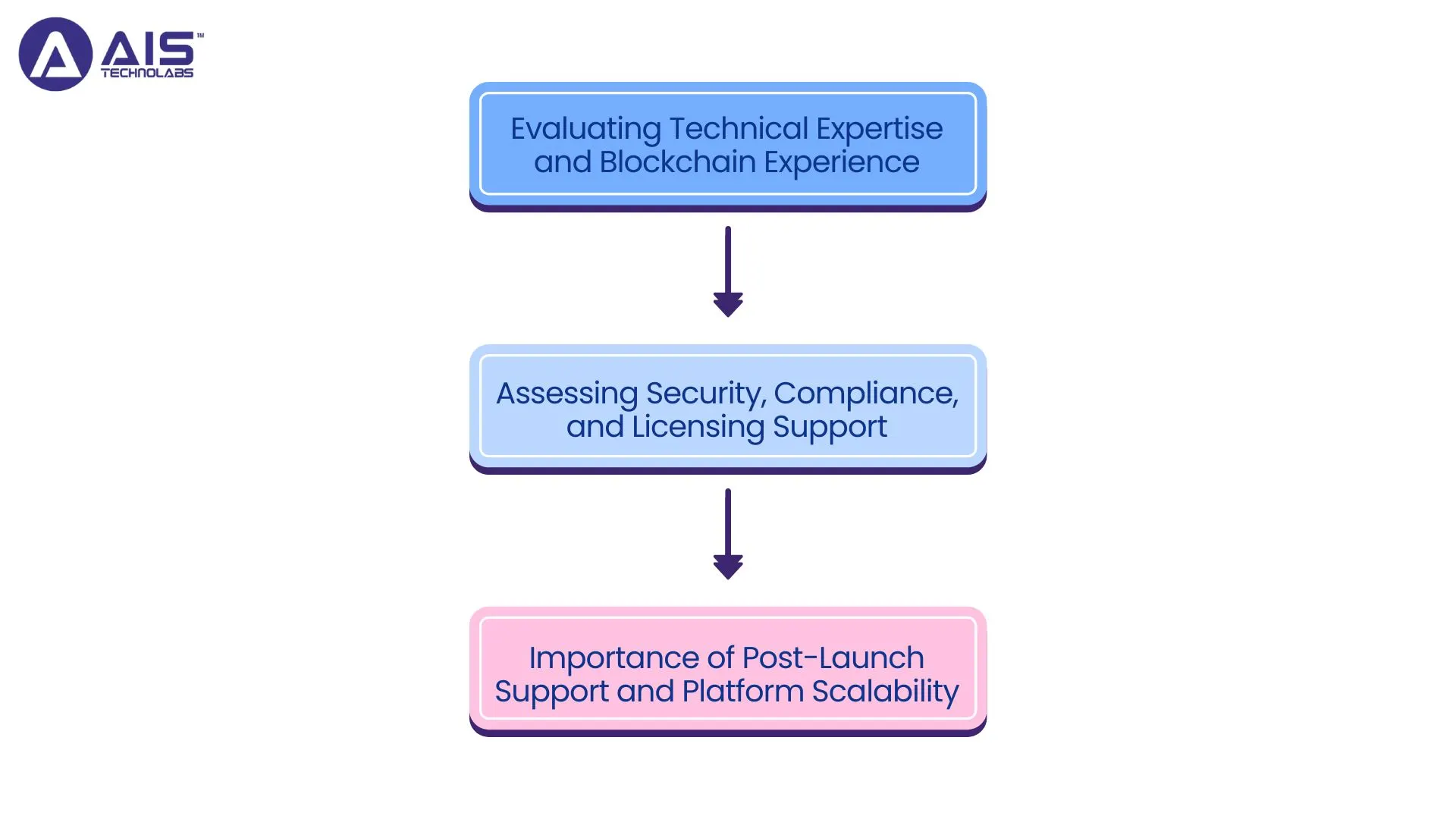
Choosing the right white label crypto casino software provider is a strategic decision that directly impacts security, compliance, scalability, and long-term profitability. The right partner offers more than software; they provide operational stability and regulatory confidence in a complex global iGaming landscape.
Evaluating Technical Expertise and Blockchain Experience
A reliable provider should demonstrate proven experience in blockchain integration, crypto payment processing, and casino platform architecture. This includes hands-on expertise with multi-cryptocurrency wallets, provably fair gaming systems, and scalable backend infrastructure.
Operators should assess whether the provider has successfully deployed platforms in real-world environments and understands the technical challenges of running crypto casinos at scale. Strong technical foundations reduce downtime, security risks, and future migration costs.
Assessing Security, Compliance, and Licensing Support
Security and compliance capabilities should be evaluated as core criteria, not optional features. A trustworthy provider offers built-in KYC and AML integration, encryption standards, anti-fraud tools, and support for gaming license requirements across jurisdictions.
Licensing assistance and regulatory guidance are particularly important for operators entering new or emerging markets. Providers that actively track regulatory changes help reduce legal exposure and ensure ongoing compliance.
Importance of Post-Launch Support and Platform Scalability
Post-launch support determines how well a casino performs after going live. Continuous software updates, security patches, performance optimization, and technical assistance are essential for maintaining uptime and player trust.
Scalability is equally important. The platform should support growth in traffic, game libraries, blockchain networks, and geographic reach without requiring major system overhauls. Long-term success depends on a provider’s ability to evolve with the market.
Future Trends in White Label Casino Software for Crypto Casinos
The future of white label casino software is closely tied to innovation in blockchain, artificial intelligence, and decentralized systems. Operators who understand these trends are better positioned to stay competitive and compliant.
AI-Driven Fraud Detection and Player Analytics
Artificial intelligence is transforming risk management and personalization in crypto casinos. AI-driven fraud detection systems analyze transaction behavior, gameplay patterns, and wallet activity in real time to identify threats before they escalate.
Advanced player analytics also enable operators to optimize retention strategies, personalize promotions, and improve overall user experience while maintaining responsible gaming standards.
Decentralized and DAO-Based Crypto Casinos
Decentralized casino models are gaining attention as blockchain governance evolves. DAO-based crypto casinos allow communities to participate in decision-making, platform governance, and revenue distribution.
White label casino software is beginning to adapt to these models by supporting decentralized components while maintaining compliance-friendly operational controls.
NFT, Metaverse, and Web3 Casino Integrations
NFT-based rewards, metaverse casino environments, and Web3 identity systems are shaping the next phase of online gambling. These technologies introduce new engagement models, digital ownership concepts, and immersive experiences.
White label platforms that support modular Web3 integrations are better positioned to adopt these innovations without disrupting core operations.
Final Thoughts on White Label Casino Software for Crypto Casinos
White label casino software has emerged as a practical and scalable solution for launching and operating crypto casinos in a rapidly evolving global market. It offers a balance between speed, cost efficiency, security, and regulatory readiness that is difficult to achieve with custom development alone.
Is White Label the Right Choice for Your Crypto Casino Business?
For most business owners, investors, and operators, white label casino software provides a lower-risk entry point with faster time to market and predictable operating costs. It is particularly well-suited for those prioritizing scalability, compliance, and long-term ROI over deep technical ownership.
Partnering with an experienced provider such as AIS Technolabs can help you navigate licensing, security, and platform scalability with confidence. If you’re evaluating your next move in the crypto gambling space, contact us to explore whether a white label strategy aligns with your business goals.
Disclaimer:
This blog is intended for informational and educational purposes only. We do not promote or facilitate gambling activities in any country where it is considered illegal. Our content is focused solely on providing knowledge about legal and regulated markets. We only work with operators and platforms that are licensed and comply with the laws of jurisdictions where casino gaming is permitted. We do not operate or endorse any form of gambling in restricted regions. In countries where only skill-based games are allowed, our involvement is strictly limited to those games.
We believe gambling should be an entertaining and responsible activity. Our goal is to ensure that the platforms we review uphold the highest standards of fairness, transparency, and player safety.
FAQs
Ans.
Yes, white label crypto casino software is legal in many regions, provided the operator complies with applicable online gambling regulations and obtains the required gaming licenses. Legality depends on the jurisdiction, licensing authority, and how KYC, AML, and responsible gaming requirements are implemented.
Ans.
Some jurisdictions allow limited or simplified KYC models, but fully no-KYC crypto casinos are increasingly restricted. Most white label casino platforms support flexible KYC configurations so operators can align with local regulatory expectations while balancing privacy and compliance.
Ans.
Bitcoin and Ethereum are the most widely used due to their liquidity, trust, and global adoption. Stablecoins are also popular as they reduce volatility and simplify balance management for both players and operators.
Ans.
Security depends on the provider, but reputable white label crypto casino platforms use blockchain-based transaction verification, smart contract audits, encryption, and cold wallet storage. These measures help protect player funds, data, and overall platform integrity across global markets.

Mary Smith
Mary Smith excels in crafting technical and non-technical content, demonstrating precision and clarity. With careful attention to detail and a love for clear communication, she skillfully handles difficult topics, making them into interesting stories. Mary's versatility and expertise shine through her ability to produce compelling content across various domains, ensuring impactful storytelling that resonates with diverse audiences.
 ASIA PACIFIC