Table of Content
Key Takeaways
- Online lottery management software is three connected systems: player account management (PAM), a certified draw engine, and a payment layer, not one monolithic app.
- Draw integrity isn't just “a certified RNG.” It needs independent audit trails, anomaly detection on ticket-sales patterns, and segregation of duties, per standards such as GLI-19 and the World Lottery Association's WLA-SCS.
- Syndicate play and jackpot and rollover rules are configuration features, not consumer add-ons. The platform manages prize-splitting, caps, and multi-draw logic automatically.
- Omnichannel sync across retail, kiosk, and digital, plus multi-currency and crypto payments, are now baseline expectations, not advanced options.
- Implementation timelines vary by engagement model (Buy, Rent, Rent-to-Buy, Custom) and scope. Kansas iLottery's roughly ten-month build is a documented example, not a universal benchmark.
Introduction
Most operators researching lottery platforms find pages repeating the same bullet points: “secure,” “scalable,” “real-time,” “multi-channel.” These pages rarely explain what any of that means operationally.
The features that actually determine whether a launch survives regulatory review are the unglamorous ones. That means how draws are audited, how syndicates get paid automatically, and how a kiosk sale reconciles with a mobile sale seconds later.
Online lottery management software is the platform that runs a lottery operator’s entire draw-to-payout lifecycle. It sells tickets, generates or receives certified draw results, verifies and pays prizes, and keeps the compliance and reporting trail regulators require.
It sits on three connected systems: a player account management (PAM) layer, a certified draw engine, and a payment and settlement layer. A platform’s quality shows up in how tightly those three are integrated, not in any one feature alone.
This checklist covers five feature pillars to evaluate in 2027: draw integrity and certified RNG, player account management and compliance, payments, analytics and omnichannel connectivity, and configurable jackpot and syndicate mechanics. Every statistic below is sourced to its original publisher.
Nothing here is invented.
What Is Online Lottery Management Software?
At its core, online lottery management software is the system of record for an entire lottery operation. It issues tickets, runs or ingests draws, validates winners, and settles prizes, while keeping the audit trail a regulator will eventually ask to see.
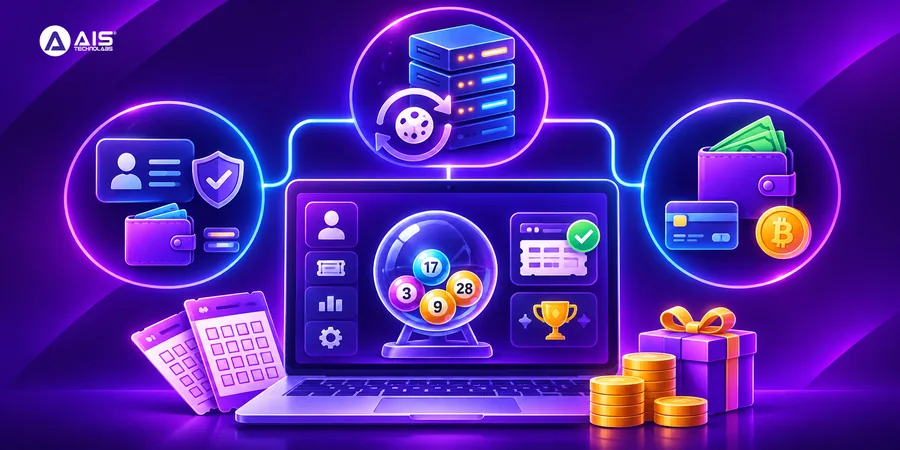
It replaces separate retail terminals, spreadsheets, and manual reconciliation with one connected platform. Industry convention treats the platform as three systems working together, not one app.
- Player Account Management (PAM): registration, identity verification, wallets, transaction history, and responsible-gaming controls.
- Draw engine: the certified RNG or draw-result ingestion pipeline, number generation or verification, and result publication.
- Payment and settlement layer: deposits, withdrawals, prize payouts, and multi-currency or crypto handling.
A platform strong in one of these and weak in another creates real risk. A brilliant draw engine behind a weak PAM means compliance gaps, and a slick payment layer with no draw audit trail means regulators won’t certify it at all.
Core Features Checklist for 2027
The features below separate an operator-ready platform from a demo.
Draw Management & Certified RNG
A draw engine has to do three things: generate or ingest results, prove they weren’t manipulated, and make that proof available for audit. For software-generated draws, that means a random number generator certified against an accredited standard, most commonly GLI-19.
GLI-19 is Gaming Laboratories International’s standard for interactive gaming systems. It requires each outcome to be equally likely and statistically independent from prior draws, tested to a 99% confidence level.
For draws tied to a physical or broadcast event, the software instead needs a verified ingestion and publication pipeline with its own audit log. Either way, a regulator should be able to reconstruct exactly how a result was produced, not just see the final number.
How Draw Integrity and Fraud Prevention Actually Work
Certification covers the RNG itself, but it doesn’t cover what happens around it. The World Lottery Association’s WLA-SCS security control standard, updated as WLA-SCS:2024, is explicit that no single person or team should influence draw integrity without oversight.
It calls for separate roles for designing, monitoring, and performing draws, so the person who built the draw logic isn’t also the one running it unsupervised. In software terms, that means three things: an independent, tamper-evident audit trail for every draw event, anomaly detection on ticket-sales patterns that flags purchase spikes or clustering before a draw closes, and enforced segregation of duties in the platform’s own permission model, not just a paper policy.
A vendor that can’t show these three working together isn’t offering real draw integrity, whatever its RNG certificate says.
Player Account Management (PAM)
PAM is the layer players touch directly: registration and identity verification, account and wallet management, ticket purchase history, and a transaction ledger that reconciles across every channel the operator sells through. A modern PAM also supports loyalty mechanics and session management without creating compliance gaps.
Every balance change, from purchase to prize credit, needs to trace back to a specific player action and timestamp.
KYC/AML & Responsible Gaming Controls
Identity verification (KYC) and anti-money-laundering (AML) screening are non-negotiable for any real-money lottery platform, run at onboarding and on an ongoing basis. Alongside that, responsible-gaming tooling is now a baseline expectation: deposit, spending, and session-time limits, plus self-exclusion tools enforceable across every channel a player uses, not just the one where they set the limit.
Exact requirements vary by jurisdiction, so the platform needs configurable limit structures rather than one hard-coded ruleset.
Multi-Currency & Crypto Payment Support
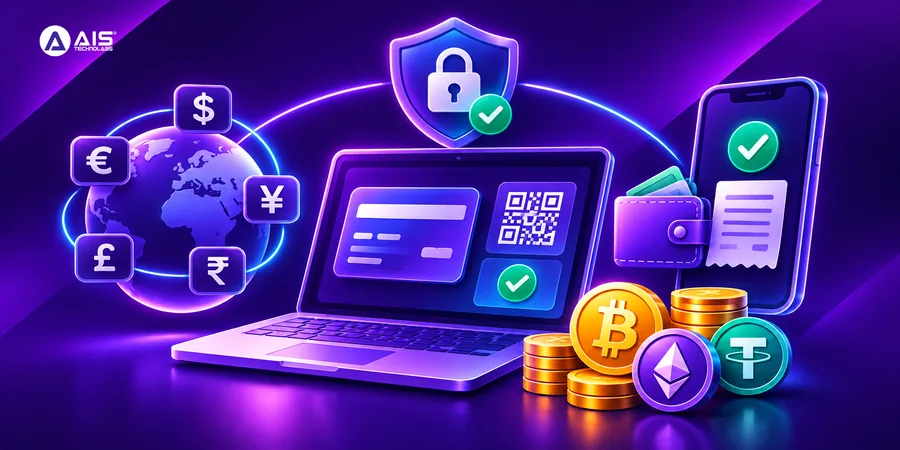
Payment flexibility is now baseline, not a differentiator. That means native multi-currency handling, plus, increasingly, crypto rails for operators whose players expect them.
The payment layer needs to settle against the same PAM ledger regardless of currency or rail, so reconciliation doesn’t fragment by method. That matters most for operators selling across multiple regulated regions, where currency mismatches create real reconciliation risk.
See how AIS Technolabs builds this into our lottery platforms: explore the lottery software providers page for how these pieces come together.
Analytics & Business Intelligence
Operators need visibility that updates in real time, not in a weekly export. That means real-time sales tracking across every channel, player behaviour analysis to spot engagement trends and churn risk, draw performance reporting covering sales velocity, payout ratios, and hold percentages, and geographic performance breakdowns across regions or retail territories.
The value isn’t the dashboard itself. It’s being able to act on a sales anomaly or a draw performance dip before it becomes a bigger problem.
Those same numbers also feed forecasting, since a sudden swing in one region’s sales often shows up in analytics before it shows up anywhere else. Reviewing draw performance and geographic data on a regular cadence, not only after a problem is reported, is what turns the analytics layer into an early-warning system rather than a reporting chore.
Syndicate & Bulk-Ticket Features
Syndicate play, groups pooling money to buy more lines and improve their odds, isn’t a niche feature. It’s a meaningful share of how major lotteries are won.
The UK National Lottery’s own published data shows syndicates account for roughly one in five major jackpot wins, which is exactly why group play needs to be a first-class software feature, not something bolted on manually.
Done properly, that means the platform handles ticket pooling, where multiple players’ contributions are combined into one purchase and tracked against each contributor. It also means automatic prize distribution, where a win is split and credited to every syndicate member’s account in the correct proportion without manual intervention.
Reconciling a syndicate win across dozens of players by hand is slow, error-prone, and a real source of disputes. Software-managed splitting removes that risk and gives every member an auditable record of their share.
This is a configuration and ledger problem, not a marketing feature, and it’s worth testing directly in any vendor demo.
Jackpot & Rollover Mechanics as a Configuration Feature
Jackpot and rollover logic look simple from a player’s seat: the pot grows until someone wins it. Underneath, though, it’s one of the more complex configuration areas in the platform.
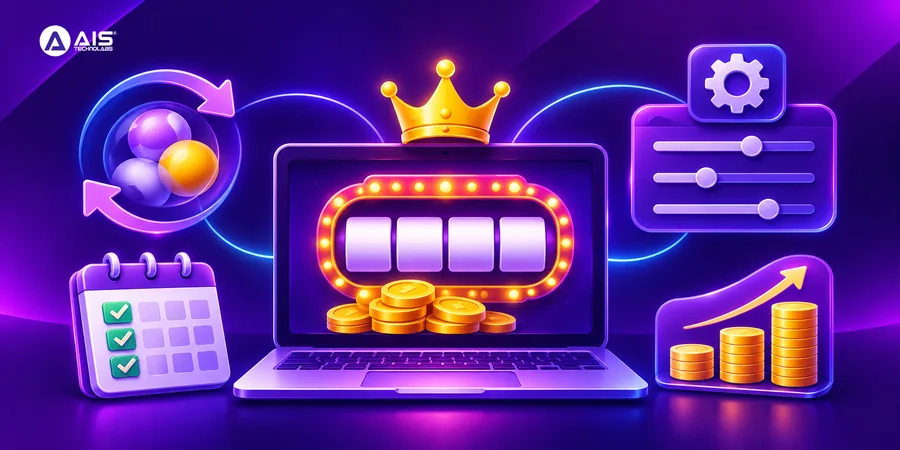
Operators need to set and adjust rollover rules, which govern what happens to an unclaimed jackpot and how many draws it can roll before a must-win or cap rule triggers. They also need caps and limits, a maximum jackpot size after which excess value redistributes to lower prize tiers or reserves.
A third piece, multi-draw jackpot configuration, governs how a jackpot behaves across a sequence of draws, including the seed value used when it resets.
These aren’t one-time settings. A competitive operator needs to adjust rollover and cap behaviour per game, sometimes per promotion, without a code change or a vendor ticket.
A platform that hard-codes jackpot logic into the draw engine itself, rather than exposing it as operator-configurable, limits how competitive an operator can be with new game formats.
Omnichannel: Connecting Retail, Kiosk, and Digital Sales
Most lottery operators sell through more than one channel: retail counters, self-service kiosks, and a digital or mobile app. The software’s job is to make all three behave like one system.
That needs inventory management, so a retail terminal and a kiosk aren’t selling against separate, disconnected ticket pools. It also needs draw-result propagation, so a result reaches every channel at the same moment, not staggered by minutes.
The third piece is a unified player ledger, so a player buying at a kiosk and checking results on their phone sees one consistent balance and history.
Operators underestimate this most, because it’s invisible until it breaks. A sync gap doesn’t show up in a demo, it shows up as a support ticket or a regulatory discrepancy during a draw audit.
Cloud vs. On-Premise Deployment
Neither deployment model is universally better. The right choice depends on the operator’s scale, regulatory environment, and existing infrastructure.
Cloud deployments shift both cost and operational burden onto a provider, which suits operators who want to launch fast and scale with demand. On-premise deployments keep that control in-house, which suits operators under strict data-residency rules or an existing infrastructure investment they want to use.
| Factor | Cloud | On-Premise |
|---|---|---|
| Scalability | Elastic: scales with traffic spikes (for example, jackpot surges) | Fixed to provisioned hardware; scaling needs capital and lead time |
| Infrastructure/maintenance cost | Operating-expense model; provider handles upkeep | Capital-expense model; operator owns and maintains hardware |
| Deployment speed | Generally faster to stand up | Slower: procurement and configuration add lead time |
| Security/operational control | Shared with the cloud provider, under a defined model | Full physical and network control stays in-house |
| Typical fit | Digital-first, multi-region launches | Strict data-residency or on-site infrastructure mandates |
Some regulators require data residency or on-site infrastructure, which effectively mandates an on-premise or hybrid approach. That’s a regulatory decision, not a technology one, and it should be settled first.
How Long Does Implementation Actually Take?
There’s no single honest answer here, because scope, regulatory review, and engagement model all change the timeline. One of the fastest publicly documented examples is Pollard Banknote’s iLottery platform for the Kansas Lottery, built on its Catalyst Gaming Platform.
Pollard has stated the project went from initial scoping to launch in roughly ten months, going live on February 13, 2025, reported as the fastest full iLottery program launch in American lottery history at that scale. That’s a real, named example of what’s achievable under the right conditions.
It is not a universal estimate, and a different operator, jurisdiction, or scope could reasonably take longer.
What actually drives the timeline is the engagement model:
- Buy: ownership of an existing software product or source-code offering. Planning centers on integration, configuration, and certification rather than ground-up development.
- Rent: access to a platform without the upfront commitment of a purchase. Planning focuses on hosting, support terms, and how much customization is included.
- Rent-to-Buy: a structured path from recurring use toward eventual ownership, with payment credit, term length, and ownership-transfer conditions defined up front.
- Custom: built around the operator’s own requirements, covering discovery, architecture, design and development, integration, testing, and deployment, each adding time proportional to scope.
AIS Technolabs doesn’t publish a fixed implementation timeline for lottery projects, because the honest answer depends on which model an operator chooses and how much certification and integration their jurisdiction requires. For what the setup process typically involves, see what you need to know about lotto software.
Choosing a Lottery Software Vendor
Picking a vendor matters more than any single feature on this list, because a weak vendor relationship undermines even a strong platform. The checklist below is roughly in the order it tends to matter.
- Compliance and regulatory track record: is the RNG certified (GLI-19 or equivalent), and where has it passed regulatory review?
- Source-code access and ownership terms: under Buy or Custom, what exactly transfers, defined clearly rather than implied?
- Third-party integration: does it connect cleanly to existing payment processors, retail and kiosk hardware, and reporting systems?
- Technical support and maintenance: what’s covered, what costs extra, and what are the real response commitments?
- Scalability and customization: can it handle a jackpot-driven traffic spike, and how much of the feature set, including jackpot rules, syndicate handling, and limits, is operator-configurable versus hard-coded?
- Security and reliability: what’s the uptime record, and how are segregation-of-duties and audit-trail requirements enforced?
Vendor selection connects directly back to draw integrity. See why lottery software providers are essential for why the vendor relationship itself, not just the feature list, determines whether a platform holds up under regulatory review.
How AIS Technolabs Supports Lottery & Keno Platforms
AIS Technolabs builds and supports lottery software, lotto software, and keno games software for operators who want both formats on one back office. That matters for operators running numbers games and draw-based keno side by side, since accounts, payments, and reporting stay unified rather than split across two systems.
Our published work, including the LuckyDraw online lottery platform case study and our lottery software case study, shows the PAM, draw-engine, and payment integration described above in practice, not in the abstract.
Evaluating a build, a license, or a vendor switch against this checklist? Get in touch and we’ll scope against your jurisdiction and engagement model.
Discuss Your Project or Request Pricing to start that conversation.
Conclusion
A lottery platform is only as strong as its weakest pillar: certified draw integrity, full PAM and compliance, flexible payments, real-time analytics, and configurable syndicate, jackpot, and omnichannel logic. Vendors strong on marketing and thin on any one of these create real operational and regulatory risk.
The features that matter most, including draw audit trails, automatic syndicate payouts, and cross-channel sync, are exactly the ones easiest to gloss over in a sales deck. Working through the checklist in this guide before signing with a vendor is the difference between a platform that survives its first regulatory audit and one that doesn’t.
If you’re building or switching lottery platforms, Discuss Your Project or Request Pricing with AIS Technolabs. Get in touch about your lottery platform.
FAQs
At minimum: a certified draw engine, full PAM with KYC/AML and responsible-gaming controls, multi-currency and crypto-capable payments, real-time analytics, and configurable syndicate, jackpot, and omnichannel logic.
The software carries an unclaimed jackpot forward into the next draw under operator-configured rules. Those rules include caps on size or roll count before a must-win trigger or redistribution to lower prize tiers.
A syndicate is a group of players pooling money to buy more ticket lines together, improving their collective odds. Properly built lottery software supports this through ticket pooling and automatic, proportional prize distribution to every member, rather than requiring the operator to split winnings by hand.
It depends on engagement model (Buy, Rent, Rent-to-Buy, or Custom) and regulatory scope. There’s no universal number.
One fast, publicly documented example, Pollard Banknote’s Kansas iLottery platform, went from scoping to launch in roughly ten months. That’s a real example of what’s achievable, not a guarantee for every project.
In virtually every regulated market, yes. The draw engine needs certification against an accredited standard such as GLI-19 by an approved testing lab before launch.
Exact requirements vary by jurisdiction.
White-label (Buy/Rent) is a pre-built platform configured to an operator’s branding and ruleset on shared underlying technology.
Custom software is designed around the operator’s own requirements from the ground up. It offers more control, but a longer engagement.
Yes. Modern platforms support native multi-currency handling and, increasingly, crypto payment rails, both settling against the same player ledger so reconciliation doesn’t fragment by payment method.
Availability depends on the vendor and the operator’s jurisdiction.

Mary Smith excels in crafting technical and non-technical content, demonstrating precision and clarity. With careful attention to detail and a love for clear communication, she skillfully handles difficult topics, making them into interesting stories. Mary's versatility and expertise shine through her ability to produce compelling content across various domains, ensuring impactful storytelling that resonates with diverse audiences.


Don't Just Plan Your Gaming Business. Build It.
Get the right technology to build and grow your iGaming business.
- Custom-Built Solutions
- Complete Technical Support
- Secure Architecture
Share your project requirements and discover the right iGaming solution for your business.
Connect with Our Experts ASIA PACIFIC