Table of Content

Key Takeaways
- Tournament start time is the riskiest moment on a poker platform. Thousands of players register, buy chips, and open WebSocket connections within the same few minutes, which is exactly when unprepared platforms break.
- PokerStars' 2022 World Championship of Online Poker (WCOOP) is the clearest public example. A DDoS attack forced cancellation of all six WCOOP Main Events on one Sunday, including a $10,300 NLHE Championship stopped mid-level with only 8 of 297 entrants out (PokerNews, poker.org).
- The fixes are architectural: horizontally scalable, stateful game servers; container orchestration that adds capacity automatically; sharded, cached databases; and monitoring that flags trouble before players feel it.
- DDoS protection and multi-region failover matter as much as raw capacity. PokerStars itself called such attacks "a constant threat to every company operating online," not a one-off.
- AIS Technolabs engineers its poker platforms to a 50,000+ concurrent-player benchmark.
Introduction
In September 2022, PokerStars, the world's largest online poker room, had to pause and then cancel every Main Event in its flagship WCOOP series on a single Sunday. Thousands of players, some deep in a $10,300 buy-in championship, were kicked out mid-hand.
The cause wasn't a bad release. It was a Distributed Denial of Service (DDoS) attack that hit at the exact moment traffic was already at its peak.
That's the nightmare scenario for any poker operator. The one day you can't afford downtime is the day your infrastructure is under the most pressure, because tournament traffic arrives in a spike concentrated in the minutes before a scheduled start.
A platform that runs fine on a quiet Tuesday can buckle on a Sunday with a $1,000,000 guarantee live. This article covers what breaks when poker traffic spikes, what PokerStars' WCOOP outage teaches every operator, and the architecture, scaling, and monitoring practices that keep a platform standing when thousands of players show up at once.
Why Tournament Traffic Spikes Break Unprepared Poker Platforms
Tournament traffic is unlike normal web traffic in three ways: it's compressed into a narrow window, it's state-heavy, and it hits the database and the game engine at the same moment. A platform sized for average daily traffic can be several multiples under-provisioned for a single tournament start.
That gap is the root cause of almost every tournament-day failure. The next two sections explain exactly what happens inside the software when that gap is exposed, using a real, publicly documented outage as the case study.
What Happens Technically When Thousands of Players Register at Once

In the minutes before a major tournament, thousands of players hit "register" within the same short window. Each registration opens a persistent WebSocket connection, writes a buy-in transaction, and gets assigned a table seat once the field is seeded.
Multiplied across thousands of players, that's a sharp spike in open connections, CPU load, and database writes, all concentrated into a handful of minutes rather than spread across a day. A server fleet sized for normal traffic runs out of connection slots or database throughput at precisely this moment.
The failure mode is rarely a clean error message. It's lag, stalled actions, and dropped connections while real hands, with real money, are live on the table. For players, that reads as the platform being unreliable; for operators, it's the single highest-cost failure window in the product.
The PokerStars WCOOP 2022 Outage, A Real Case Study in Tournament-Day Failure
Per poker.org's reporting, PokerStars went offline for roughly 18 hours spanning a Sunday and the following morning. The $10,300 NLHE "High Roller" Championship (WCOOP Event #92-H) had only reached Level 4, with just 8 of 297 entrants busted, when the site paused all action.
PokerStars battled the issue for about two hours before abandoning the resumption of play. It then cancelled the affected tournaments and refunded buy-ins to remaining players under its "Roll Forward" contingency policy.
PokerStars later confirmed, per PokerNews, that Distributed Denial of Service (DDoS) attacks caused the outage. It was not a data breach, and no player account or personal information was accessed. All six WCOOP Main Events were rescheduled to November 5 to 6, 2022.
PokerStars' own statement is instructive: "We have a great track record of keeping our platform operational, however, we know how frustrating it can be to experience this kind of disruption... such events are a constant threat to every company operating online, and we are no different." Even a market leader can go down when tournament-day load and an external attack coincide, and the response plan matters as much as the infrastructure itself.
Core Architecture Principles for High-Traffic Poker Platforms
Platforms that survive tournament-day spikes share one architectural foundation: components that scale independently of each other. The hardest single piece to get right is the stateful game server, which the next two sections cover in detail.
Microservices vs Monolithic, Why Table/Game Servers Must Scale Independently

A monolithic poker platform bundles registration, lobby, game logic, and payments into one deployable unit. That means a spike in registrations forces the whole application to scale, including parts of the system that don't actually need extra capacity.
A microservices approach separates these concerns instead. The registration and lobby service, the game/table server, and the payments service each scale on their own metrics, independently of one another.
This matters because registration spikes and in-game load peak at different times and by different magnitudes. Coupling them together means over-provisioning everything to cover the worst case of any one component, without any guarantee that the game servers, the part players actually feel lag on, get the capacity they need first. A platform built on turnkey or white-label poker software still benefits from this separation, since the underlying architecture determines how well it absorbs a spike regardless of the commercial model on top.
Stateful Game Servers and WebSocket Connection Limits
Unlike a typical stateless web request, a poker table server holds live state for every seat: cards, stacks, timers, and action history, all synced to players over a persistent WebSocket connection. That statefulness makes horizontal scaling harder than for a stateless API.
A player can't simply be routed to any available server, because their table's state lives on one specific instance. Losing that instance, or routing a reconnect to the wrong one, breaks the hand.
Operators need to plan for connection limits well before a tournament: file descriptor limits, load balancer connection caps, and network address translation table limits. Most cloud infrastructure defaults are tuned for general web traffic, not for tens of thousands of long-lived WebSocket connections opened in a short burst, so these limits need deliberate tuning ahead of a scheduled event rather than discovery during one.
Auto-Scaling Poker Software for Concurrent Player Surges
Fixed server capacity either sits idle for most of the year or falls short on tournament day. Auto-scaling, adding capacity automatically as load rises and releasing it afterward, is what makes both of those outcomes avoidable.
Horizontal Scaling of Game and Table Servers On Demand
Horizontal scaling means adding more table-server instances rather than making one server bigger. It's the only practical way to absorb a tournament-day spike without paying for that capacity 365 days a year.
New table-server instances can spin up automatically as more tables open, with a load-balancing layer assigning new tables to whichever instance currently has capacity. This keeps any single server from being overloaded while others sit idle.
The scaling trigger should be tied to real tournament-day signals, specifically scheduled start times and current registration counts, rather than purely reactive CPU thresholds. By the time CPU usage spikes, players are already registering and the platform is already under load; a signal tied to the schedule itself gives the system a head start.
Setting Realistic Concurrency Targets, Benchmarked Against Published Figures
Concurrency targets should be set against real, named benchmarks rather than guesswork. Evenbeter (formerly EvenBet Gaming), a Malta-licensed poker and iGaming software provider, publishes that its software has been used by more than 48 million players across 200 launched operators as of 2026.
That's a vendor-published total-reach figure, not a live concurrent-session number, but it's still a useful signal of what production poker infrastructure is built to handle at scale. AIS Technolabs engineers its poker platforms to a 50,000+ concurrent-player benchmark.
The practical takeaway for operators is to size their platform against their own realistic peak, meaning expected registrants plus a safety margin for a viral or heavily marketed event, rather than against "normal" daily traffic. A generic industry number is a reference point, not a substitute for testing your own platform.
Container Orchestration (Kubernetes) for Elastic Scaling
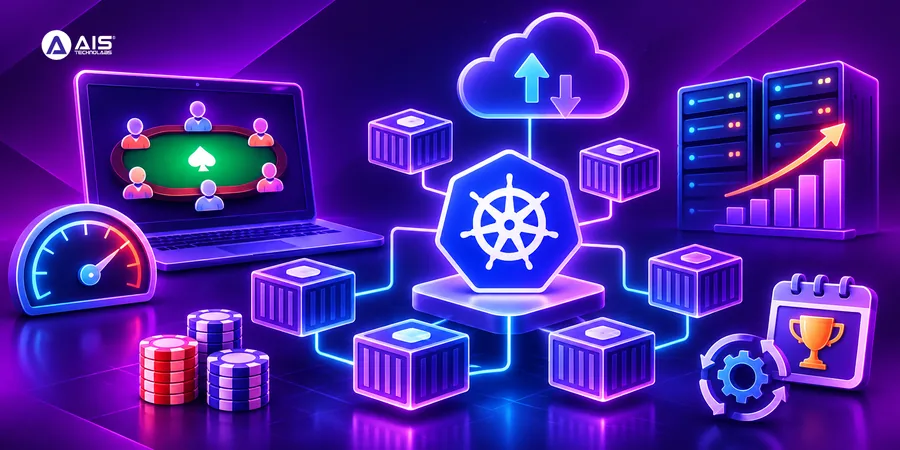
Kubernetes, or an equivalent container orchestrator, automates the work of adding and removing server instances based on load. It health-checks each instance continuously and routes traffic only to the ones that are actually healthy.
For a poker platform, this means table-server pods can scale out automatically ahead of a scheduled tournament and scale back down afterward. Operators no longer need to manually provision servers before every major event and hope the estimate was right.
That automation also shortens recovery time if something does go wrong mid-event, since a failed pod is replaced automatically rather than requiring a manual restart under pressure. The orchestration layer becomes part of the platform's resilience, not just its cost efficiency.
Handling Concurrent Poker Players Without Lag or Disconnects
Scaling server count solves raw capacity. Keeping each individual player's experience lag-free during a spike is a separate, equally important problem covered in the next two sections.
Session and Live Table-State Management (In-Memory Caching)
Live table state, meaning whose turn it is, the current pot, and each player's timer, needs to be read and written far faster than a traditional disk-based database allows. In-memory data stores such as Redis hold this fast-changing state in memory rather than on disk.
That lets a table server update and broadcast a game action in milliseconds rather than tens or hundreds of milliseconds. This is what prevents the visible stutter players describe as "lag" during peak load.
The bottleneck usually isn't the network connection between the player and the server. It's how fast the server itself can read and update the state of the hand, which is exactly what in-memory caching is designed to speed up.
Preventing WebSocket Bottlenecks During Peak Registration Windows
Every connected player holds an open WebSocket connection, and a surge of simultaneous connection attempts, everyone registering in the same five minutes, can exhaust connection-handling capacity before a single hand is even dealt. This is a different problem from raw server count: it's about how efficiently each server handles many simultaneous connections.
Mitigations include connection-handling layers purpose-built for high concurrency, such as event-driven servers rather than a one-thread-per-connection model. Pre-warming infrastructure ahead of a known tournament start time also helps, since it avoids cold-start delays exactly when load first arrives.
Queuing or staggering non-time-sensitive requests, like general lobby browsing, so they don't compete with registration traffic for the same resources, is a further safeguard. None of these measures require more servers; they require the existing servers to handle connections more efficiently.
Load Balancing and Database Performance Under Tournament-Day Server Load
Once traffic is distributed across enough servers, the database layer becomes the next likely bottleneck. Every registration, buy-in, and hand result is a write that has to land correctly even under peak load.

Distributing Traffic Across Regions with Smart Load Balancers
Players in a global tournament field connect from many regions at once. Geo-aware load balancing routes each player to the nearest healthy server cluster, which cuts latency and spreads load across regions instead of funneling a worldwide field through a single data center.
This also provides a natural second benefit. If one region develops a problem, traffic can be redirected to a healthy region rather than lost entirely, which ties directly into the failover strategy covered later in this article.
Database Sharding and Read Replicas for Hand History and Transaction Data
A single database instance can't absorb thousands of simultaneous buy-in and hand-history writes without becoming the system's bottleneck. Sharding splits data, for example by table or by region, across multiple database instances so writes aren't all competing for the same disk and the same locks.
Read replicas offload reporting, hand-history lookups, and lobby queries to separate database instances. That way, read-heavy traffic never competes with the write-heavy traffic a live tournament generates at the exact same time.
Caching Strategies to Reduce Database Load at Peak
Not every read needs to hit the database directly. Lobby listings, tournament structures, and leaderboard snapshots change infrequently enough to be cached and served without a database round-trip.
That frees up database capacity for the writes that actually need it: chip counts, hand results, and payouts. Caching the stable, slow-changing data is often a bigger win than it looks, because it removes a large share of total read traffic from the database entirely.
Infrastructure Monitoring and Early-Warning Systems
The difference between a near-miss and a full outage is often how early the warning signs were caught. It also depends on whether anyone was actively watching for them before the tournament started, not after players started complaining.

Real-Time Metrics to Watch Before and During a Tournament
Operators should track active WebSocket connections, server CPU and memory, database write latency, queue depth, and error rates in real time. Dashboards should be built specifically around tournament start times rather than generic daily averages.
A metric that looks fine on a 30-minute average can hide a dangerous 60-second spike exactly when registration opens. Averages smooth over the exact moment that matters most on tournament day, which is why short-window, event-specific dashboards matter more than daily summaries.
Automated Alerts and Load-Testing Before Major Events
Alerts should fire on leading indicators, such as a rising connection queue or climbing write latency, rather than only on hard failures. That gives the team minutes to react before players are actually affected.
Load-testing a platform against a simulated tournament-day spike, not just average traffic, before a major scheduled event is the closest thing to a dress rehearsal for the real spike. Skipping this step means the first real test of the platform's limits happens in front of a live, paying audience.
Failover, Multi-Region Redundancy and DDoS Protection
Capacity planning assumes everything else works as intended. Failover and attack mitigation cover what happens when it doesn't, which is exactly what happened to PokerStars in 2022.
Active-Active Multi-Region Failover
In an active-active setup, two or more regions run live traffic simultaneously rather than one region sitting idle as a backup. If one region degrades, traffic shifts to the healthy region instead of going dark for every player at once.
This is a meaningfully stronger position than a traditional active-passive backup. An active-passive setup still requires a manual or delayed failover under pressure, exactly when the team has the least time to spare.
DDoS Mitigation Lessons from the WCOOP 2022 Outage
PokerStars' own account of the WCOOP outage is a reminder that DDoS attacks are an ongoing cost of doing business online, not a rare edge case. Most attempts are invisible to players because of the protection layers already in place.
Per PokerNews, PokerStars said such attacks "mostly go unnoticed by customers because of the investment we have made in our security systems and the layers of protection we have in place to successfully repel them." The September 2022 incident was the exception that got through, not the normal case.
Standard mitigations include traffic-scrubbing services, rate limiting, and anycast network routing that absorbs attack traffic across many points of presence instead of one single target. Tournament day is also the highest-value day to target, since the business and reputational cost of downtime is highest exactly then.
Zero-Downtime Deployments During Live Tournaments

Code changes shouldn't require taking the platform offline, especially not during a live tournament. Rolling or blue-green deployments let a new version of the software go live gradually, with traffic shifted over only after the new instances are confirmed healthy.
Most operators simply freeze non-critical deployments during their highest-traffic scheduled events. That avoids introducing a new, untested variable into the system on the one day it can least afford a surprise.
A Pre-Tournament Scaling Checklist for Poker Operators
- Confirm auto-scaling triggers and minimum server counts ahead of the scheduled start, rather than relying on reactive scaling alone.
- Load-test against a simulated spike that matches or exceeds expected registration volume.
- Verify WebSocket and connection limits at every layer: load balancer, operating system, and application.
- Confirm database read replicas and caching are warm and in front of lobby and reporting traffic.
- Review that DDoS mitigation and rate-limiting rules are active, not just configured.
- Freeze non-essential deployments during the event window.
- Set up real-time dashboards and alerts specifically for the tournament window, not generic daily thresholds.
- Confirm the refund and contingency policy, what happens if play has to pause, is documented and ready before it's needed.
- Brief the support and communications team on what to say if something does go wrong.
How AIS Technolabs Builds Poker Platforms That Handle Tournament-Day Traffic
AIS Technolabs designs and builds poker software, from white-label and turnkey poker platforms to fully custom development, with tournament-day load treated as a first-class requirement rather than an afterthought bolted on after launch. That means horizontally scalable game servers, container-based auto-scaling, sharded databases, and multi-region failover built into the architecture from the start, engineered to a 50,000+ concurrent-player benchmark.
Whether you're adding poker to an existing casino platform or building a dedicated poker room, the goal is the same: a platform that performs identically whether it's a quiet Tuesday or the final table of your biggest guaranteed tournament of the year.
See AIS Technolabs' poker software development solutions, or contact the AIS Technolabs team to discuss your platform's scaling requirements.
Conclusion
Tournament day is the moment your poker platform is judged most harshly and watched most closely, by players and by the market. The PokerStars WCOOP 2022 outage shows that even an established, well-resourced platform can be caught out when peak load and an external attack coincide.
The difference between a bad hour and a damaged reputation often comes down to architecture decisions made months in advance: independently scalable services, auto-scaling game servers, sharded and cached databases, real-time monitoring, and genuine multi-region failover. Operators who treat scaling as a pre-tournament checklist item, not a one-time build decision, are the ones whose biggest tournament day looks exactly like every other day, which is the whole point.
Disclaimer
Performance, concurrency, and capacity figures referenced in this article, including vendor-published benchmarks and AIS Technolabs' own concurrent-player benchmark, describe production capability and are not a guaranteed performance level for any specific platform configuration. Actual scalability depends on architecture choices, infrastructure provisioning, traffic patterns, and testing carried out on the specific platform in question.
This article is for general technical and business information only and is not security, legal, or compliance advice. Operators should work with their own infrastructure and security teams, and confirm current DDoS protection, data protection, and regulatory requirements with qualified professionals before relying on any architecture described here.
FAQs

Mary Smith excels in crafting technical and non-technical content, demonstrating precision and clarity. With careful attention to detail and a love for clear communication, she skillfully handles difficult topics, making them into interesting stories. Mary's versatility and expertise shine through her ability to produce compelling content across various domains, ensuring impactful storytelling that resonates with diverse audiences.
Keep going
Explore Our iGaming Insights



Don't Just Plan Your Gaming Business. Build It.
Get the right technology to build and grow your iGaming business.
- Custom-Built Solutions
- Complete Technical Support
- Secure Architecture
Share your project requirements and discover the right iGaming solution for your business.
Connect with Our Experts ASIA PACIFIC