Table of Content
Key Takeaways
- Online lottery platforms run on six distinct game types: draw-based, instant-win, digital scratch-card, Keno, raffle, and skill-based. Each one uses a different engine, payout model, and certification path.
- Scratch-off and instant-win games are not a side product. In FY2025 they made up roughly 65% of all US lottery sales, and in Florida specifically, nearly 74% of the state lottery's $9.63 billion in annual sales (NASPL Insights).
- Certification is not one-size-fits-all. Draw-based games need certified RNG and audited draw procedures; instant-win and digital scratch-card games are tested by labs like GLI, iTech Labs, eCOGRA, or BMM for payout-table integrity, not just randomness.
- Real multi-game operators (Michigan, Pennsylvania, Virginia) prove that draw, instant-win, and Keno can run on one platform, but each state phased them in differently based on market readiness and regulation.
- The right game mix depends on your market, player demographics, and regulatory environment, not on copying what a competitor built.
Introduction
Online lottery games fall into six core types: draw-based, instant-win, digital scratch-card, Keno, raffle, and skill-based. Most guides stop at describing how each one plays.
What they skip is the part that actually matters to an operator: each type needs a different draw engine, a different RNG certification path, and a different licensing conversation with your regulator. Picking a game type is a build decision, not just a catalog decision.
Here is the problem most new lottery operators run into. They decide to “add a lottery product” to their platform, assume one RNG certificate and one build covers every game, then discover midway through licensing that a draw-based lottery and an instant-win scratch game are reviewed differently by the regulator.
They’re tested by different lab processes, and built on different backend logic entirely. That discovery usually arrives late, after a vendor contract is signed and a launch date is already public.
This guide treats each lottery game type as its own product: what it takes to build, what it takes to certify and license, and which real operators run it well. We’ll also look at which types actually generate revenue, using published industry data rather than assumptions.
We’ll also cover how operators mix multiple types without duplicating their licensing and build effort. No hard sell, just the real operational shape of each lottery game type.
The Core Types of Lottery Games
Before building anything, an operator needs to know exactly which of these six product types they are launching, because the term “lottery software” covers products that barely resemble each other technically. A draw-based lotto and a digital scratch card share a brand name but almost nothing else in their engine, payout logic, or certification path.
Treating them as interchangeable is the single most common planning mistake we see from new operators. The six types below cover effectively every lottery product sold today, from traditional state lotteries to iGaming-adjacent platforms.
Draw-Based Lottery
Draw-based lottery is the classic model: players pick numbers, a draw happens at a fixed time, and prizes are paid against a published matrix. This is Powerball, Mega Millions, and most national lotteries worldwide.
Technically, it needs a certified RNG (or an audited physical draw mechanism), a draw-scheduling engine, and a prize-matrix configuration system that can handle rollovers and jackpot caps. Because draws are public events with fixed payout odds, regulators scrutinize the draw mechanism itself more closely than they do instant-win payout tables.
Certification typically covers both the RNG and the physical or digital draw procedure.
Instant-Win Lottery
Instant-win games reveal a result the moment a ticket is purchased, with no wait for a scheduled draw. The win or loss is determined by a pre-set payout table pulled randomly by the RNG, similar in structure to a slot machine’s paytable.
Building this requires a payout-table engine that can be weighted and rebalanced without manual recoding, plus RNG certification focused on statistical fairness of the draw against that table. Instant-win games are usually the highest-volume product on a lottery platform because the purchase-to-result loop is seconds long.
That speed is also why they carry the heaviest responsible-gaming scrutiny from regulators.
Digital Scratch-Card Games

Digital scratch cards are the online equivalent of the physical scratch ticket: a pre-determined, RNG-generated result displayed through an interactive “scratch” animation rather than a physical card. The build challenge here is mostly front-end, rendering the scratch interaction smoothly across devices.
The actual result logic is identical to instant-win: a certified RNG pulling against a fixed payout table. Because the visual layer is separate from the result logic, licensing bodies generally certify the underlying RNG and payout table the same way they would any instant-win game.
The scratch animation itself is treated as presentation, not as part of the certified outcome.
Keno
Keno sits between draw-based and instant-win: players pick numbers from a larger pool (typically 1 to 80), and draws happen frequently, often every few minutes, with wins based on how many picks match. It needs the same certified-RNG draw engine as traditional draw-based lottery, but run on a much faster cycle.
That faster cycle means the draw-scheduling and results-propagation system has to handle far higher throughput. Keno is also one of the easier products to deploy across retail, kiosk, and digital channels simultaneously because the draw frequency keeps all three channels in near-constant sync.
If you're building or sourcing a dedicated engine for this, our Keno games software page covers the platform side. We've also written about why Keno games software is a game-changer for online casinos and the future of online Keno trends if you want the market context first.
Raffle
Raffle-style lottery sells a limited, fixed number of tickets for one or more defined prizes, with the draw happening once the ticket allocation sells out or a set date arrives. Unlike draw-based lottery’s open-ended ticket sales, a raffle’s finite ticket pool means the system must track exact ticket counts in real time.
It must also close sales precisely at the cap, since overselling breaks the stated odds the operator published. Licensing for raffles tends to focus heavily on truth-in-advertising around the odds and the guaranteed prize structure.
That focus exists because the appeal of a raffle is a known, fixed probability rather than an open-ended jackpot.
Skill-Based Lottery Games
Skill-based lottery games blend a lottery-style prize structure with a skill element, like a puzzle or a game of knowledge, that affects either eligibility to win or the prize tier reached. These occupy an unusual regulatory position: because an element of skill affects the outcome, some jurisdictions classify them differently from pure-chance lottery products.
That different classification can mean a separate or additional licensing review. Build-wise, they need everything a standard instant-win game needs, plus a skill-assessment module that has to be auditable on its own.
Regulators will want proof the skill component isn't a disguised chance mechanism.
What Changes Technically Between Game Types
The gameplay differences above are only the visible layer. Underneath, the three mechanisms below, draw engines, instant-win payout logic, and scratch-card rendering, are what actually separate one build from another.
They’re also the part a vendor’s sales deck rarely breaks down in any technical detail. Understanding these three is what lets an operator ask a vendor the right questions before signing, instead of discovering the gaps after launch.
Draw Engines & Certified RNG for Draw-Based Games
A draw engine for draw-based lottery has to manage a schedule (daily, weekly, or multi-weekly draws), hold ticket sales open until a precise cutoff, trigger the RNG draw at the scheduled time, and publish verifiable results immediately after. The certified RNG itself has to pass statistical randomness testing under the applicable standard (commonly GLI-19 or an equivalent).
In most regulated markets the draw process itself, not just the RNG, is independently witnessed or logged for audit. Rollover and jackpot-cap logic also lives in this layer.
A missed jackpot has to roll forward correctly into the next scheduled draw without manual intervention.
Instant-Win RNG & Payout-Table Logic
Instant-win games are built around a payout table: a defined set of prize tiers and the probability of hitting each one, which the RNG draws against at the moment of purchase. Building this well means the payout table can be rebalanced (new prize tiers, adjusted odds, seasonal promotions) without redeploying the RNG certification each time.
Most regulators allow a certified RNG to serve multiple payout-table configurations as long as each table itself is reviewed. This separation of "certified random engine" from "configurable payout table" is what lets operators launch new instant-win games quickly.
They can do this without a full recertification cycle every time.
Digital Scratch-Card Rendering Mechanics
The technical split in digital scratch cards is between the certified result (generated the instant the ticket is purchased, before any animation plays) and the scratch interaction itself, which is purely a front-end reveal of an outcome that was already determined. This matters for both compliance and player trust.
The system has to be able to prove the result existed before the scratch animation started, otherwise it isn’t a true instant-win product. Rendering also has to perform identically across mobile and desktop.
A scratch interaction that feels different, or laggier, on one device undermines the “instant” part of the experience regulators and players both expect.
Licensing and RNG Certification Differences by Game Type
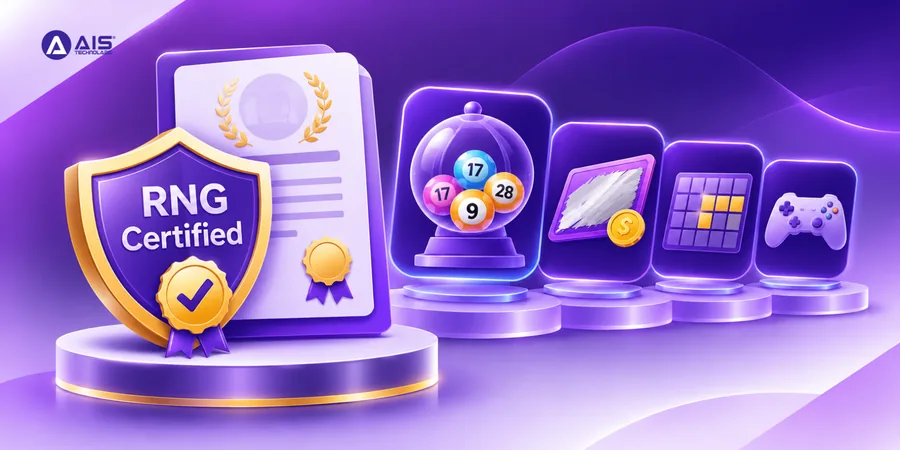
Certification is not a single checkbox that covers every lottery product an operator runs. Draw-based games are typically certified on both the RNG and the draw procedure itself, since the draw is a public, witnessed event.
Instant-win and digital scratch-card games are certified on the RNG plus the specific payout table in use, meaning a new prize structure can require a fresh review even on an already-certified RNG. Keno sits closer to draw-based certification because of its frequent, scheduled draws.
Skill-based lottery products may need an additional review of the skill-assessment logic on top of standard RNG certification.
The labs that perform this testing are independent of both the operator and the regulator. GLI (Gaming Laboratories International) is the most widely recognized name in RNG and game-logic certification across US and international lottery and gaming markets.
iTech Labs and eCOGRA both test RNG randomness and payout-table accuracy and are commonly accepted across multiple jurisdictions. BMM Testlabs is another long-established independent testing lab used for RNG and game-certification work in regulated gaming markets.
As Track360's draw-integrity guide explains, a certified RNG (tested under a standard like GLI-19) and an eCOGRA or iTech Labs seal both function the same way for the player: proof that an accredited, independent lab verified the randomness and the regulator accepted that certificate, rather than the operator’s own word. We have not identified any specific certification held by AIS Technolabs’ own platform, so we’re not claiming one here.
What an operator should confirm with any vendor is which lab certified which specific game type. A single RNG certificate rarely covers every product on the platform.
| Game type | What gets certified | Typical certification focus |
|---|---|---|
| Draw-based | RNG + draw procedure | GLI-19 style RNG testing, witnessed/audited draw |
| Instant-win | RNG + payout table | RNG randomness, payout-table accuracy (GLI, iTech Labs, eCOGRA, BMM) |
| Digital scratch-card | RNG + payout table (pre-reveal result) | Same as instant-win, plus proof result predates the animation |
| Keno | RNG + draw procedure (high frequency) | Similar to draw-based, tuned for rapid draw cycles |
| Raffle | Ticket-cap integrity + odds disclosure | Accurate ticket-count tracking, advertised-odds accuracy |
| Skill-based | RNG/chance component + skill-assessment logic | Standard RNG certification plus an auditable skill module |
Which Game Types Actually Perform Best? (With Real Data)
Operators often assume draw-based lottery, the jackpot-headline product, drives the most revenue. The actual sales data says otherwise, consistently, across states and years.
This is published industry data, not AIS Technolabs' own research. We're citing it precisely so you can verify it yourself rather than take our word for it.
In Florida, one of the largest and most mature US lotteries, scratch-off games accounted for nearly 74% of the state lottery's total $9.63 billion in FY2025 sales, according to NASPL Insights. That is not an outlier.
Industry-wide, instant scratch tickets made up roughly 65.3% of the $96.2 billion in total US lottery sales in FY2025 ($62.8 billion of the total), against 33.3% for draw games, per NASPL figures reported by ScratchCheck. Looking across a longer historical window, scratch and instant games have typically produced somewhere between 60% and 75% of total US lottery revenue year over year, per industry reporting from LotteryUSA.
The practical takeaway for an operator building a platform from scratch: a lottery product that launches with only a draw-based jackpot game, however exciting the marketing, is launching without the product type that actually carries most of the industry's revenue. Instant-win and digital scratch-card capability belongs in a platform's first release, not a “phase two” add-on.
Real Operators Running Multiple Game Types
Theory aside, several US state lotteries already run draw-based, instant-win, and Keno-style products on one platform. Their rollout sequencing is instructive for any operator planning the same mix.
Michigan Lottery was the first American lottery to launch iLottery with eInstants, going live in August 2014, and was only the fourth lottery globally to do so at the time, per NASPL Insights' ten-year retrospective. Michigan added online draw-game sales (including Powerball and Mega Millions) in 2016, two years after its instant-win launch, per PlayMichigan's gambling history timeline.
That two-year gap confirms instant-win and draw-based products were deliberately sequenced rather than launched together.
Pennsylvania iLottery launched its online games in 2018, offering instant-win style games playable on computer, tablet, or mobile with prizes up to $600,000, according to the official Pennsylvania Lottery announcement. PA iLottery has since expanded its online draw-game and instant-win catalog substantially, run alongside its existing retail network.
Virginia Lottery launched its iLottery program on July 1, 2020, and the launch was described by platform partner NeoPollard Interactive as one of the most successful iLottery launches on record at the time, per coverage reported by CasinoCityTimes. Virginia's online catalog combines instant-win games with draw-game ticket purchasing, run alongside its long-standing retail and Keno presence.
The common pattern: none of these three states launched every game type simultaneously. Each sequenced instant-win first or alongside a narrower draw-game set, then expanded once the platform, player base, and regulatory relationship were proven.
How to Choose the Right Game Mix for Your Platform
There is no universal “correct” game mix. The right combination depends on four practical factors, and skipping any one of them is how operators end up building (and certifying) a product nobody in their market actually wants.
Target market matters first: a market with an established retail lottery culture tends to respond well to Keno and draw-based products that mirror what players already know. Newer or digital-first markets often convert better on instant-win and digital scratch-card products that reward instantly.
Player demographics shift the mix again. Younger, mobile-first players generally favor the fast, instant-win style of play, while an established retail player base often prefers the familiar draw-based format.
Regulatory environment can outright decide the question for you, since some jurisdictions license draw-based and instant-win products on different timelines or with different ownership and sourcing rules. That affects what you can launch first regardless of player preference.
Finally, existing platform capabilities should shape sequencing the same way Michigan, Pennsylvania, and Virginia sequenced theirs: launch the game type your current engine and licensing position can support well today. Expand once that foundation is proven, rather than trying to certify every game type in one release.
Not sure which game mix fits your market? Talk to AIS Technolabs.
How AIS Technolabs Supports Multi-Game-Type Lottery Platforms
Running draw-based, instant-win, digital scratch-card, and Keno products on one platform means the underlying engine has to support multiple certification paths, multiple payout-table structures, and multiple draw-scheduling cadences without becoming six separate systems to maintain. That is the core engineering problem AIS Technolabs works on with lottery and Keno operators.
It means a platform architecture flexible enough to add a new game type without rebuilding the player account, payments, and reporting layers underneath it. Our lottery software providers page covers the full platform scope.
Our lotto software page focuses specifically on draw-based lotto builds, and our Keno games software page covers the high-frequency draw engine Keno needs.
Two published projects show this in practice. Our lottery software case study and the LuckyDraw online lottery platform case study both document real platform builds rather than hypothetical capability claims.
If you're planning a multi-game-type lottery platform and want to see what the engineering conversation actually looks like, request pricing or discuss your project with AIS Technolabs directly.
Conclusion
Online lottery is not one product with six skins. Draw-based, instant-win, digital scratch-card, Keno, raffle, and skill-based lottery games each need a different draw or payout engine, a different certification path through labs like GLI, iTech Labs, eCOGRA, or BMM, and a different place in your licensing conversation.
The sales data backs this up plainly: instant-win and scratch-style games, not draw-based jackpots, carry the majority of real-world lottery revenue, often 60 to 75% of total sales industry-wide. Operators like Michigan, Pennsylvania, and Virginia prove multiple game types can run on one platform, but only when sequenced deliberately against market readiness and regulatory timelines, not launched all at once.
Choosing the right mix starts with your market, your players, and your regulator, not with copying another operator's catalog. Talk to AIS Technolabs about your lottery platform to plan the game mix and the build sequence together.
Disclaimer
This article is for general informational purposes. Licensing and RNG certification requirements vary by jurisdiction and change over time; confirm current requirements with your regulator and a qualified testing lab (such as GLI, iTech Labs, eCOGRA, or BMM) before launch.
Sales and launch figures cited above are drawn from the named third-party sources (NASPL, NASPL Insights, ScratchCheck, LotteryUSA, La Fleur's, PlayMichigan, the official Pennsylvania Lottery, CasinoCityTimes, and Track360) and were accurate as of publication; verify current figures directly with those sources. AIS Technolabs does not hold out any specific RNG or game-testing certification on its own platform in this article.
FAQs
Six core types run on modern online lottery platforms: draw-based (pick numbers, scheduled draw), instant-win (result on purchase), digital scratch-card (RNG result revealed through a scratch animation), Keno (frequent number-draw games), raffle (fixed ticket pool, single draw), and skill-based lottery (a skill element affects the win or prize tier). Most large multi-game platforms, including Michigan, Pennsylvania, and Virginia's state lotteries, run several of these types side by side rather than offering just one.
Instant-win and digital scratch-card games consistently generate the largest share of lottery revenue. Industry-wide, scratch and instant games made up roughly 65.3% of the $96.2 billion in total US lottery sales in FY2025, according to NASPL data reported by ScratchCheck, and in Florida specifically, scratch-offs reached nearly 74% of the state's $9.63 billion in FY2025 sales per NASPL Insights.
Draw-based jackpot games generate headlines, but instant-win products generate the bulk of day-to-day revenue.
Generally, yes, in practice. A draw-based lottery's certification covers the RNG and the draw procedure itself, since draws are scheduled, public events.
An instant-win game's certification covers the RNG plus the specific payout table it draws against, and a new payout table can require its own review even if the underlying RNG is already certified elsewhere on the platform. Labs like GLI, iTech Labs, eCOGRA, and BMM handle this testing independently of the operator and the regulator.
Yes, and several real state lotteries prove it. Michigan launched instant-win eInstants in 2014 and added online draw games in 2016; Pennsylvania's iLottery (2018) and Virginia's iLottery (2020) both combine instant-win and draw-game sales on one platform alongside Keno and retail.
The technical requirement is a platform architecture that supports multiple certification paths and payout structures without duplicating the player account, payments, and reporting layers for each game type.
Both use a certified RNG and a scheduled draw, but Keno's draws happen far more frequently, often every few minutes, from a larger number pool (typically 1 to 80), while draw-based lottery (like Powerball-style games) draws daily, weekly, or multi-weekly from a smaller number range. Keno's high draw frequency means its draw-scheduling and results-propagation systems need to handle much higher throughput than a traditional draw-based lottery engine.

Mary Smith excels in crafting technical and non-technical content, demonstrating precision and clarity. With careful attention to detail and a love for clear communication, she skillfully handles difficult topics, making them into interesting stories. Mary's versatility and expertise shine through her ability to produce compelling content across various domains, ensuring impactful storytelling that resonates with diverse audiences.
Don't Just Plan Your Gaming Business. Build It.
Get the right technology to build and grow your iGaming business.
- Custom-Built Solutions
- Complete Technical Support
- Secure Architecture
Share your project requirements and discover the right iGaming solution for your business.
Connect with Our Experts ASIA PACIFIC