Table of Content
Key Takeaways
- A casino platform quote prices year one. Build vs buy only becomes a real comparison across a 3-year total cost of ownership window, because the three paths diverge most in years two and three, not at signing.
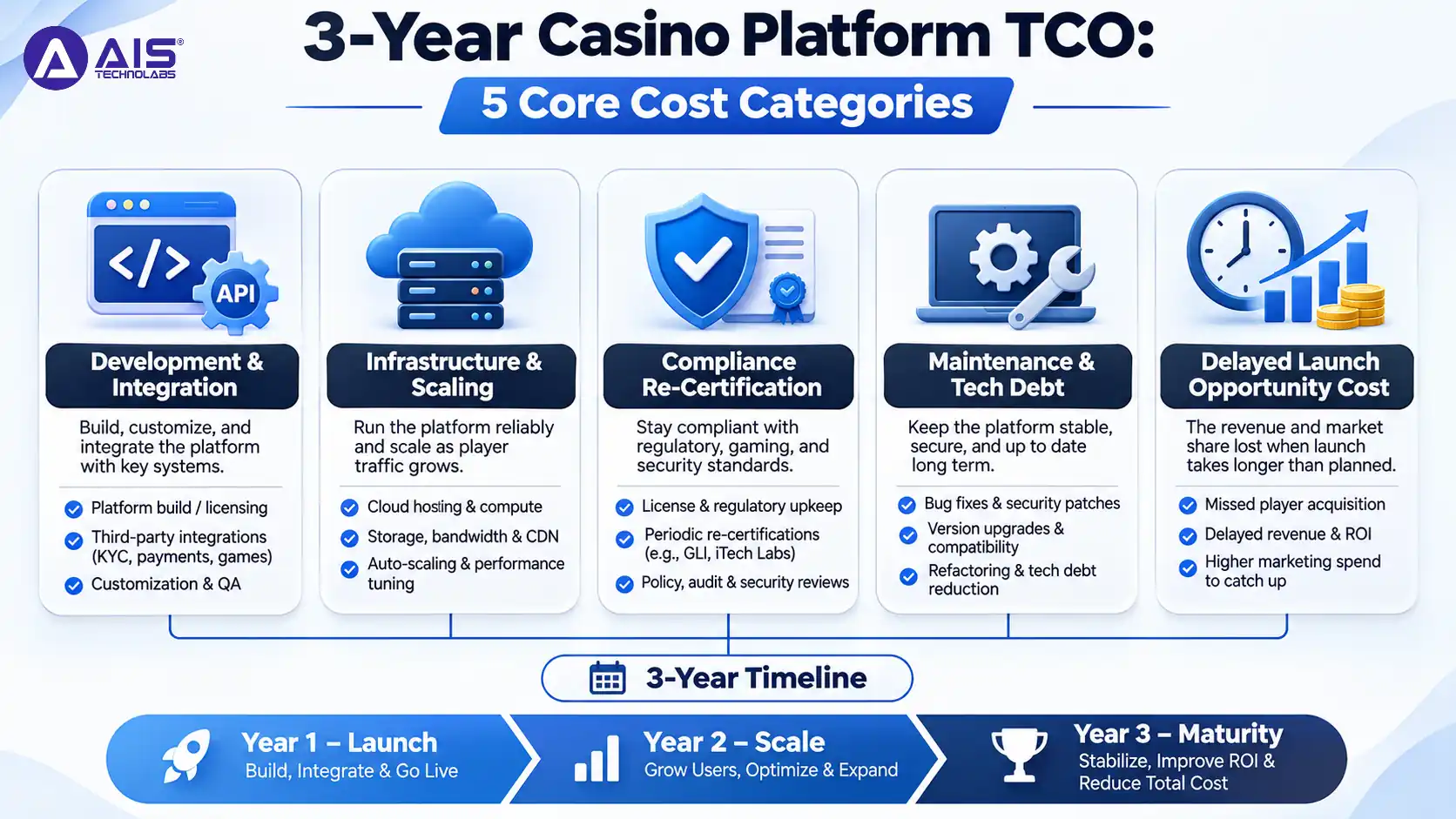
- Five cost categories decide the real number: development and integration, infrastructure and scaling, compliance re-certification, maintenance and technical debt, and the opportunity cost of a delayed launch.
- Custom build, white-label rental, and turnkey buy each win on a different category. None of the three is cheapest on every line, so the right answer depends on which categories matter most to your launch.
- The biggest hidden cost in a "build" plan is almost never the initial development quote. It is the ongoing maintenance and re-certification load a vendor already absorbs across many clients, and a single operator has to absorb alone.
- Comparing a license-fee vendor against a revenue-share vendor needs the same 3-year TCO model on both sides, not a side-by-side comparison of two different pricing mechanics.
The Problem With Sticker Price
A development quote and a white-label monthly fee are not the same kind of number, and comparing them directly is how a 3-year decision gets made on a 90-day number.
A custom build quote typically covers design, development, integration and initial testing: the cost of getting to a working platform. A white-label or turnkey quote covers access to an already-built, already-certified platform, usually priced as a setup fee plus an ongoing fee or revenue share. Line them up side by side and the build quote can look larger on day one, because it is carrying work the white-label price has already amortized across every other operator on that platform.
The question that actually matters for a CFO and CTO making this decision jointly is not "which number is smaller today." It is: which path costs less, and launches sooner, across the first three years of running the platform, including the costs that do not show up on an initial quote at all.
That is what a total cost of ownership model is for.
The 5-Category TCO Model
A 3-year TCO comparison holds up only if it prices the same five categories for every path under consideration. Skipping one, usually compliance re-certification or the opportunity cost of a delayed launch, is the most common way a "build" plan ends up looking cheaper on paper than it turns out to be in year two.
Development & Integration
This is the category every quote already covers, so it is the easiest one to compare and the least likely to surprise anyone. For a custom build, it is the full design-to-launch cost: architecture, game and payment integrations, RNG and compliance work, QA, and initial deployment. For white-label and turnkey paths, it is a setup or customization fee layered onto an existing platform.
Live-dealer content is a useful stress test for this framework on its own: building and certifying a live studio integration in-house rarely clears the TCO bar against licensing it through an existing live casino software provider. Walk that one line item through the model first.
Infrastructure & Scaling
A custom build carries its own hosting, uptime, DDoS protection and capacity planning from day one, and those costs scale with player volume whether or not revenue scales at the same rate. A white-label or turnkey platform usually bundles infrastructure into the ongoing fee, so the operator's scaling cost is closer to a step function (a new pricing tier) than a continuous engineering bill.
The TCO question here is not "which is cheaper at current volume." It is "what does each path cost at 3x current volume," because that is the scenario that actually tests an infrastructure decision.
Compliance Re-Certification
Every path needs initial certification, but the paths diverge sharply on what happens after launch. A custom-built platform re-certifies on the operator's own schedule and the operator's own budget line, every time a regulator updates a requirement or the operator enters a new jurisdiction. A white-label or turnkey platform usually re-certifies once, centrally, and that cost is spread across every operator on the platform.
Compliance re-certification costs vary meaningfully by jurisdiction and licensing regime, and they change as regulations are updated, so confirm current requirements with your compliance counsel or licensing advisor before building this line item into a 3-year budget. Treat the number in this section as a category to model, not a figure to copy.
Maintenance & Tech Debt
A platform that launches clean in year one still needs security patches, dependency upgrades, and bug fixes in years two and three, and a custom build puts all of that on the operator's own engineering team, indefinitely. A white-label or turnkey vendor spreads that same maintenance cost across every client on the platform, which is usually why its ongoing fee looks small next to a custom build's year-one quote and larger next to that same build's year-three maintenance bill.
This is the category most "build" proposals underweight, because a maintenance budget is easy to defer in a project plan and hard to defer once the platform is live and a regulator, a payment provider, or a player-facing bug forces the issue.
Opportunity Cost of Delayed Launch
A custom build's timeline risk is a real cost, not a scheduling inconvenience. Every month between "decision made" and "platform live" is a month of player acquisition, marketing spend and market position the operator does not get back, and custom builds slip timelines more often than configuration-based launches do.
Model this category in revenue terms, not just in months: what does a 3-to-6-month delay cost in lost player acquisition and market position in your specific market, not in the abstract. For a fast-moving market or a licensing window that will not reopen, this single category can outweigh every other line in the model.
Where Each Path Wins
No path wins on every category, which is why a scoring model beats a single "which is cheaper" headline.
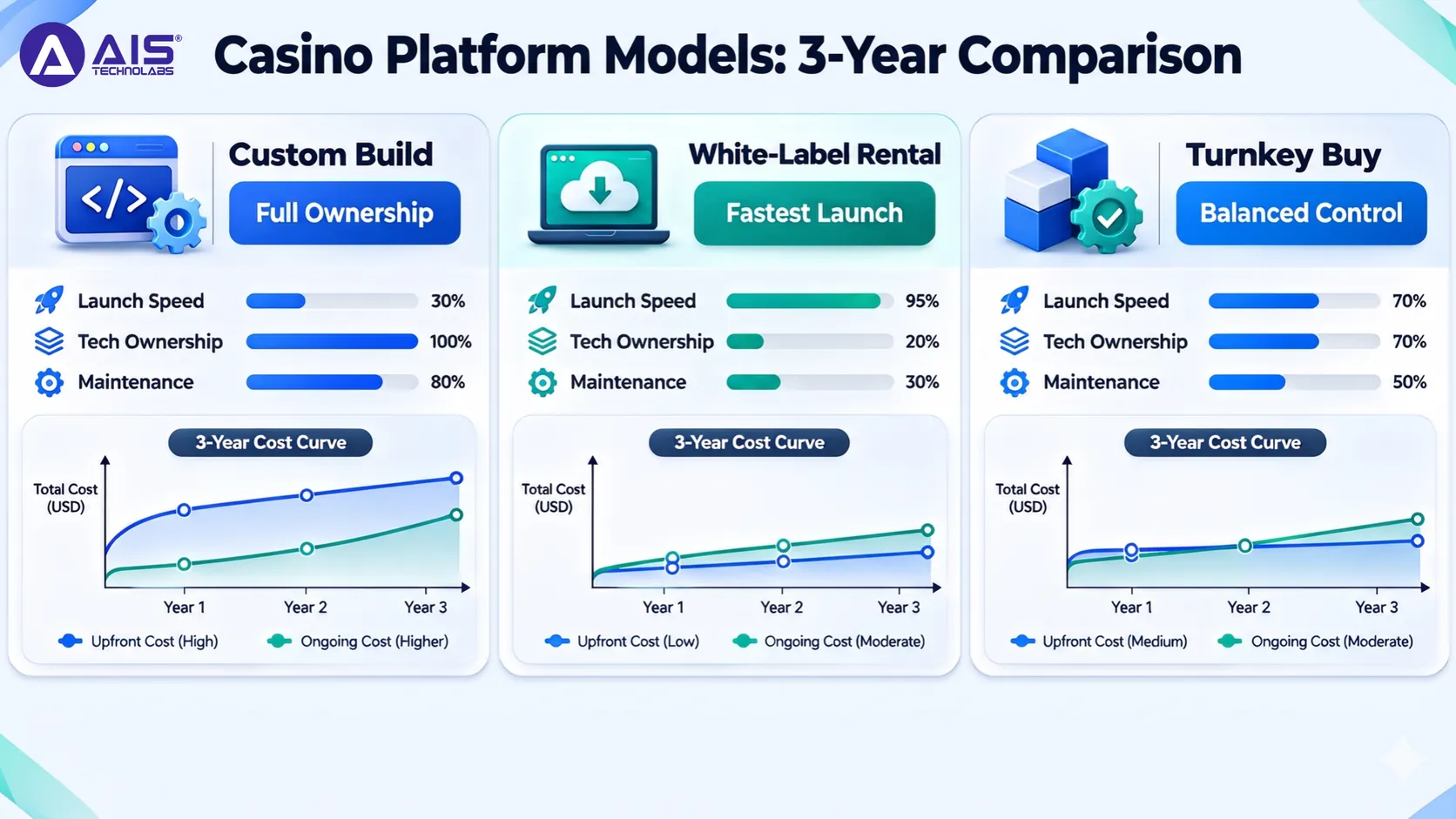
Custom build tends to win on long-term ownership and the ability to build genuinely unique functionality, and it tends to lose on development and integration cost, maintenance load, and timeline risk. It is the strongest fit for an operator with a long-term product roadmap, proprietary systems to integrate, or requirements no existing platform configuration can meet.
White-label rental tends to win on speed to launch, predictable ongoing cost, and centrally handled maintenance and re-certification, and it tends to lose on long-term ownership and the ceiling on how far customization can go. It is the strongest fit for a new operator or a new brand under an existing operator that needs to be live fast and iterate from there.
Turnkey buy (including rent-to-buy structures) sits between the two: it usually offers more ownership than a pure rental model, with less timeline and maintenance risk than a ground-up custom build. It is the strongest fit for an operator that wants a path toward owning its technology without carrying 100% of the development and maintenance cost from day one.
Whichever path the framework points you toward, price it against a real quote: ask any casino software provider you're evaluating to break out exactly these cost lines, not one bundled number. A vendor that cannot or will not break a quote into development, infrastructure, compliance, maintenance and launch-timeline components is a vendor whose pricing you cannot actually model.
Hidden Build Costs to Watch
A handful of specific omissions are responsible for most "build" plans that look artificially cheap next to a white-label or turnkey quote. Check for all five before trusting a build estimate.
- No maintenance budget past launch. A development quote that stops at "go-live" is pricing one-third of a 3-year TCO model, not the whole thing.
- No re-certification line for future regulatory changes. A quote priced against today's requirements in today's markets will miss the next licensing renewal or jurisdiction expansion entirely.
- No infrastructure cost at scale. A hosting estimate sized for launch-day traffic, not 3x that volume, understates the category that tends to grow fastest.
- No dedicated resourcing for security patching and dependency upgrades. "The dev team will handle it" is not a budget line; it is a staffing assumption that competes with every other engineering priority once the platform is live.
- No timeline-risk adjustment. A build estimate that assumes zero schedule slippage is pricing the best case, not the likely case, and the opportunity-cost category above is exactly where that optimism gets expensive.
Scoring Worksheet
Score each path from 1 (weak fit) to 5 (strong fit) on each category, based on your own numbers and your own timeline, not a generic industry average. The category weighting should reflect what matters most for your launch: a fast-moving licensing window weighs opportunity cost heavily; a long product roadmap weighs ownership heavily.
| TCO Category | Custom Build | White-Label Rental | Turnkey Buy |
|---|---|---|---|
| Development & integration cost | Score 1 to 5 | Score 1 to 5 | Score 1 to 5 |
| Infrastructure & scaling cost | Score 1 to 5 | Score 1 to 5 | Score 1 to 5 |
| Compliance re-certification cost | Score 1 to 5 | Score 1 to 5 | Score 1 to 5 |
| Maintenance & tech debt cost | Score 1 to 5 | Score 1 to 5 | Score 1 to 5 |
| Opportunity cost of delayed launch | Score 1 to 5 | Score 1 to 5 | Score 1 to 5 |
| Weighted total |
Fill in a 1-to-5 score per cell, multiply by your own category weighting, and total each column. The path with the highest weighted total is the one your own numbers support, not the one with the lowest number on a single vendor quote.
Disclaimer
Compliance and licensing requirements vary by jurisdiction and change over time. The categories and worksheet above are a planning framework, not legal or regulatory advice; confirm current compliance and re-certification requirements with your own licensing counsel before finalizing a budget.
FAQs

Mary Smith excels in crafting technical and non-technical content, demonstrating precision and clarity. With careful attention to detail and a love for clear communication, she skillfully handles difficult topics, making them into interesting stories. Mary's versatility and expertise shine through her ability to produce compelling content across various domains, ensuring impactful storytelling that resonates with diverse audiences.

Don't Just Plan Your Gaming Business. Build It.
Get the right technology to build and grow your iGaming business.
- Custom-Built Solutions
- Complete Technical Support
- Secure Architecture
Share your project requirements and discover the right iGaming solution for your business.
Connect with Our Experts ASIA PACIFIC