Table of Content
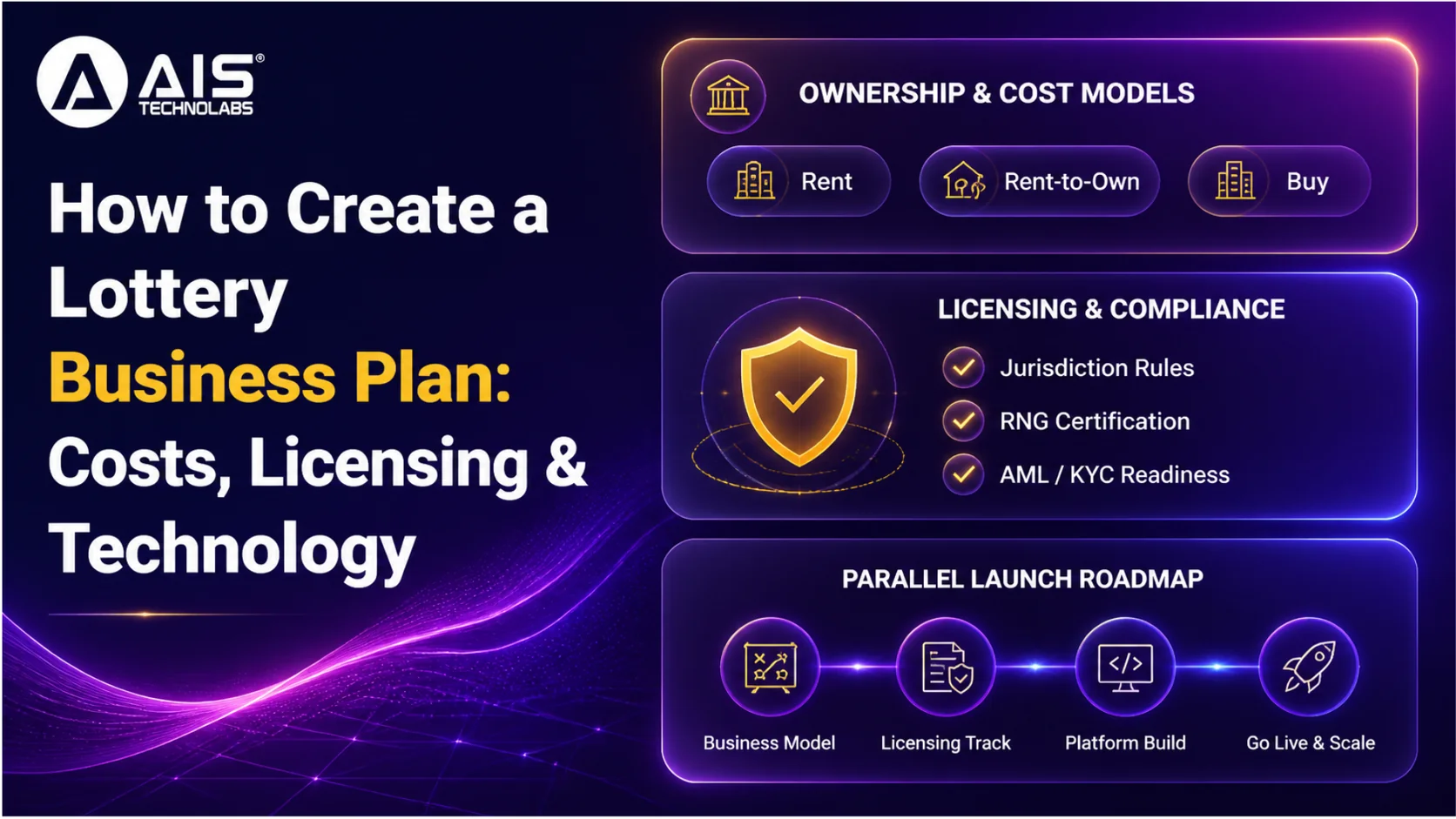
Most lottery business plans fail for the same reason: they are built around a single software quote instead of a real cost and compliance picture. An operator gets a number from a vendor, drops it into a template built for a generic retail business, and only discovers the gaps, a licensing timeline that outlasts the funding runway, a platform cost that was never scoped past year one, after the plan is already in front of investors or a regulator.
This guide builds a lottery business plan the way a gambling technology provider actually sees the decision: what a licensor and an investor both need answered, what a lottery platform really costs across three different ownership models, and where the line sits between what your technology provider can promise you and what only a regulator can.
What a Lottery Business Plan Actually Needs to Answer
A lottery business plan is a working document, not a pitch deck. Its job is to force four decisions into writing before money moves: which lottery business model you are running, which jurisdiction's rules apply to you, what the platform will actually cost across its first few years, and how you will acquire and keep players once you launch.
The five questions investors and licensors both ask
Both audiences converge on the same five questions, asked for different reasons.
What exactly are you selling, and to whom. A draw-based online lottery, a syndicate product, and a charity raffle are different businesses with different licensing paths.
What does it cost to launch and to keep running, not just to build.
What license do you hold or need, and in which jurisdiction.
How does the business make money, and from which revenue lines.
What happens if a core assumption is wrong, fraud, a payment failure, a licensing delay.
Why a generic template falls short for a regulated gambling product
A standard small-business plan template assumes you control your own compliance timeline. A lottery business does not. Licensing review windows, RNG certification, and AML/KYC obligations sit outside your control and directly gate your launch date, your technology budget, and your revenue model. A plan that treats these as a single checkbox line item, rather than as cost and schedule drivers in their own right, is the single most common reason a lottery business plan underestimates both its budget and its timeline.
Choosing Your Lottery Business Model
The model you choose determines almost everything downstream: licensing scope, platform requirements, and revenue structure.
Online platform vs. retail vs. hybrid
A pure online lottery platform sells and settles digitally end to end, which concentrates your technology and compliance requirements but removes retail infrastructure costs. A retail-based model shifts cost toward physical distribution and point-of-sale integration. A hybrid model, retail sales with a digital player account layer, is increasingly common because it lets an operator add digital convenience without rebuilding distribution, but it also means budgeting for both sides of the business.
Syndicate, raffle, charity, and blockchain-based models, briefly
Beyond the three structures above, several narrower models are worth naming because they change your plan's revenue and compliance sections differently: syndicate platforms (pooled ticket purchasing, revenue from membership or service fees), raffle and charity lotteries (often a distinct, lighter-touch licensing category, since a share of proceeds funds a stated cause), and blockchain-based lottery products (provably fair draw mechanics as a trust feature, with their own additional technical and in some jurisdictions regulatory considerations). Each deserves its own line in your plan rather than being folded into "online lottery" as if the economics were identical.
Lottery Licensing and Compliance, What's Actually Required
Jurisdiction shapes everything else in the plan
Licensing requirements vary by jurisdiction in scope, cost, and timeline, and that variation is exactly why this section of your plan should be jurisdiction-specific rather than generic. Typical requirements across regulated lottery markets include an operating license from the relevant gaming authority, RNG certification for any draw mechanism, and AML/KYC procedures for player onboarding and payouts. Confirm the current requirements for your specific jurisdiction before you budget or schedule against them; licensing rules change, and a plan built on last year's requirements is a plan built on the wrong numbers.
What your technology provider can and can't promise you
This is worth stating plainly, because most lottery business plan guides blur it: a technology provider can build a platform that meets a jurisdiction's technical requirements (certified RNG, audit logging, AML/KYC tooling, responsible gaming controls), and can often point you toward the licensing process. A technology provider cannot guarantee you a license, a regulatory approval, or a legal right to operate. That decision sits with the regulator, informed by your own legal counsel. Any plan, or any vendor conversation, that implies otherwise is a plan built on a false assumption. Budget separately for qualified legal and licensing counsel; treat your technology vendor's role as technical readiness, not regulatory guarantee.
The Real Cost of Starting a Lottery Business: Buy, Rent, or Rent-to-Own
Why a single "it costs $X" number is misleading
Most lottery business plan guides answer the cost question with one flat number or a single tier list. That number hides the real decision, which is not "how much" but "under which ownership model." A rented platform, a purchased platform, and a rent-to-own path carry very different upfront costs, ongoing costs, and long-term ownership outcomes, and your plan should model the one that actually fits your capital position, not the one that was quoted first.
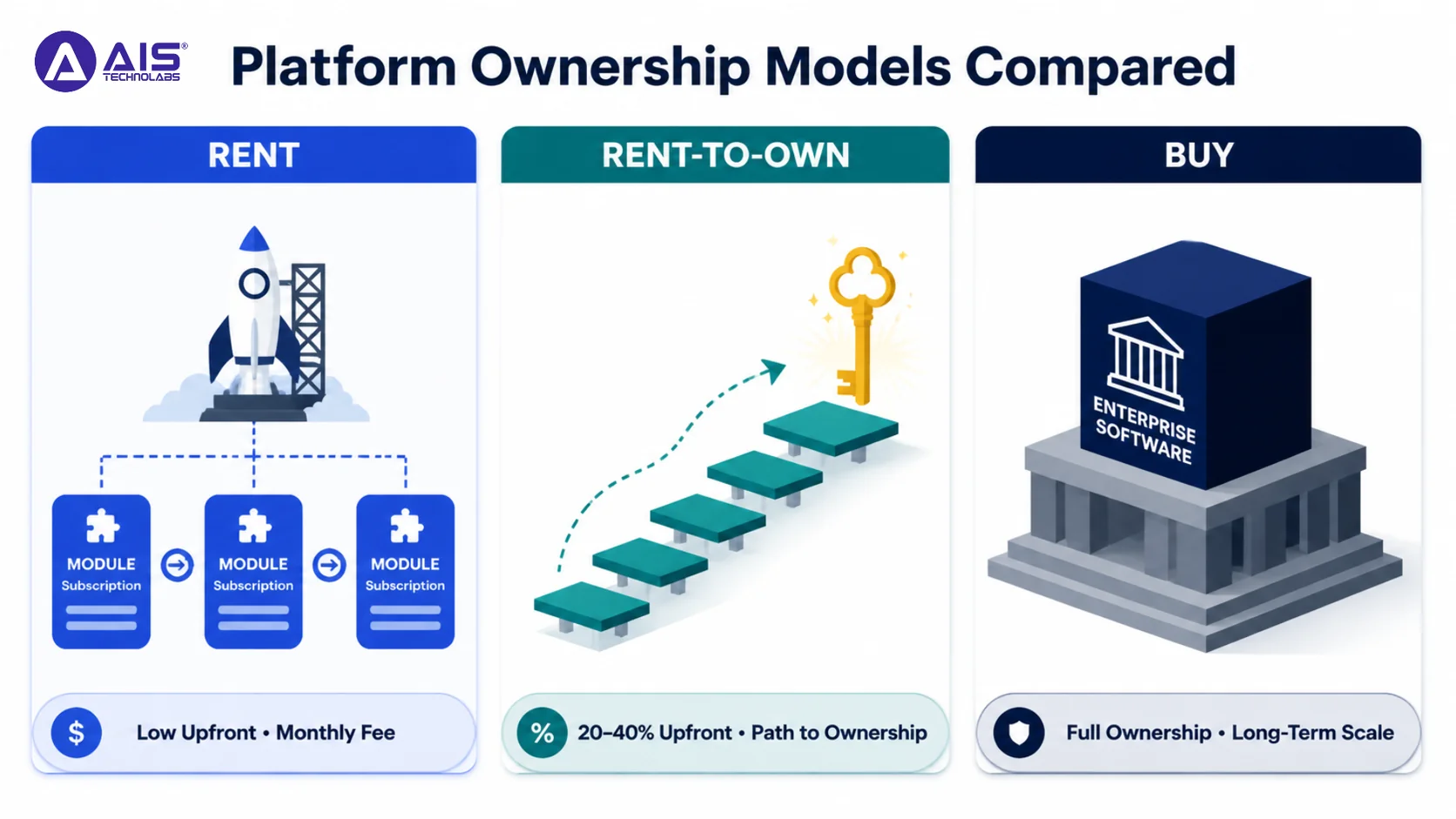
The three engagement models compared
The ranges below are general gambling-platform industry-benchmark ranges, drawn from AIS Technolabs' commercial documentation. They describe typical market structure across gambling technology engagements broadly, not a lottery-specific or guaranteed AIS quote. Use them to understand the shape of the decision, then get a scoped quote for your actual requirement.
| Model | Best for | Typical structure |
|---|---|---|
| Rent | New operators, MVP and initial-market launches, lower upfront investment | Entry: $2,000 to $5,000/month. Mid-market: $5,000 to $15,000/month. Enterprise: $15,000 to $50,000+/month |
| Buy | Established operators, long-term ownership, enterprise projects | Single game: $3,000 to $25,000. Full platform: $25,000 to $150,000. Full ecosystem: $100,000 to $500,000+ |
| Rent-to-Own | Operators who want to launch now and move toward ownership on a predictable schedule | Typically 20 to 40% upfront, 12 to 36 month term, with rental payments credited toward ownership |
A worked example, how to read the model, not copy a price
Take a rent-to-own structure sized at a $60,000 platform value: a $15,000 upfront payment, $2,000 monthly payments, over a 24-month term. The point of this example is not the dollar figures, which will not match your scope, but the shape of the trade-off: lower upfront cost, a predictable monthly number you can model against projected revenue, and a defined path to ownership instead of an open-ended rental. Build your own version of this table with a vendor who will show you where your specific requirement lands, rather than budgeting against someone else's example.
For how this same decision plays out on the casino side of the business, the same build-vs-buy math applies across casino platforms too, and for the lottery-specific version of the buy-vs-build question, the buy-vs-build decision deserves its own look.
Weighing rent, buy, or rent-to-own for your own lottery platform? Discuss Your Gambling Project with AIS Technolabs and get a scoped breakdown instead of a flat quote.
Technology Requirements Your Plan Must Budget For
Core platform capabilities
At minimum, a lottery platform needs: a certified random number generator for any draw mechanism, draw and prize distribution management, payment system integration, player account management, CRM for player behavior and retention, and reporting built for regulatory audit, not just internal analytics. Treat each of these as its own budget line rather than a single "platform" cost, since the cost and complexity of each varies by jurisdiction and by the games you plan to run.
What's often missing from first-draft budgets
The most common gaps in a first-draft lottery business plan are ongoing compliance work (licensing is not a one-time cost; audits, reporting, and rule changes recur), scaling costs as player volume grows past your initial infrastructure sizing, and ongoing technical support. A platform budget that only covers initial build and launch, with nothing allocated past month one, is the single most common reason a lottery business plan runs out of runway before it runs out of market opportunity.
Working through this is easier against a real build than in the abstract; see how that plays out in a real lottery software build, and when you are ready to scope your own requirement against a lottery software provider that can show you exactly where each of these costs lands, that conversation will sharpen every number in this section of your plan.
Revenue Model and Financial Projections
Where lottery revenue actually comes from
Lottery revenue typically comes from some combination of: ticket sale commissions or margins, subscription or recurring-play products, syndicate membership or service fees, affiliate and partner revenue, advertising, and premium membership tiers. Which of these apply to you depends directly on the business model you chose earlier in this plan; a syndicate platform's revenue structure looks nothing like a draw-based online lottery's.
Building a realistic 1, 2, and 5-year projection
Build your projection as a framework, not a guess: start from your chosen revenue lines, apply a conservative player acquisition estimate for year one based on your actual marketing budget (not an industry-wide average), layer in your real platform and compliance costs from the sections above, and stress-test the result against a slower-than-expected licensing timeline. A projection that only works if licensing clears on schedule and player acquisition hits an optimistic target is not a projection, it is a best case. Model the best case and a conservative case side by side, and plan your runway against the conservative one.
Go-to-Market and Growth
Marketing channels that fit a regulated product
Lottery marketing operates inside the same regulatory boundaries as the product itself. SEO, affiliate marketing, PPC, influencer partnerships, referral programs, push notifications, and CRM-driven retention campaigns are the common channel set, but each needs to be checked against your jurisdiction's advertising rules for regulated gambling products before it goes into the plan, not after.
Retention, the metric most first-time plans underweight
Most first-time lottery business plans put nearly all of their marketing budget and attention into acquisition and treat retention as an afterthought. In a recurring-play business like a lottery, retention economics usually matter more than acquisition cost alone: a platform with strong CRM-driven retention and a responsible gaming framework that keeps players engaged safely will outperform one that only optimizes for first-ticket sales. Build a retention budget and a retention metric into your plan from the start, not as a year-two addition.
From Plan to Vendor: A Lottery Software Evaluation Checklist
Your business plan's job is to turn into a real vendor conversation. Use it to ask sharper questions, not just to collect quotes.
Questions to ask any lottery software provider before you sign
- Which of the three ownership models (rent, buy, rent-to-own) do you offer, and what changes in each?
- What is certified, and by whom, specifically the RNG and any compliance tooling?
- What is included in the platform cost, and what is billed separately once you are live (support, scaling, compliance updates)?
- Can you show a real build for a business model close to mine, not just a feature list?
- What happens to my data, my source code, and my ownership rights under each engagement model?
- What is your role in my licensing process, and what is explicitly not your role?
A vendor who answers all six clearly, including the honest limits of what they can promise on licensing, is giving you a plan-ready answer. A vendor who only answers the first one is giving you a sales answer.
A Lottery Business Launch Roadmap
Tie the roadmap back to the plan you have just built, rather than treating it as a separate checklist.
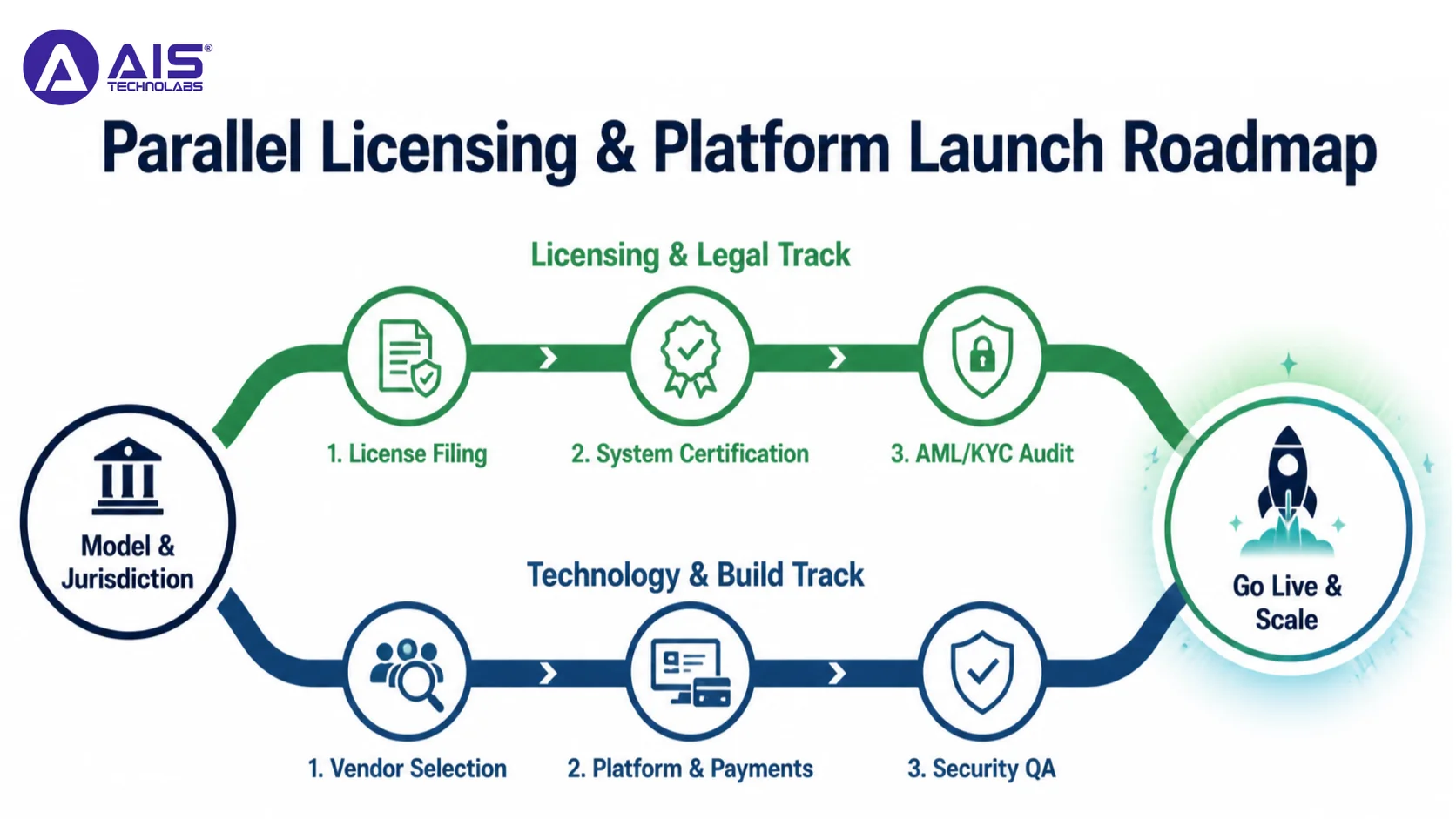
- Research and model selection: confirm your business model and jurisdiction, using the decisions from the sections above.
- Licensing: begin your licensing application in parallel with technology planning, not after it, since licensing timelines usually run longer than development timelines.
- Technology selection: choose your ownership model and vendor using the evaluation checklist above.
- Development and testing: build or configure your platform against the technology requirements you budgeted for, and test against your actual compliance obligations, not just functional requirements.
- Pre-launch compliance review: confirm licensing, RNG certification, and AML/KYC readiness before committing to a launch date.
- Launch: go live against the financial projection's conservative case, not the best case.
- Scale: revisit your retention metrics, compliance obligations, and platform scaling costs at a fixed interval, not only when something breaks.
FAQs
Building a lottery business plan and want it checked against a real cost and technology framework? Request a Consultation with AIS Technolabs' gambling technology team.

Mary Smith excels in crafting technical and non-technical content, demonstrating precision and clarity. With careful attention to detail and a love for clear communication, she skillfully handles difficult topics, making them into interesting stories. Mary's versatility and expertise shine through her ability to produce compelling content across various domains, ensuring impactful storytelling that resonates with diverse audiences.


Don't Just Plan Your Gaming Business. Build It.
Get the right technology to build and grow your iGaming business.
- Custom-Built Solutions
- Complete Technical Support
- Secure Architecture
Share your project requirements and discover the right iGaming solution for your business.
Connect with Our Experts ASIA PACIFIC