Table of Content
(503 views)
Published:May 15, 2026 at 7:44 am
Last Updated:5 Jun 2026 , 10:13 am
Key Takeaways:
- Learn how to decide between building AI solutions vs buying AI solutions based on business goals, budget, and scalability
- Understand the impact of build vs buy AI strategy on development speed, cost efficiency, and ROI
- Identify where off-the-shelf AI tools work best, including automation, chatbots, and pre-trained models
- Discover when custom AI development is the better choice for control, flexibility, and differentiation
- Evaluate key risks such as vendor lock-in, maintenance overhead, and integration challenges
- Understand how data security, privacy, and ownership influence AI solution selection
- Explore how businesses can reduce risk by choosing the right AI adoption strategy
- Consider hybrid approaches that combine custom AI development with ready-made AI platforms for optimal performance
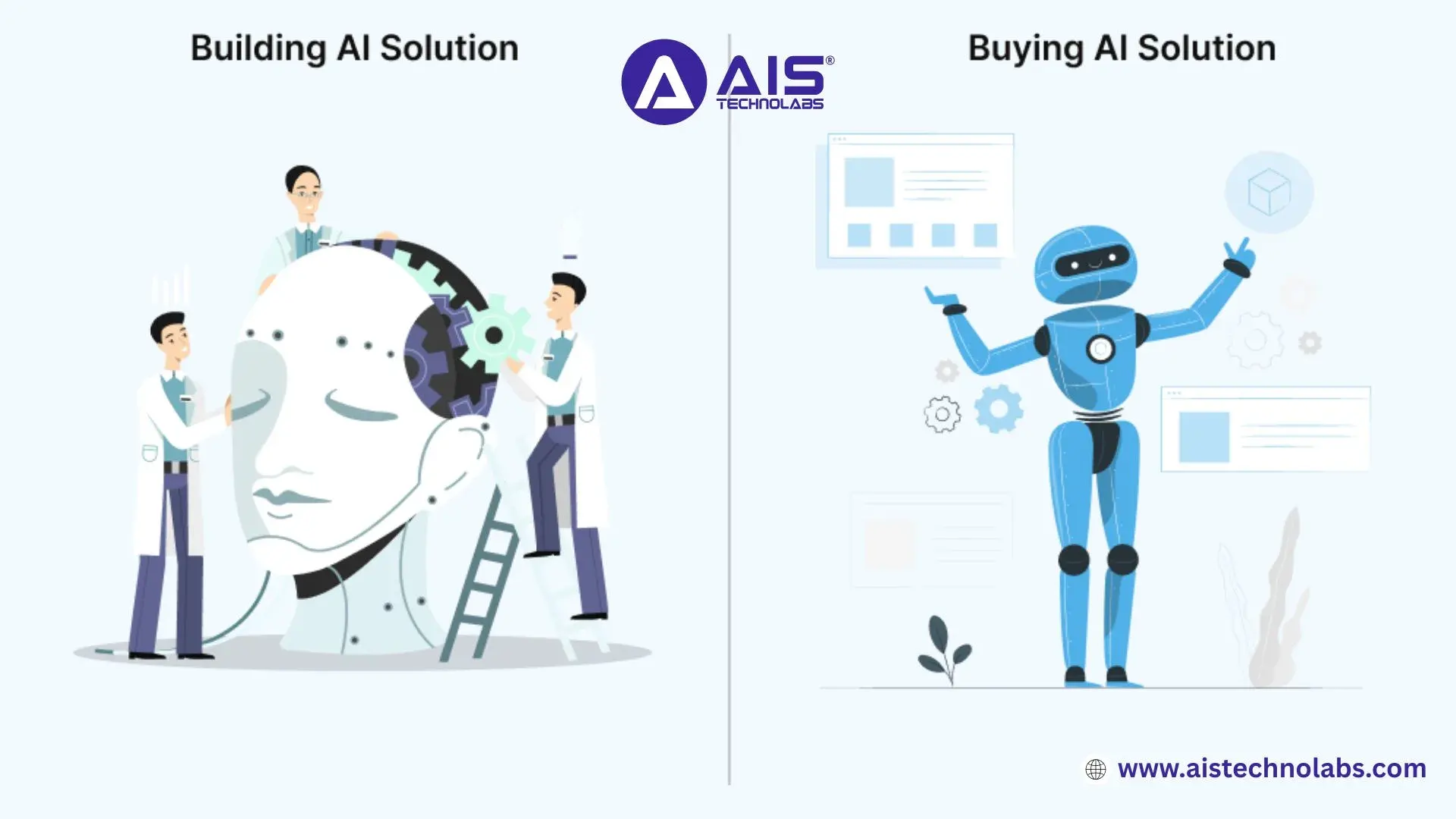
The Build vs Buy Decision in AI
There comes a time when every CTO faces a decision: the need for artificial intelligence within the business, the board’s query regarding your AI strategy, your competitors' products with artificial intelligence already in the market, and eventually someone posing the question, “Do we build our own or simply purchase?” Whether you are exploring this for the first time or revisiting an existing AI stack, connecting with expert AI consulting services early in this process is one of the highest-leverage moves a CTO can make.
This is the build vs buy AI solutions question, and it is deceptively simple on the surface. In practice, it involves a matrix of tradeoffs spanning technical feasibility, data privacy, total cost of ownership, time-to-market, and long-term competitive differentiation. The wrong call doesn't just cost money — it can lock you into architecture decisions that haunt your engineering team for years.
The stakes have also changed dramatically. Two years ago, "buying AI" meant licensing a rule-based automation platform or plugging into a narrow SaaS feature. Today, it means accessing foundation models with hundreds of billions of parameters, integrating multimodal APIs, and potentially deploying on-premise large language models. The build vs buy AI solutions landscape has exploded in complexity — which makes a structured decision framework more critical than ever.
This report was made particularly for those CTOs and other technologists who are dealing with this dilemma in the year 2025. In the following sections, we'll cover when to build, when to buy, how to correctly model costs, and the benefits that you could gain from adopting an integrated strategy. At the conclusion of this discussion, you'll be able to apply this framework to your AI initiatives.
When to Build Custom AI
Building a custom AI solution is not the default right answer — but there are scenarios where it is clearly the correct one. Understanding those scenarios is the first step toward making a defensible architectural decision.
Your Data Is Your Moat
In the case where your competitive advantage comes from proprietary information, whether clinical data, transactional data, user behavior, or industrial sensor information, then building models on such data can give you capabilities that no one else can duplicate. There is no existing generic language model that knows the purchasing history of your customers for the past fifteen years. The foundation model has no idea what your industry-specific jargon means.
When your data is genuinely unique and when AI performance is tightly coupled to that data's richness, building a custom AI solution is not just a preference — it is a strategic imperative.
Regulatory and Data Sovereignty Requirements
In terms of HIPAA for healthcare providers, SOC 2 for financial firms, and FedRAMP for government agencies, sensitive data cannot always be funneled via third-party APIs. If purchasing AI requires that you send sensitive patient data or your financial model algorithms to a server elsewhere, then building your own AI solution is likely going to be your only recourse.
Working with an AI development company that understands these compliance frameworks is often the right move here, giving you the engineering muscle to build securely without assembling an entire internal ML team from scratch.
You Need Deep Workflow Integration
Pre-built AI solutions are designed for the largest potential audience. In situations where there is a need for close integration into your existing infrastructure – bespoke ERPs, custom APIs, unique data schemas – then your off-the-shelf software is going to spend more time working against you than with you.
If your AI needs to be embedded within your process rather than sitting above it, the benefits of custom development begin to stack up quickly.
Long-Term Cost Efficiency at Scale
APIs from leading AI vendors prove to be extremely economical at lower volumes. However, when it comes to high monthly queries into the tens of millions, the token- or call-based pricing of SaaS AI can turn out to be rather expensive. Companies that utilize large volumes of AI inference, such as search engines, personalized recommendation engines, and high-frequency trading algorithms, realize that investing in developing and hosting their own models can pay off in one to two years. This inflection point varies dramatically by use case, but it is a critical factor in the build-vs-buy AI solutions cost model, and we will quantify it more precisely in the cost comparison section.
For a deeper dive on what AI-powered software development looks like in practice, see our blog: Top 10 Insights on AI-Powered Software Development.
Unique Model Behavior Is a Product Feature
For certain enterprises, the behavior of their AI is the product itself. When creating an application native to the AI — such as a legal reasoning engine, a diagnostic assistant, or even a creative writer with a particular style — the behavior of the model is not simply a service offered by the backend. Rather, the behavior of the model becomes part of the user experience itself. In such circumstances, relying on the purchase of a commodity AI and trying to distinguish yourself with prompts becomes a risk.
When to Buy Off-the-Shelf AI
Building is not always the answer — and for many organizations, the smarter path is buying a proven solution and focusing engineering resources on integration and product differentiation.
Speed to Market Is Paramount
When your competitor launched an AI product in the previous quarter while you're still just considering the infrastructure to be built, your time-to-market could be costing you more in terms of market share than the license costs would save. The use of AI development as-a-service providers and platform-as-a-service companies will allow you to cut down those weeks to mere days.
Time to market takes precedence in winner-take-all markets. In such a market, what you need to consider is not whose architecture is better but rather how soon you get there.
You Lack Internal ML Expertise
Building a production-grade AI system requires a very specific blend of skills: machine learning engineering, data engineering, MLOps, evaluation framework design, and model governance. This talent is expensive, scarce, and takes time to hire and onboard. For companies without a pre-existing ML foundation, attempting to build from scratch introduces enormous execution risk.
Buying from an established vendor — or engaging AI consulting services to guide your architecture decisions — gives you access to battle-tested systems and domain expertise without the three-year talent-building journey.
The Use Case Is Commodity
Not every AI use case is a competitive differentiator. Sentiment analysis on customer support tickets, document summarization, meeting transcription, spam filtering, and basic forecasting — these capabilities are useful and valuable, but they are not the reason a customer chooses you over a competitor.
When the AI capability is infrastructure rather than differentiation, buying is almost always the right answer. There is no strategic value in training your own sentiment classifier when perfectly capable solutions exist at a fraction of the cost.
You Are Validating Before Committing
One of the most underrated arguments for buying early is optionality. Before your organization has validated that AI will actually drive the business outcomes you expect, committing to a full custom build is a bet on both the technology and the use case simultaneously. Buying a pre-built solution lets you validate product-market fit, measure actual user adoption, and quantify ROI — all before making the larger investment in custom infrastructure.
Think of buying as a learning accelerator. Once you have proved the value, you have the evidence to justify the build investment. Many successful AI programs follow exactly this arc: buy to validate, then build to differentiate.
You Need Ongoing Research Improvements
Large AI vendors — the hyperscalers and foundation model companies — invest billions in research annually. When you buy their models, you are effectively subscribing to an ongoing improvement curve. A custom model you train today may be state-of-the-art for twelve months before falling behind the capabilities of a foundation model that has been updated with new pretraining data, architectural improvements, or safety fine-tuning.
For capabilities that evolve rapidly, like general reasoning, code generation, or multimodal understanding, buying access to a continuously improved foundation model, including access to mature generative AI development services and tooling, can be more strategically sound than owning a static custom asset.
Cost Comparison – Build vs Buy
Cost is almost always the first question in the build vs buy AI solutions conversation, and it is almost always the least well-analyzed. Most organizations either underestimate the total cost of building or underestimate the long-run cost of buying. Here is how to think about both sides of the ledger with precision.
The True Cost of Building
The upfront costs of building are the easiest to enumerate: data infrastructure, compute for training and inference, model evaluation tooling, and engineering salaries. But the hidden costs are where budgets routinely blow up.
Data preparation is consistently the most underestimated cost line. Raw data is rarely ready for training. Labeling, cleaning, deduplication, and quality auditing can consume more calendar time and cost than the model training itself. Organizations routinely discover midway through a build project that their training data requires six to twelve months of remediation before it is usable.
MLOps infrastructure — the pipelines that manage model versioning, deployment, A/B testing, monitoring, drift detection, and retraining — is a parallel engineering effort that often requires a dedicated platform team. Without it, models degrade silently in production. The machine learning development services you engage should have a clear MLOps story built into their delivery methodology.
Talent costs are both a capital expenditure and an operational one. Senior ML engineers command compensation packages well above typical software engineering benchmarks, and the competition for that talent from hyperscalers and well-funded AI startups is intense. According to McKinsey research on the state of AI, organizations that treat AI as a strategic capability — not just a technology layer — consistently outperform peers in both adoption speed and measurable ROI.
A realistic total cost of ownership for a mid-complexity custom AI build over three years — including data, compute, talent, and infrastructure — commonly falls between $2M and $8M for an enterprise-scale system. Early-stage or narrower applications can come in significantly lower, particularly when engaging an experienced AI development company to accelerate delivery.
The True Cost of Buying
Off-the-shelf AI looks cheap on a per-unit basis. API calls cost fractions of a cent. SaaS licenses are fixed monthly fees. But the total cost picture changes at scale.
Consider an application making 50 million API calls per month against a major foundation model API. At current pricing for mid-tier models, that translates to annual API costs in the range of $600,000 to $2M+, depending on context window sizes and output token volumes. Add vendor lock-in risk, and the cost of migrating if pricing changes becomes a real operational consideration.
There are also integration costs that are easy to overlook: prompt engineering investment, evaluation harnesses, output validation layers, human-in-the-loop systems, and the ongoing cost of managing vendor relationships and contracts.
The decision is not "build is expensive, buy is cheap." It is a genuine NPV analysis across a realistic time horizon — typically three to five years — that accounts for volume growth, vendor pricing risk, and the opportunity cost of engineering resources deployed to either path.
The Crossover Point
Most organizations find that buy wins on cost below a certain scale threshold, and build wins above it. The specific crossover varies by use case, but as a rule of thumb, if your projected API costs over three years exceed the estimated cost of building and operating an equivalent custom system, the build option deserves serious financial modeling. Many organizations engaging AI consulting services for the first time are surprised to discover they crossed this threshold earlier than expected.
Decision Framework (Flowchart)
The following decision framework is designed to guide CTOs through the build vs buy evaluation systematically. Work through each node sequentially.
START
│
├─► Is the AI capability a core competitive differentiator?
│ ├─ YES → Is your proprietary data unique and sufficient for training?
│ │ ├─ YES → BUILD (or fine-tune on your data)
│ │ └─ NO → BUY foundation model + build integration layer
│ │
│ └─ NO → Is the use case commoditized with proven vendor solutions?
│ ├─ YES → BUY off-the-shelf
│ └─ NO → Evaluate hybrid approach
│
├─► Do you have strict data sovereignty or compliance requirements?
│ ├─ YES → Can a vendor support on-premise or private cloud deployment?
│ │ ├─ YES → BUY with private deployment option
│ │ └─ NO → BUILD (self-hosted custom AI solution)
│ │
│ └─ NO → Continue evaluation
│
├─► What is your time-to-market requirement?
│ ├─ URGENT (< 3 months) → BUY (use buy to validate)
│ └─ FLEXIBLE (> 6 months) → Continue evaluation
│
├─► Do you have in-house ML engineering capability?
│ ├─ YES → Model the 3-year cost comparison
│ │ ├─ BUILD cheaper → BUILD
│ │ └─ BUY cheaper → BUY
│ │
│ └─ NO → Engage AI consulting services to close the gap
│
└─► END: Document decision with financial model and revisit annually
The framework above is intentionally iterative — the right answer today may change as your scale grows, your data matures, and the vendor landscape evolves. The best AI consulting company relationships include periodic reassessment of these decisions rather than treating them as permanent commitments.
Hybrid Approach – Buy the Base, Build the Differentiator
For most mature organizations, the most strategically sound approach is neither pure build nor pure buy — it is a hybrid architecture that layers custom capability on top of a purchased foundation.
The Practical Architecture
The hybrid model typically looks like this: you license a foundation model or AI platform from a reputable vendor (or access it via API), then build the proprietary layer that makes the capability specific, accurate, and differentiated for your context.
This proprietary layer might include:
- Fine-tuning or retrieval-augmented generation (RAG) using your internal knowledge base, documents, and domain corpus
- Custom evaluation and guardrail systems that enforce your specific quality, safety, and compliance standards
- Feedback loops and retraining pipelines that continuously improve the system based on real user interactions
- Integration middleware that connects the AI layer to your specific internal systems, APIs, and data streams, often handled through dedicated AI integration services.
The foundation model vendor handles the hard part: keeping the base model state-of-the-art, improving reasoning capabilities, and managing the underlying infrastructure at scale. You handle the part that is uniquely yours: the domain knowledge, the workflow integration, and the behavioral tuning.
Why Hybrid Wins in Most Enterprise Scenarios
The hybrid approach resolves the core tension in the build vs buy AI solutions debate. Pure buy sacrifices differentiation for speed. Pure build sacrifices speed for differentiation. Hybrid gives you a production-grade foundation on a commercially proven timeline, while the custom layer preserves your ability to build a genuinely differentiated product.
This is also where engaging experienced AI development services creates disproportionate value. The architectural decisions made at the interface between the bought foundation and the built layer — how you structure your RAG pipeline, how you design your evaluation harness, how you instrument production for drift detection — have enormous downstream consequences. Getting these right early is far cheaper than refactoring them at scale.
The Buy-to-Build Progression
One underappreciated version of the hybrid approach is the temporal one: start by buying, then progressively build as you accumulate the data and organizational capability to do so cost-effectively.
Many of the most sophisticated AI teams in the world follow exactly this pattern. They initially deploy a third-party model to get into production, collect real-world data from that deployment, use that data to fine-tune a custom model, and eventually replace the third-party dependency with a self-hosted system. The bought system did not fail — it bootstrapped the data flywheel that made the custom build viable.
This is a particularly compelling path for organizations that are investing in AI for the first time. Rather than betting the entire budget on a custom build before you understand your actual use case requirements, you buy to learn, then build to win.
Organizational Capability as a Variable
The hybrid equation also shifts over time as your organization builds internal AI capability. A company that today lacks an ML engineering team may find in eighteen months that it has hired a strong platform team, built an internal data infrastructure, and accumulated enough domain-specific training data to make a more aggressive custom build financially and operationally viable.
The best build vs buy AI solutions decisions include a roadmap component: not just "what do we do now?" but "what organizational capabilities are we committing to build, and how does that change the answer in twelve, twenty-four, and thirty-six months?"
Conclusion
The build vs buy AI solutions question does not have a universal answer. It has a contextual one, and arriving at the right context-specific answer requires rigorous analysis across competitive strategy, data assets, regulatory environment, cost modeling, organizational capability, and time horizon.
The framework in this guide can be summarized in four principles:
1. Lead with differentiation. If AI is core to your competitive moat, the economics and strategic logic both favor building or deeply customizing. If AI is infrastructure, buy and integrate.
2. Respect your constraints. Compliance requirements, talent availability, and time-to-market windows are real constraints that can eliminate options regardless of their theoretical appeal.
3. Model the full cost. Neither build nor buy is cheap when you account honestly for the total cost of ownership. The right answer depends on volume, timeline, and realistic capability assumptions — not sticker price.
4. Default to hybrid. For most organizations, the most resilient architecture buys a foundation and builds the differentiator. This combines vendor innovation velocity with proprietary competitive advantage.
Whether you are early in your AI journey and looking for guidance from an experienced AI consulting company, or you are a mature team re-evaluating an existing AI stack, the principles above apply. The build vs buy AI solutions decision is not a one-time event — it is an ongoing strategic conversation that deserves the same rigor as any other major capital allocation decision your organization makes. To explore where some of the leading players in this ecosystem are headed, see our roundup of the top AI companies in the USA.
The organizations that get this right will not necessarily be those with the largest budgets or the most sophisticated engineers. They will be those who ask the right questions, build the right frameworks, and revisit those frameworks as the technology and their own capabilities evolve.
FAQs
Ans.
Start by asking whether your competitive differentiation depends on AI behavior that a commodity model cannot replicate. If the answer is yes — because your data is unique, your domain is specialized, or your model's behavior is itself a product feature — a custom AI solution is worth serious evaluation. If the AI is infrastructure rather than differentiation, off-the-shelf is almost always faster and cheaper.
Ans.
The most common mistake is treating cost as the primary variable while ignoring organizational capability and time-to-market risk. Companies underestimate the talent requirements, data preparation burden, and MLOps infrastructure needed to build successfully. The result is a build project that takes three times as long as planned and delivers half the capability promised. Engaging AI consulting services early — even just for scoping and architecture review — reduces this risk substantially.
Ans.
An experienced AI consulting company brings several things a purely internal evaluation often lacks: independent benchmarking data on vendor solutions, firsthand experience with the hidden costs of custom builds, and pattern recognition from similar decisions made at comparable organizations. They can also help you structure the financial model, run vendor evaluations, and design the hybrid architecture — accelerating a decision process that can otherwise take six to nine months.
Ans.
At its simplest, a hybrid approach uses a purchased foundation model (accessed via API or deployed in a private cloud) combined with a custom retrieval layer, fine-tuning on proprietary data, and purpose-built integration middleware. The vendor's model handles generalized reasoning and language understanding; your custom layer handles domain knowledge, compliance guardrails, and workflow-specific behavior. This is the most common architecture pattern recommended by AI development services firms for enterprise deployments.
Ans.
At minimum annually, and immediately following any of these trigger events: a significant change in your query volume, a major shift in vendor pricing or capabilities, the emergence of a new open-source model that reduces the cost of custom builds, or a meaningful expansion of your internal ML engineering team. The build vs buy AI solutions landscape in 2025 is moving fast enough that decisions made twelve months ago may deserve reassessment today.
Ans.
Yes, but the transition is much smoother if you architect for it from the beginning. That means maintaining clean data pipelines, building evaluation harnesses that are model-agnostic, and designing your integration layer with abstraction boundaries that allow you to swap the underlying model without rewriting your application logic. Working with a skilled AI development company during the initial design phase can future-proof your architecture significantly.
Ans.
Data readiness is frequently the deciding factor. Organizations that believe they are ready to build often discover that their data is insufficiently labeled, too sparse for fine-tuning, or too inconsistently structured for reliable model training. A preliminary data audit — conducted either internally or through AI consulting services — should precede any build commitment. If your data is not ready, buy while you build the data foundation, rather than committing to a custom build on a shaky data substrate.

Harry Walsh
Harry Walsh, a dynamic technical innovator with 8 years of experience, thrives on pushing the boundaries of technology. His passion for innovation drives him to explore new avenues and create pioneering solutions that address complex technical problems with ingenuity and efficiency. Driven by a love for tackling problems and thinking creatively, he always looks for new and innovative answers to challenges.
 ASIA PACIFIC