Table of Content
(505 views)
Published:April 8, 2026 at 8:33 am
Last Updated:2 May 2026 , 11:23 am
Introduction
Probably, you have searched for the cost to build an MVP in 2026. Fair enough, because it’s better to have an estimation of what you will need to spend.
Well, generally, most businesses spend between $10,000 and $120,000+ as MVP development costs. Now, this is a general estimation of the market, and your exact MVP development cost will be based on a few important things, which we will be talking about in the rest of this article.
No more online searches, because today we will share everything you need to know about MVP development, how much does mvp costs, and what factors influence its pricing.
General Estimation of MVP Development Costs
In the table below, we have shared a basic cost to build an MVP.
Factors That Affect Your Overall MVP Development Cost
Several variables determine how much you'll spend. Understanding these helps you make smarter decisions about where to invest and where to save.
Complexity of Your Product
The complexity of your minimum viable product is responsible for the majority of your investment.
Like, obviously, as we mentioned, even in the general estimation, your overall MVP development cost can rise from $3000 to $10,000 with features like payment gateways.
Similarly, with AI-powered recommendations, you can expect to spend anywhere between $10,000 and $25,000 more.
Development Team Location
Location creates a 2-5x difference in hourly rates, and it directly impacts your cost to build an MVP.
Asian developers charge $10-$75 per hour. You'll find skilled teams in India, Pakistan, and Vietnam at these rates. Eastern European developers run $30-$75 hourly, and they offer good quality at reasonable prices. US and Western European developers charge $75-$200+ per hour.
Quality doesn't always scale with price, but communication and timezone alignment do. US teams offer easier collaboration for American startups, while offshore teams require more structured communication.
Platform Choice
Your platform decision affects the cost to build MVP software and the timeline. Web applications cost the least. Even a single code-based work across all browsers will surely add up to $10,000 to $40,000 for a basic web MVP.
Native mobile apps (different versions for iOS and Android) are the costliest because you are developing two different products. You will need to budget $40,000-$80,000 for both.
Cross-platform development using React Native or Flutter will be 20-30% cheaper than native development. You will be developing once for both iOS and Android platforms, and the cost to build an MVP for you will be around $25,000 to $55,000.
Progressive Web Apps (PWAs) offer a middle ground between web and mobile development, combining the reach of a website with the functionality of an app. In many cases, the cost to build an MVP is similar to standard web development; however, PWAs deliver an app-like experience, which can naturally influence the overall MVP app cost depending on features and complexity.
Features and Integrations
Every feature you add increases your MVP pricing, and this is where most startups blow their budgets.
- Payment processing integration costs $3,000-$10,000 based on complexity.
- Third-party API integrations run $2,000-$8,000 each.
- User authentication systems cost $1,500-$5,000.
- Admin dashboards for managing users and content add $5,000-$10,000. Analytics integration costs $2,000-$6,000 based on depth.
Like we said in our rapid MVP development guide, focus on 3-5 core features maximum. Everything else can wait for version 2.
Industry-Specific Requirements
Certain industries carry higher costs because of regulatory compliance and security needs.
Fintech and healthcare MVPs cost 30-50% more than standard apps. HIPAA compliance for healthcare or PCI-DSS for payment processing requires additional security measures, audits, and documentation.
Okay, we will give you a general estimation of what you can actually expect to pay for MVPs of different industries:
Obviously, industry requirements aren't optional. If you're building in a regulated space, you need to factor these costs in from day one.
Proven Tips to Reduce Your MVP Development Cost
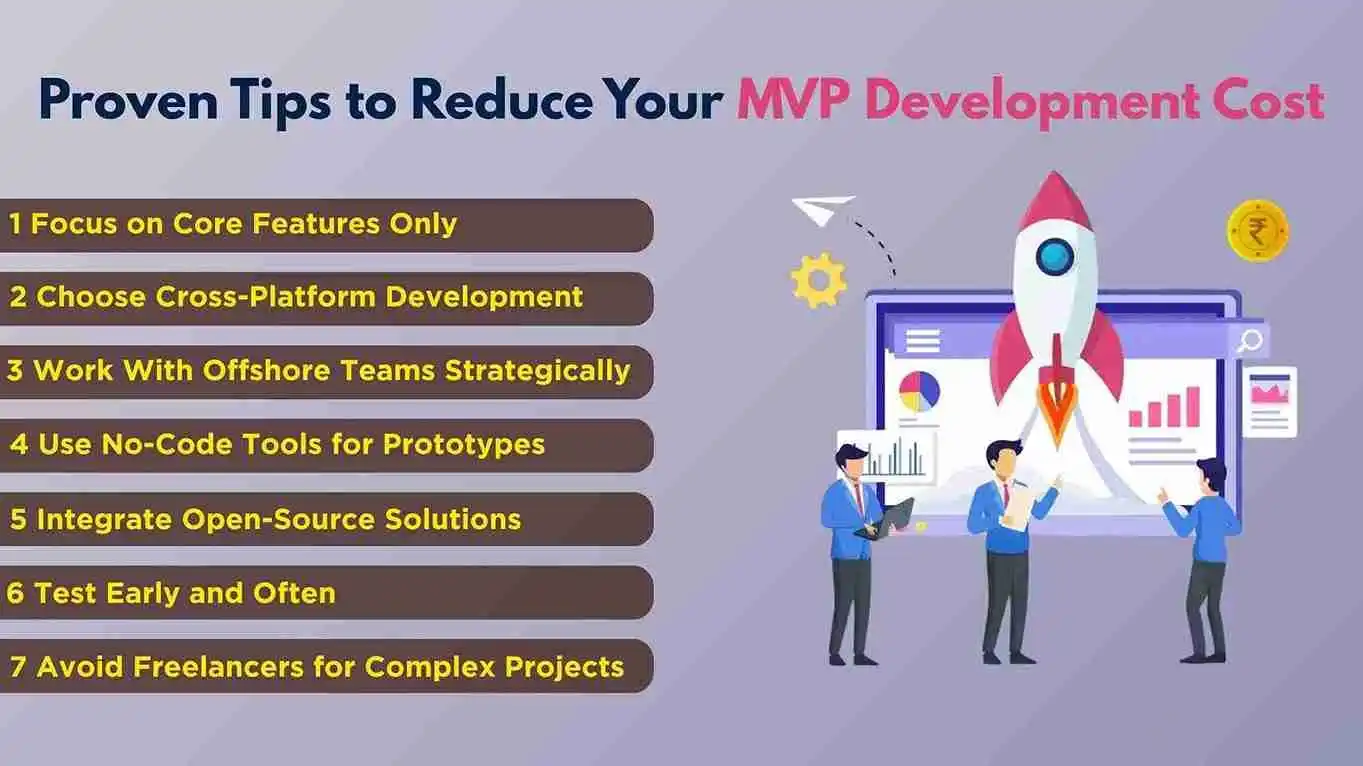
Smart decisions during planning cut 30-50% from your budget without hurting quality.
Focus on Core Features Only
Cut features that aren't needed for testing your main hypothesis. Every extra feature adds 1-2 weeks and $3,000-$10,000 to costs.
Create a priority list using the MoSCoW method we covered in our how to build an MVP guide. Build only "must-have" features in version 1. Everything else waits for user feedback.
Choose Cross-Platform Development
Building for both iOS and Android using React Native or Flutter saves 20-30% compared to native development. You maintain one codebase instead of two, which reduces both initial costs and future maintenance expenses.
Work With Offshore Teams Strategically
Offshore dedicated teams offer 40-60% cost savings while maintaining quality, but the key is choosing experienced teams with good communication and proven MVP experience.
At AIS Technolabs, our teams in India and the US work together, so you get cost efficiency without giving up oversight or communication quality.
Use No-Code Tools for Prototypes
Platforms like Bubble or Webflow let you build functional prototypes for under $5,000. Test your core concept before spending $50,000+ on custom development.
Just understand that no-code has limitations. It works great for validation, but you'll need custom development for scaling.
Integrate Open-Source Solutions
Why build authentication from scratch when proven open-source solutions exist? Using established libraries and frameworks for common functionality saves thousands in development time.
Test Early and Often
Finding bugs during development costs 10x less than fixing them after launch. Set aside 15-20% of your development budget for proper testing.
Avoid Freelancers for Complex Projects
Individual freelancers might seem cheaper, but MVP development needs coordinated team effort. Designers, developers, and QA specialists must work together smoothly.
Agencies and dedicated teams deliver 35% faster because they have processes and internal communication already set up.
Real example: A SaaS company we worked with initially budgeted $90,000 for their MVP. By focusing on 5 core features instead of 12, using cross-platform MVP development, and leveraging our hybrid team model, the final cost came down to $52,000—resulting in a 42% savings.
Concluding It All For You
Ultimately, it is always a good idea to schedule a direct conversation with trusted and experienced MVP development companies to get a fair estimate of your MVP development costs.
Prioritize your functionality, organize your team effectively, and adopt contemporary development methodologies to maximize your budget.
At AIS Technolabs, we have assisted numerous startups in the United States in developing MVPs that meet their budget and quality requirements. Our clear MVP development pricing begins with understanding your needs and budget.
FAQs
Ans.
AI features spike MVP development cost by 20-40% ($15k+ extra), but tools like Copilot cut coding time 30%, netting savings overall. Weigh if basic ML is MVP-essential or v2 material.
Ans.
Haggle MVP pricing by bundling prototypes ($3k savings), offering equity for discounts (5-10%), or phased payments. Pros get 15-25% off—mention competitor quotes politely.
Ans.
MVP development cost averages $30k-$60k for most startups in 2026, but simple ones dip to $10k while complex ones hit $120k+. Inflation and AI tools bumped rates 15% since 2024—get multiple quotes to nail your real number.

Mary Smith
Mary Smith excels in crafting technical and non-technical content, demonstrating precision and clarity. With careful attention to detail and a love for clear communication, she skillfully handles difficult topics, making them into interesting stories. Mary's versatility and expertise shine through her ability to produce compelling content across various domains, ensuring impactful storytelling that resonates with diverse audiences.
 ASIA PACIFIC