Table of Content
(502 views)
Published:May 6, 2026 at 12:35 pm
Last Updated:16 May 2026 , 12:31 pm
Key Takeaways:
Introduction
If you’ve experimented with large language models inside your business, you’ve likely hit the same wall most teams run into within the first few weeks: the answers sound right, but they’re not always actually right. That challenge is exactly what our Generative AI Development Services are designed to solve, building AI systems grounded in your real data from day one.
Most modern LLMs are trained on a mixture of public data, licensed datasets, and synthetic content. What they don’t have is access to your internal documents, your customer conversations, your pricing sheets, your contracts, or your product updates. So when you ask something business-specific, the model fills in the gaps. Confidently.
This is what people call hallucination, and depending on the use case, it’s not just annoying, it’s risky. Now here’s the interesting part. According to multiple industry reports, over 60-70% of enterprise AI pilots fail to reach production, and one of the biggest reasons is a lack of trust in outputs. If teams can’t rely on answers, adoption stalls. This is where RAG AI steps in.
Instead of trying to retrain or fine-tune a model every time your data changes, RAG gives the model access to your data at the moment it needs it. No guessing. No outdated knowledge. Just grounded responses. And that shift, from static training to dynamic retrieval, is what’s quietly redefining how businesses deploy AI today.
In this blog, we’ll walk you through what Retrieval-Augmented Generation actually is, how it works under the hood, and how you can build it step by step without turning your engineering roadmap upside down.
What Is RAG?
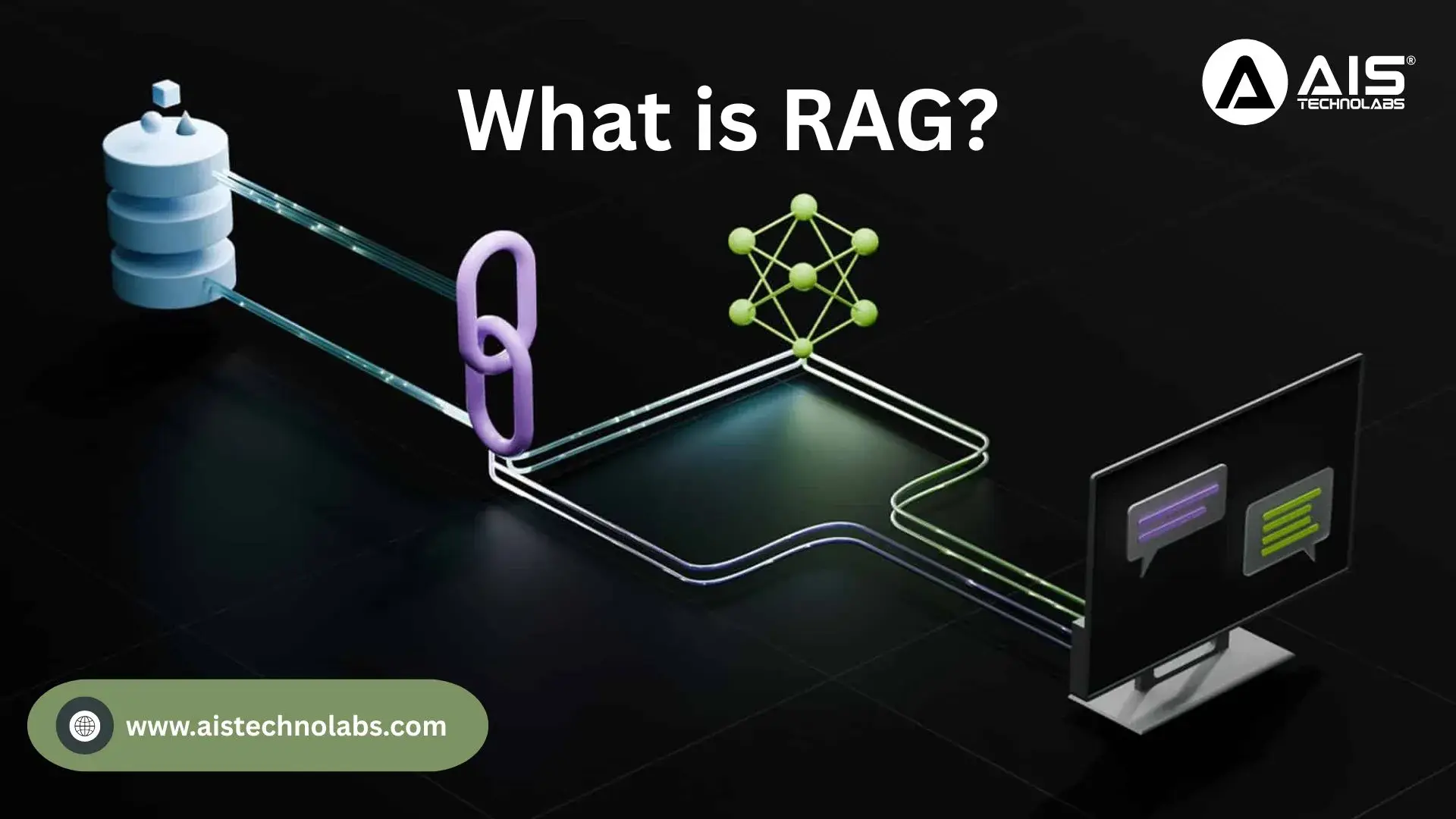
Retrieval-Augmented Generation (RAG) is an architecture that combines information retrieval with generative AI, allowing language models to generate answers based on external, real-time data sources instead of relying solely on pre-trained knowledge.
In simple terms, RAG AI works by first searching through your documents, whether that’s PDFs, databases, or internal systems, and then feeding the most relevant pieces into a language model. The model uses this context to produce responses that are grounded, accurate, and specific to your business.
This approach eliminates the need for constant retraining while ensuring outputs stay aligned with the latest information. It also improves transparency, since responses can often be traced back to the source documents.
Because of this, Retrieval-Augmented Generation has become the preferred approach for companies
building production-ready AI systems, especially in environments where accuracy matters more than creativity.
Why RAG Solves the Biggest Problem With LLMs
Most teams don’t abandon AI because it’s hard to integrate. They abandon it because they stop trusting it. And that usually traces back to three issues: hallucinations, outdated knowledge, and the cost of keeping models relevant. RAG AI addresses all three, but not in a theoretical way. It fixes them at the architecture level.
1. Hallucination Problem → RAG Provides Ground Truth
When an LLM doesn’t know something, it doesn’t say “I don’t know.” It predicts what should come next based on patterns it has learned. That’s why you get answers that look polished but fall apart under scrutiny.
RAG changes this behaviour by injecting verified context into the prompt. Instead of relying on memory, the model is guided by actual data retrieved from your systems. So instead of: “What’s our refund policy?” getting a generic answer pulled from internet patterns, the model references your real policy document.
This is where enterprise RAG becomes powerful. You’re not just improving accuracy, you’re anchoring responses in verifiable truth. That’s a completely different level of reliability, especially for use cases like compliance, legal, or finance.
2. Stale Training Data → RAG Uses Live Documents
Here’s something most people underestimate: even the best models are outdated the moment they’re released. Your business isn’t.
Your pricing changes. Your policies evolve. Your product features update. If your AI system depends on training data alone, it starts drifting almost immediately. RAG AI solves this by working with live data sources. Whether you’re pulling from a CMS, a document store, or a knowledge base, the system retrieves the latest version at query time.
This is why companies investing in Generative AI Development Services are shifting toward retrieval-based systems. It’s not about making the model smarter; it’s about making the system current.
3. Fine-Tuning Cost → RAG Requires No Model Retraining
Fine-tuning sounds appealing at first. Train the model on your data, and you’re done, right? Not quite.
Every time your data changes, you either retrain the model or accept that it’s outdated. Retraining isn’t just expensive, it’s slow, resource-heavy, and often overkill for most business needs.
With RAG vs fine-tuning, the difference becomes clear. RAG doesn’t require retraining at all. You update your data, and the system immediately reflects those changes. Our Machine Learning Development Services team frequently guides businesses through this decision, helping you choose the right approach based on your data update frequency, budget, and use case complexity.
How RAG Works: The 3-Step Architecture
At a glance, RAG AI might seem complex, but under the hood, it follows a clean three-step flow. Once you understand this loop, the entire system becomes easier to design and scale.
Step 1: Indexing: Turning Documents into Searchable Intelligence
Everything starts with your data. You take documents, PDFs, web pages, databases, support tickets and break them into smaller chunks. These chunks are then converted into embeddings, which are numerical representations of meaning.
These embeddings are stored in a vector database, which allows the system to search based on semantic similarity instead of keywords. The quality of this step matters more than most teams realise. If your chunking strategy is off, too large, too small, or poorly structured, you’ll struggle with retrieval accuracy later.
This is often where experienced teams offering RAG development services focus heavily, because good indexing sets the foundation for everything else.
Step 2: Retrieval: Finding What Actually Matters
When a user asks a question, that query is also converted into an embedding. The system then compares this query embedding against your stored data in the vector database and retrieves the most relevant chunks, usually the top 3 to 5 matches.
This is not keyword matching. It’s meaning-based retrieval. So even if the wording is different, the system can still find the right context.
For businesses building enterprise RAG, this step often includes additional layers like filtering, metadata constraints, or hybrid search (we’ll cover that later).
Step 3: Generation: Producing Grounded Answers
Now comes the part most people are familiar with. The retrieved chunks are inserted into the prompt, and the language model generates a response using that context.
This is where RAG AI shines. The model isn’t guessing, it’s synthesising information from real data. If done right, the answer not only sounds natural but is also backed by actual documents. In many systems, you can even show citations, which adds another layer of trust.
RAG vs. Fine-Tuning - Which Does Your Business Need?
When teams start exploring AI seriously, this question comes up quickly: should you use RAG, or should you fine-tune a model?
The honest answer is, it depends. But in most business scenarios today, the balance is shifting heavily toward RAG. Here’s how the comparison plays out in practice:
In the ongoing debate of RAG vs fine-tuning, most modern systems actually combine both, but RAG tends to be the starting point. For businesses exploring this decision, our AI Consulting Services can help you assess which approach fits your goals before any build begins.
Step-by-Step: Building a RAG System
Building a RAG system isn’t about stacking tools; it’s about designing a pipeline that holds up under real usage. The pieces are accessible today, but how you connect them determines whether the system works in production or falls apart after a demo. Let’s walk through it the way most teams actually build.
Pro Tip: If you want a broader view of how AI is reshaping software development pipelines, check out our blog on Top 10 Insights on AI-Powered Software Development.
Step 1: Document Ingestion and Chunking Strategy
Start with your data, but don’t just dump everything in. Clean it. Structure it. Remove duplicates. Then break it into chunks that make sense contextually, not arbitrarily.
A good rule: each chunk should contain one coherent idea. If you’re working with large documents, overlapping chunks often help preserve context. Teams offering Generative AI Development Services spend a surprising amount of time here, because better input almost always means better output.
Step 2: Generate and Store Embeddings
Once your data is ready, convert each chunk into embeddings using models like OpenAI’s text-embedding-3. These embeddings are then stored in a vector database such as Pinecone, Weaviate, or Chroma.
This step transforms your documents into something the system can search intelligently. It’s also where scalability decisions come into play, especially if you’re dealing with millions of records.
Step 3: Build a Retrieval Pipeline with Similarity Search
Now you connect the dots. When a query comes in, it’s embedded and matched against your stored data. The system retrieves the most relevant chunks based on similarity.
This pipeline can be simple or advanced, depending on your needs. Frameworks like LangChain and LlamaIndex are two of the most production-ready options for building this orchestration layer. Some teams add filters, re-ranking, or even multiple retrieval passes. For RAG AI, this is where performance tuning begins.
Step 4: Prompt Engineering for RAG
This is where many RAG systems quietly fail. You can have clean data and strong retrieval, but if your prompt isn’t structured properly, the model still drifts. It either ignores context or blends it with its own assumptions.
In RAG AI, prompting isn’t about being clever; it’s about being controlled. A simple but effective pattern looks like this:
- Define the role (“You are an assistant answering based only on the provided context”)
- Inject retrieved chunks clearly separated
- Add strict instructions (“If the answer is not in the context, say you don’t know”)
What you’re doing here is narrowing the model’s behaviour. You’re removing its tendency to improvise.
In production-grade enterprise RAG, prompts are often templated, versioned, and tested just like code. Small tweaks, like changing how context is ordered, can impact answer quality more than switching models.
If you’re working with an AI development company, this is one of those areas where experience shows quickly. Good prompt design doesn’t look fancy, but it performs consistently.
Step 5: Evaluate Retrieval Quality (What Most Teams Skip)
Here’s the uncomfortable truth: most RAG systems are never properly evaluated. Teams test a few queries, see decent answers, and move forward. Then real users arrive, ask messy questions, and the system starts breaking. Evaluation in RAG AI happens at two levels: retrieval and generation.
For retrieval, you care about:
- Recall: Did the system fetch the right documents?
- Relevance: Were the retrieved chunks actually useful?
For generations, you look at:
- Accuracy of the final answer
- Faithfulness to the source
- Consistency across similar queries
Some teams create benchmark datasets, sets of questions with known correct answers. Others rely on human evaluation loops. If you’re serious about scaling RAG development services, you need this layer. Otherwise, you’re flying blind.
Step 6: Deploy and Monitor (Where Systems Become Real)
Getting a RAG system to work in a notebook is easy. Getting it to behave in production is where things get real. Once deployed, you need visibility into:
- What queries are users asking
- Where retrieval fails
- How often does the model say, “I don’t know.”
- Latency across retrieval and generation
This is where strong AI Integration Services make the difference, ensuring your RAG system connects cleanly with your existing enterprise stack and monitoring infrastructure. Businesses investing in LLM systems treat RAG as a living system, not a one-time build. It evolves with usage.
Real Business Use Cases for RAG
The reason RAG AI is gaining traction isn’t that it’s technically interesting; it’s because it solves real operational problems. Let’s walk through where it’s already delivering value.
Enterprise Knowledge Base Q&A
Large organisations sit on thousands of documents, policies, manuals, and internal guides. Finding the right information often takes longer than it should. With enterprise RAG, employees can ask questions in plain language and get answers grounded in internal documentation.
Instead of searching across folders or intranets, the system pulls the exact sections needed and generates a clear response. The impact is subtle but powerful: faster decisions, fewer interruptions, and less dependency on internal experts.
Related read: AI in Cybersecurity, Real-World Examples. See how AI-powered retrieval is also reshaping enterprise security documentation and compliance workflows.
Customer Support Automation
Traditional chatbots fail because they follow scripts. RAG-powered systems don’t. By connecting to product documentation, FAQs, and support logs, a RAG AI assistant can answer customer queries with real, up-to-date information.
This reduces ticket volume without sacrificing accuracy. More importantly, it avoids the biggest mistake support bots make: guessing. If you're building customer-facing conversational AI, our AI Chatbot Development Services are specifically designed to power RAG-backed, production-ready support systems.
Related read: Implementing Voice & NLP in Android Chatbot Apps, Explore how NLP and voice capabilities extend RAG chatbot experiences across mobile. Companies offering Generative AI Development Services are seeing strong adoption here, especially in SaaS and eCommerce, where product information changes frequently.
Legal Document Analysis
Legal teams deal with dense, high-stakes information. Missing a clause or misinterpreting a document isn’t an option. RAG AI allows lawyers to query contracts, agreements, or case files and receive answers tied directly to source text.
Instead of scanning hundreds of pages, they can ask: “Are there any termination clauses in this contract?” And get a response backed by exact excerpts. This is one of the clearest examples of how RAG reduces effort without introducing risk.
Internal HR Assistants
HR policies are often buried in long documents that employees rarely read fully. A RAG-powered assistant changes that dynamic.
Employees can ask: “What’s the leave policy for maternity?” & “Can I carry forward unused vacation days?” And get instant, policy-backed answers. For companies scaling quickly, this becomes essential. It reduces HR workload while improving employee experience.
Financial Report Analysis
Finance teams work with structured but complex data, earnings reports, forecasts, and compliance documents. RAG AI helps analysts extract insights without manually digging through reports.
Instead of scanning spreadsheets or PDFs, they can query: “What were the key cost drivers last quarter?” And receive a contextualised answer based on actual data. For leadership teams, this translates into faster, data-backed decisions.
Advanced RAG Techniques (2026)
As RAG matures, teams are layering more sophistication into the pipeline. Our blog on AI-Powered Software Development covers the broader engineering context, but here's where RAG-specific innovation is heading:
Hybrid search is becoming standard, combining semantic (dense) retrieval with keyword (sparse) matching to improve accuracy. Re-ranking models are then used to reorder retrieved results based on deeper relevance signals.
HyDE (Hypothetical Document Embeddings) is another emerging approach, where the system generates a “fake” ideal answer first, then retrieves documents closer to that representation.
And then there’s agentic RAG, where systems don’t just retrieve and respond, but decide when to call tools, query databases, or refine their own searches before generating an answer. Our AI Agent Development Services are built around exactly these kinds of multi-step reasoning architectures for enterprise environments.
Conclusion
RAG AI isn’t just another AI trend; it’s a shift in how businesses think about using language models. Instead of forcing models to memorise your world, you let them access it when needed. That one change makes systems more accurate, more adaptable, and far easier to maintain.
For most companies, especially those working with an AI development company, RAG is the fastest path from experimentation to production.
It’s not about replacing models, it’s about grounding them. And if you’re building AI that people actually rely on, that grounding makes all the difference. At AIS Technolabs, this is exactly where most real-world AI journeys begin.
FAQs
Ans.
In most business cases, yes, RAG AI is more flexible and cost-effective, especially when your data changes frequently.
Ans.
Costs vary, but a basic setup using modern tools can start small and scale gradually without heavy upfront investment.
Ans.
It depends on scale and use case; Pinecone, Weaviate, and Chroma are all solid options used in production.
Ans.
Yes, modern RAG systems can integrate both structured and unstructured data sources seamlessly.
Ans.
Not always, RAG handles most knowledge-based tasks, while fine-tuning is useful for behaviour or formatting control.
Ans.
A basic system can be built in weeks, but refining it for real-world usage takes continuous iteration.

Harry Walsh
Harry Walsh, a dynamic technical innovator with 8 years of experience, thrives on pushing the boundaries of technology. His passion for innovation drives him to explore new avenues and create pioneering solutions that address complex technical problems with ingenuity and efficiency. Driven by a love for tackling problems and thinking creatively, he always looks for new and innovative answers to challenges.
 ASIA PACIFIC