Table of Content
(501 views)
Published:June 8, 2026 at 7:48 am
Last Updated:8 Jun 2026 , 11:40 am
Key Takeaways:
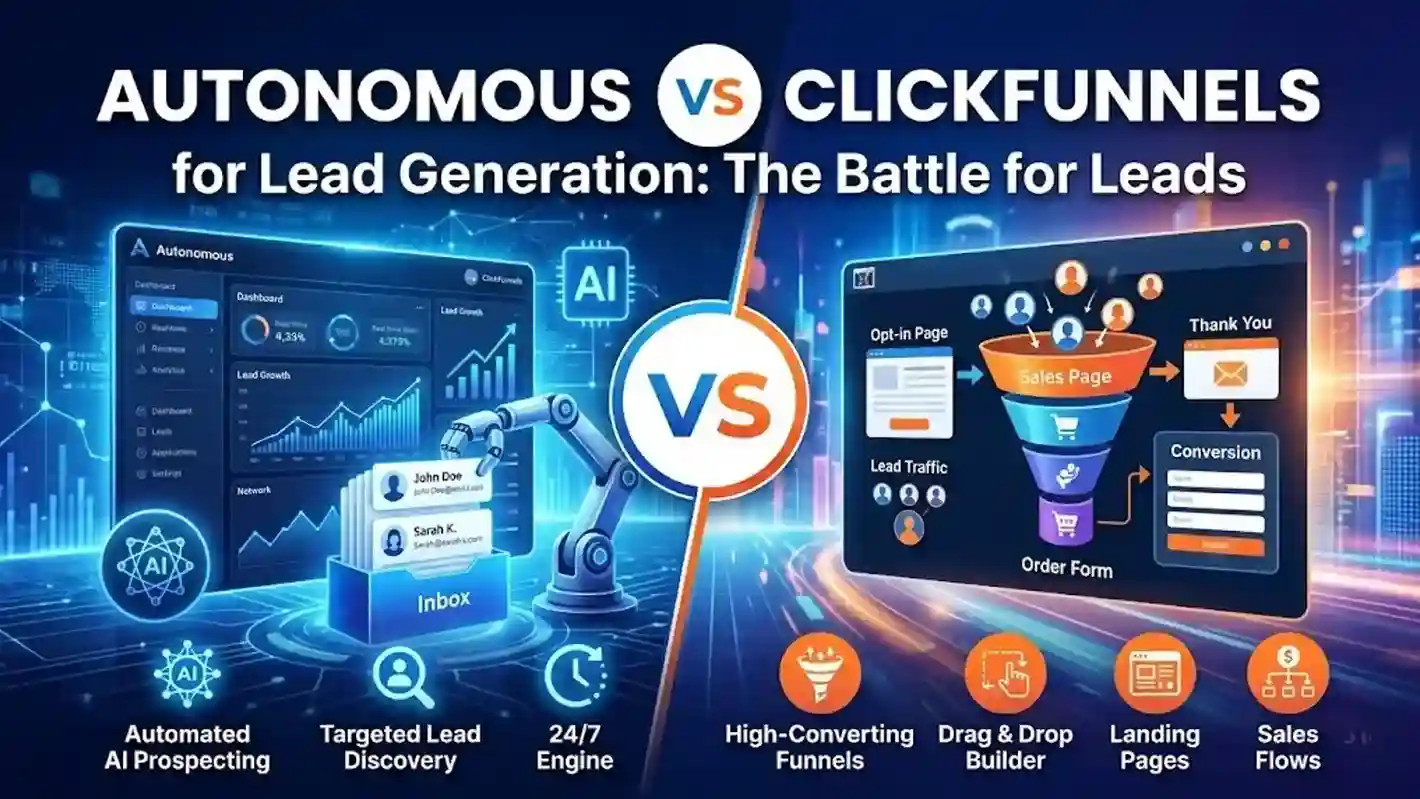
- ClickFunnels excels as a dedicated sales funnel builder, while Autonomous provides a complete lead generation ecosystem that includes CRM, automation, communication, and customer management.
- Businesses comparing Autonomous vs ClickFunnels should evaluate not only lead capture capabilities but also how effectively each platform handles lead nurturing, follow-up, and conversion.
- Autonomous helps reduce software sprawl by combining funnel building, AI-powered automation, appointment scheduling, reputation management, and sales pipeline tracking within a single platform.
- For organisations focused on long-term growth, customer retention, and operational efficiency, Autonomous offers a broader solution that supports the entire customer journey beyond the initial lead capture stage.
Introduction
If someone had asked us this question five years ago, the answer would have been relatively straightforward.
ClickFunnels was one of the most recognisable names in online lead generation. It helped businesses build landing pages, create sales funnels, capture leads, and drive conversions without requiring a dedicated development team. For many entrepreneurs, coaches, consultants, and marketers, it became the default choice for launching campaigns quickly.
Fast forward to 2026, and the conversation has changed significantly. Lead generation is no longer just about getting someone to fill out a form.
Businesses today need to capture leads, qualify them, nurture them, communicate across multiple channels, book appointments, manage conversations, collect payments, track attribution, and retain customers. In other words, generating a lead has become only the first step in a much larger customer journey.
That shift is exactly why the debate around Autonomous vs ClickFunnels has become increasingly relevant.
Both platforms can help businesses generate leads. However, they approach the challenge from very different perspectives. One focuses primarily on funnel creation and conversion optimisation, while the other aims to manage the entire customer lifecycle from first interaction to long-term retention.
For business owners evaluating software investments in 2026, understanding that difference is critical.
How Lead Generation Has Evolved
One of the biggest mistakes businesses make when comparing software platforms is evaluating them through an outdated lens.
A decade ago, lead generation was relatively simple. A visitor landed on a page, entered their contact information, and became a lead. The marketing team's job was to drive traffic, and the sales team's job was to close deals.
Today's customer journey is far more complex.
A prospect may discover your business through a Google search, visit your website, leave without converting, engage with a social media post three days later, submit a form, receive a text message, schedule a consultation, and then complete a purchase weeks afterwards.
The software supporting this journey needs to do more than collect information.
It needs to orchestrate interactions.
This is where the Autonomous vs ClickFunnels comparison becomes interesting because both platforms solve different parts of the same challenge.
ClickFunnels: Built for Funnels First
There's no denying the impact ClickFunnels has had on digital marketing.
The platform helped popularise the concept of sales funnels for small and medium-sized businesses. It made it possible for non-technical users to build landing pages, opt-in forms, webinar funnels, and sales sequences without hiring developers.
For businesses primarily focused on funnel optimisation, ClickFunnels remains a capable solution.
Its strengths include:
- Funnel building
- Landing page creation
- Conversion-focused templates
- Upsell and downsell flows
- Membership areas
- Basic email marketing functionality
If your primary objective is creating high-converting sales funnels, ClickFunnels continues to perform well. The challenge arises when businesses ask what happens after a lead enters the funnel.
That's where many organisations discover they need additional tools.
- A CRM platform.
- An SMS solution.
- A calendar booking tool.
- A review management platform.
- A social media scheduler.
- An automation platform.
- A customer communication hub.
Over time, businesses often find themselves stitching together multiple applications to create a complete system.
Autonomous: Built Around the Entire Customer Journey
The philosophy behind Autonomous is fundamentally different. Rather than starting with funnels, Autonomous starts with the customer journey itself.
Instead of asking, "How do we generate more leads?" the platform asks, "How do we manage everything that happens before and after lead generation?"
This distinction shapes the entire experience. When evaluating Autonomous vs ClickFunnels, one of the first things decision-makers notice is that Autonomous functions as a unified growth platform rather than a dedicated funnel builder.
Lead capture remains an important component, but it's only one part of a broader ecosystem that includes:
- CRM functionality
- Email marketing
- SMS marketing
- Appointment scheduling
- AI-powered conversations
- Sales pipelines
- Reputation management
- Social media management
- Payment processing
- Reporting and analytics
For businesses trying to reduce software complexity, that consolidation can be significant.
The Lead Follow-Up Problem Most Businesses Ignore
In our experience, most businesses don't lose leads because their landing pages perform poorly.
They lose leads because follow-up breaks down.
- A prospect submits a form.
- Someone forgets to call.
- An email gets buried.
- A text message never gets sent.
- An appointment reminder doesn't go out.
- By the time the business responds, the prospect has already moved on.
This is where the Autonomous vs ClickFunnels conversation extends beyond funnel performance.
Autonomous places heavy emphasis on automation and communication after lead capture. Businesses can build workflows that automatically respond to inquiries, send SMS messages, schedule appointments, trigger email sequences, and route opportunities through custom sales pipelines.
- ClickFunnels captures the lead.
- Autonomous focuses on what happens next.
For many organisations, that's where the majority of revenue is won or lost.
AI Changes the Comparison Entirely
Perhaps the biggest difference in the Autonomous vs ClickFunnels discussion involves artificial intelligence. Most businesses evaluating software in 2026 are no longer asking whether AI matters.
They're asking how effectively it's integrated into daily operations. Autonomous incorporates AI throughout the platform.
AI can assist with:
- Lead qualification
- Appointment booking
- Website conversations
- SMS communication
- Voice interactions
- Content creation
- Workflow generation
- Review responses
Instead of functioning as a separate feature, AI becomes part of the operational infrastructure.
For example, a prospect visiting a website outside business hours can engage with an AI assistant that answers questions, collects information, and schedules appointments automatically.
That level of automation significantly reduces response times and helps businesses engage leads while interest is highest.
When comparing Autonomous vs ClickFunnels, this AI-driven operational support often becomes a deciding factor for businesses focused on scale.
CRM and Lead Management: A Significant Difference
Lead generation doesn't stop once a contact enters the database. Organisations need visibility into every interaction that follows.
This is another area where the comparison becomes less about funnels and more about relationship management.
Autonomous includes a full CRM environment where businesses can track communication history, sales opportunities, appointments, notes, tasks, and pipeline progression from a centralised dashboard.
This creates a complete picture of each prospect and customer. ClickFunnels provides lead capture capabilities, but businesses often rely on external CRM solutions for deeper relationship management.
When evaluating Autonomous vs ClickFunnels, companies with sales teams frequently prioritise the visibility and operational control that comes with an integrated CRM system.
Multi-Channel Communication Matters More Than Ever
Customers communicate differently than they did even a few years ago. Some prefer email. Others prefer SMS. Many reach out through Instagram, Facebook, WhatsApp, or website chat.
Businesses that fail to meet customers on their preferred channels often struggle with engagement. Autonomous was designed around multi-channel communication.
Businesses can manage conversations across email, SMS, social messaging, voice interactions, and web chat from a unified environment. This creates a smoother customer experience while simplifying internal operations.
In the broader Autonomous vs ClickFunnels comparison, this capability often appeals to service businesses, agencies, consultants, healthcare providers, and local businesses that rely heavily on ongoing customer communication.
Software Consolidation and Operational Efficiency
One trend that's impossible to ignore in 2026 is software consolidation.
Business owners are increasingly questioning whether they need ten separate subscriptions to run marketing, sales, customer service, and operations.
Every additional platform introduces:
- Additional costs
- Additional training
- Additional integrations
- Additional complexity
Many organisations evaluating Autonomous vs ClickFunnels are actually trying to solve this broader challenge. ClickFunnels remains highly focused on funnels and conversion experiences.
Autonomous attempts to replace multiple systems by combining lead generation, customer management, automation, communication, scheduling, and reporting into a single platform.
The result isn't simply fewer subscriptions. It's a more connected operational environment.
Which Platform Is Better for Lead Generation?
The honest answer depends on what you mean by lead generation.
If your definition is limited to creating landing pages, opt-in forms, and conversion funnels, ClickFunnels remains a strong contender.
Its funnel-building capabilities are well established and continue to help businesses generate leads effectively.
However, if lead generation includes everything required to capture, nurture, qualify, convert, and retain prospects, the comparison changes considerably.
Autonomous approaches lead generation as part of a larger customer acquisition and retention strategy. Instead of optimising only the top of the funnel, it supports the entire journey.
That's why many businesses comparing Autonomous vs ClickFunnels ultimately evaluate not just lead volume but operational efficiency, response speed, customer engagement, and long-term revenue growth.
Final Thoughts
The question isn't whether ClickFunnels works. It clearly does.
The real question is whether businesses in 2026 need more than a funnel builder. For many organisations, the answer is yes.
Lead generation has evolved from a marketing activity into a connected operational process that spans communication, automation, sales, customer experience, and retention.
That shift explains why the conversation around Autonomous vs ClickFunnels continues to gain momentum. ClickFunnels remains an excellent platform for building and optimising funnels.
Autonomous expands the conversation by addressing what happens before, during, and after a lead enters the system. For businesses seeking a dedicated funnel-building platform, ClickFunnels remains a proven option.
For businesses seeking a unified growth engine capable of managing the entire customer lifecycle, Autonomous offers a broader vision of what lead generation can become in 2026. You can connect with AIS Technolabs to learn more about the difference.
FAQs
Ans.
Yes. While ClickFunnels focuses on capturing leads, Autonomous automates follow-ups through AI, SMS, and workflows, helping businesses respond faster and reduce lead leakage.
Ans.
Service-based businesses often benefit more from Autonomous because it combines CRM, scheduling, communication, and lead nurturing into a single platform, eliminating the need to rely on multiple tools.
Ans.
Not always. If you already have a robust CRM and automation stack, ClickFunnels may fit well. Autonomous is often more attractive for businesses looking to consolidate their tech stack.
Ans.
AI is becoming a major differentiator. Autonomous uses AI for lead qualification, appointment booking, customer conversations, and workflow automation, extending beyond traditional funnel building.

Mary Smith
Mary Smith excels in crafting technical and non-technical content, demonstrating precision and clarity. With careful attention to detail and a love for clear communication, she skillfully handles difficult topics, making them into interesting stories. Mary's versatility and expertise shine through her ability to produce compelling content across various domains, ensuring impactful storytelling that resonates with diverse audiences.
 ASIA PACIFIC