Table of Content
(506 views)
Published:February 13, 2026 at 11:13 am
Last Updated:25 May 2026 , 12:35 pm
Key Takeaways:
- White label casino software provides a ready-made online casino platform, helping businesses launch faster without building casino software from scratch.
- The legality of white label online casino software varies by country, as some jurisdictions fully regulate online gambling while others impose restrictions or complete bans.
- A valid online gambling license is mandatory in regulated jurisdictions, making legal compliance and casino licensing essential before launch.
- Businesses targeting global iGaming markets must understand local gambling laws, KYC/AML regulations, and compliance requirements to avoid penalties, fines, or operational shutdowns.
- This guide explains which countries legally permit white label casino operations, where online gambling is restricted, and the key licensing requirements operators must follow.
Introduction
The global iGaming industry is growing fast, but legality remains the biggest concern for operators, investors, and regulators alike. One question dominates early planning discussions: Is white label casino software legal, and where can it be used safely?
The short answer is yes—white label casino software is legal in many jurisdictions, but only when used within the boundaries of local online gambling regulations, licensing rules, and compliance frameworks. The long answer depends on geography, responsibility models, and regulatory maturity, which this guide explains in detail.
What Is White Label Casino Software and How Does It Work?

White label casino software is a ready-made online casino solution provided by a licensed software vendor and operated under the client’s brand. The platform includes games, payments, security, and back-office systems, allowing operators to launch quickly without building software from scratch.
In this model, the online casino platform provider supplies the technology, while the operator controls branding, marketing, and player acquisition. Legal responsibility is typically split, making early clarity essential for compliance, licensing, and risk management.
Is White Label Casino Software Legal?
White label casino software is legal when it is operated under a valid gaming license and complies with local online gambling regulations. The software itself is not illegal; legality depends on where and how it is deployed.
Jurisdiction, licensing authority, player location, and payment compliance all determine legality. In regulated markets, white label online casino software must meet strict standards. In grey markets, legality may be tolerated but still carries operational risk.
Who Is Legally Responsible in a White Label Casino Model?

Legal responsibility in a white label casino model primarily lies with the operator, not the software provider. While providers ensure technical compliance, operators are accountable for licensing, player protection, and regulatory reporting.
The operator typically holds the gaming license, manages KYC and AML integration, handles taxation, and ensures responsible gaming tools are active. The casino software solution provider supports compliance but does not replace regulatory accountability.
Key Legal Requirements for White Label Casino Software
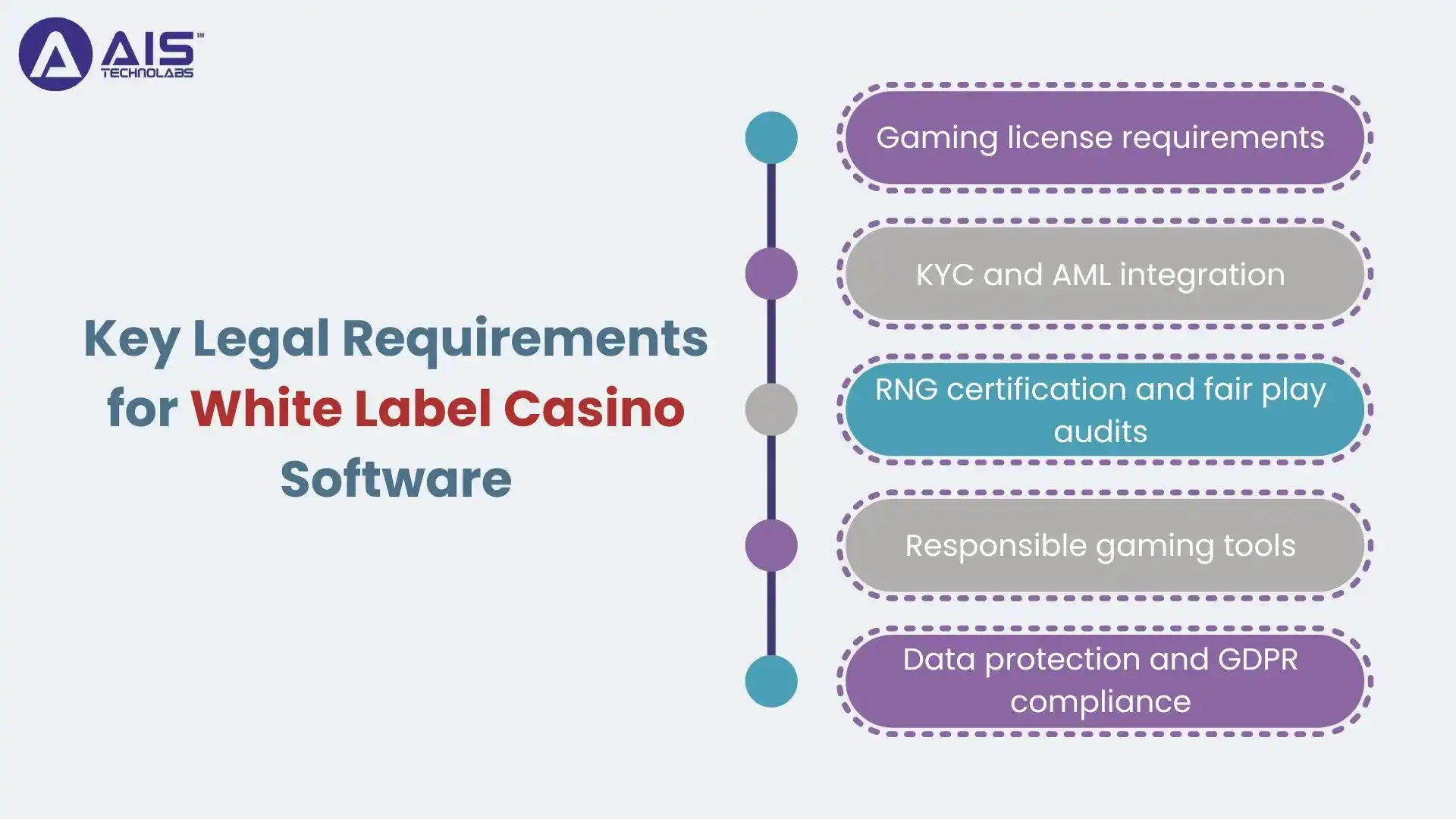
To operate legally, white label casino software must meet a set of core regulatory and technical requirements defined by the licensing authority. These requirements are consistent across most regulated markets.
Gaming license requirements determine where the platform can operate and advertise. KYC and AML integration ensures player identity verification and fraud prevention. RNG certification and fair play audits validate game integrity. Responsible gaming tools protect players, while GDPR compliance safeguards personal data.
Country-Wise Regulations for White Label Casino Software

White label casino legality varies significantly by region, reflecting differences in regulatory maturity, consumer protection laws, and market openness. Understanding regional frameworks is critical for international casino operators.
White Label Casino Regulations in Europe
Europe is one of the most regulated iGaming regions globally. Malta (MGA) allows white label gambling software under strict licensing and technical audits. The UK (UKGC) requires local operator licenses, even when using a white label casino platform. Curacao and other EU-friendly jurisdictions offer faster licensing but with evolving compliance standards.
White Label Casino Regulations in North America
In the United States, online gambling legality is determined at the state level, making white label deployment complex. Only licensed states allow operations, and partnerships with local license holders are mandatory. Canada follows provincial frameworks, where operators must work with approved entities to remain compliant.
White Label Casino Regulations in Asia-Pacific
The Philippines, regulated by PAGCOR, supports licensed white label online casino software for offshore operations. India remains a mixed market, where legality depends on whether games are classified as skill or chance, placing many platforms in a grey area.
White Label Casino Regulations in Latin America
Latin America is rapidly regulating. Colombia operates a clear licensing regime, while Brazil and Mexico are formalizing frameworks. White label casino software for emerging markets is increasingly viable but requires close monitoring of regulatory updates.
White Label Casino Regulations in Africa
South Africa enforces strict gambling laws, primarily at the provincial level. Nigeria, Kenya, and other emerging markets show growing acceptance, though regulatory clarity varies. Operators must adopt a compliance-first approach to manage long-term risk.
White Label Casino Software in Regulated vs Grey Markets

Regulated markets provide legal certainty but require higher compliance investment, while grey markets offer faster entry with greater legal risk. White label casino software can function in both, but operator strategy must differ.
In regulated markets, compliance, audits, and reporting are mandatory. In grey markets, enforcement may be inconsistent, but future regulatory shifts can disrupt operations. Sustainable operators prioritize regulation-ready platforms even in less mature regions.
Common Legal Risks When Using White Label Casino Software

Most legal risks arise not from the software itself, but from how it is operated and marketed. Awareness of these risks is essential for long-term stability.
Operating without a valid license is the most common issue. Non-compliant payment gateway integration can lead to banking restrictions. Weak player verification increases fraud exposure. Cross-border marketing without authorization often triggers regulatory penalties.
How to Choose a Legally Compliant White Label Casino Software Provider
Choosing the right provider is one of the most important legal decisions an operator makes. A compliant provider reduces regulatory friction and operational risk.
Operators should verify licensing history, RNG certification, casino security features, and audit transparency. Due diligence should include questions about jurisdictional support, data protection practices, and scalability. Regulators and banks expect documented compliance readiness, not assumptions.
Is White Label Casino Software Legal for Startups and Affiliates?
Yes, white label casino software is legal for startups and affiliates, provided licensing and marketing rules are followed. However, smaller entities face additional scrutiny.
Startups must ensure their casino business model aligns with local regulations and payment requirements. Affiliates and media houses must follow advertising and promotion rules, especially in regulated jurisdictions where brand licensing is tightly controlled.
Expert Legal Insights from iGaming Software Providers
Industry experts recommend prioritizing compliance architecture over speed alone. While white label casino software enables rapid launch, sustainable growth depends on regulatory adaptability.
Trends indicate tighter AML enforcement, increased player protection standards, and more cross-border cooperation among regulators. Providers now design region-agnostic casino platforms that can adapt as laws evolve, protecting long-term casino software ROI.
Final Verdict: Is White Label Casino Software Legal in Your Country?
White label casino software is legal when operated within the regulatory framework of the target market. The decisive factors are licensing, compliance execution, and jurisdictional awareness.
Operators should proceed when licensing clarity exists, pause when regulations are ambiguous, and seek legal advice when expanding across borders. A long-term compliance strategy is no longer optional—it is essential for survival in the global iGaming market.
For businesses evaluating compliant solutions, working with experienced providers like AIS Technolabs can simplify licensing, compliance, and technical readiness. To explore your options responsibly, feel free to contact us.
Disclaimer:
This blog is intended for informational and educational purposes only. We do not promote or facilitate gambling activities in any country where it is considered illegal. Our content is focused solely on providing knowledge about legal and regulated markets. We only work with operators and platforms that are licensed and comply with the laws of jurisdictions where casino gaming is permitted. We do not operate or endorse any form of gambling in restricted regions. In countries where only skill-based games are allowed, our involvement is strictly limited to those games.
We believe gambling should be an entertaining and responsible activity. Our goal is to ensure that the platforms we review uphold the highest standards of fairness, transparency, and player safety.
FAQs
Ans.
No. Legality depends on local online gambling regulations, licensing rules, and enforcement policies in each country.
Ans.
In most regulated markets, yes. The operator usually must hold a valid gaming license, even when using a white label casino platform.
Ans.
Sometimes. Certain licenses allow international operations, but many countries require local authorization or restrictions.
Ans.
Curacao licenses are widely used but not accepted everywhere. Some regulated markets require local or higher-tier licenses.
Ans.
Operators must adapt quickly. Platforms with flexible compliance tools and scalable architecture handle regulatory changes more effectively.

Mary Smith
Mary Smith excels in crafting technical and non-technical content, demonstrating precision and clarity. With careful attention to detail and a love for clear communication, she skillfully handles difficult topics, making them into interesting stories. Mary's versatility and expertise shine through her ability to produce compelling content across various domains, ensuring impactful storytelling that resonates with diverse audiences.
 ASIA PACIFIC