Table of Content
(503 views)
Published:May 25, 2026 at 7:22 am
Last Updated:26 May 2026 , 3:50 am
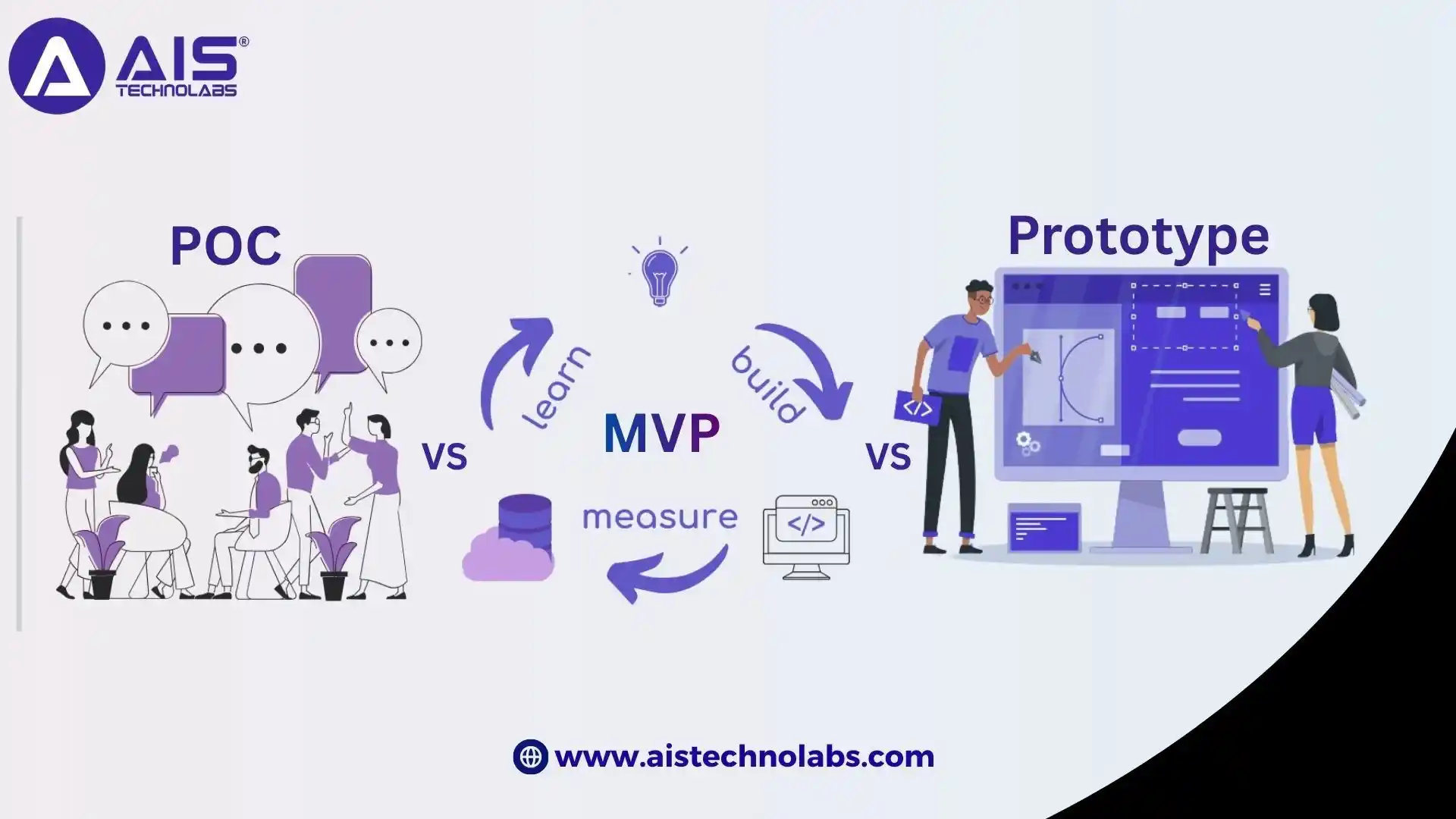
Key Takeaways:
- POC vs MVP vs Prototype represents three different product validation approaches used during digital product creation.
- A prototype helps businesses visualize product design and user experience before development begins.
- A proof of concept validates whether a technical idea or feature can actually work.
- An MVP focuses on launching a functional product with essential features for real users.
- Understanding these approaches is crucial because each stage minimizes risks, improves validation accuracy, and helps businesses make better product decisions throughout the development lifecycle.
- The product development lifecycle enables businesses to collect user feedback, reduce unnecessary spending, and improve product-market fit.
- A structured product development process helps companies launch products faster while maintaining scalability.
- Businesses should always evaluate product performance before expanding features or entering larger markets.
Introduction
Launching a successful digital product is no longer just about having a creative idea. Modern businesses must validate concepts, test user expectations, verify technical feasibility, and minimize risks before investing heavily in full-scale development. This is why understanding POC vs MVP vs prototype has become increasingly important for startups, enterprises, and entrepreneurs.
Many businesses confuse these three terms because they all relate to product validation and development. However, each approach serves a completely different purpose in the overall product journey. Selecting the wrong strategy can result in wasted budgets, delayed launches, poor customer adoption, and technical failures.
Companies use prototypes, Proof of Concepts, and Minimum Viable Products at different stages to improve product accuracy and reduce uncertainty. A prototype focuses on visual representation and user experience, while a Proof of Concept validates technical feasibility. An MVP, on the other hand, helps businesses test real customer demand by launching a simplified yet functional version of the product.
The growing popularity of lean development models has made product development one of the most widely adopted strategies in the digital business ecosystem. Startups increasingly rely on early product versions to launch products quickly, collect customer insights, and refine features based on actual user behavior rather than assumptions.
At the same time, the product development process has evolved significantly with advancements in agile methodologies, cloud technologies, AI-powered development tools, and rapid deployment platforms. Businesses can now build, launch, and test solutions faster than ever before.
This comprehensive guide explains the key differences between prototypes, POCs, and MVPs, their advantages, real-world applications, and how businesses can strategically use them to create successful products.
Understanding the Core Difference Between POC, MVP, and Prototype
Before diving deeper into each approach, it is important to understand how these three concepts differ from one another. Although they may seem similar on the surface, they are used at different stages and serve entirely different objectives.
Understanding POC vs MVP vs Prototype helps businesses determine which MVP validation strategy should be used at a specific phase of product development.
What is a Prototype?
A prototype is an early version of a product that visually demonstrates how the final product will look and behave. It is primarily used for design validation, user experience testing, and stakeholder presentations.
In many startup product development projects, prototypes are created before any actual coding begins. This allows businesses to identify usability problems and improve workflows early in the process.
Prototypes are especially useful when businesses need to showcase product ideas to investors, internal teams, or clients before committing significant MVP development resources.
Purpose of a Prototype
The primary objective of a prototype is to transform ideas into visual experiences. Businesses can test layouts, navigation structures, screen interactions, and user journeys without building the complete product.
Prototypes help teams answer questions such as:
- Does the product flow make sense?
- Is the interface user-friendly?
- Will users understand the navigation?
- Are the design elements visually effective?
Types of Prototypes
Low-Fidelity Prototype
Low-fidelity prototypes are simple wireframes or sketches that represent basic layouts and functionality. These are usually inexpensive and quick to create.
High-Fidelity Prototype
High-fidelity prototypes are interactive and visually polished. They closely resemble the final product and often include animations, clickable screens, and advanced interactions.
Benefits of Using a Prototype
- Helps validate product design
- Improves communication between teams
- Identifies usability issues early
- Saves development costs
- Enhances user experience planning
- Reduces unnecessary revisions
Limitations of Prototypes
Despite their advantages, prototypes also have limitations.
- They are not fully functional products
- Technical feasibility cannot be validated
- Real market feedback cannot be collected
- They may create unrealistic stakeholder expectations
Still, prototypes remain an essential component of the product validation process because they reduce design-related errors before development begins.
What is a Proof of Concept (POC)?
A Proof of Concept, commonly known as a POC, is created to determine whether a specific technology, feature, or idea is technically feasible.
Unlike prototypes, which focus on design and user experience, POCs focus entirely on technical validation.
Businesses often use POCs for innovative products involving artificial intelligence, blockchain, IoT, machine learning, AR/VR, or complex software integrations.
For example, if a company wants to develop a real-time language translation application using AI, a POC can verify whether the translation engine delivers accurate and scalable results.
Purpose of a POC
The main purpose of a POC is to reduce technical uncertainty and validate whether the proposed idea can actually work in practice.
A POC answers technical questions such as:
- Can the technology handle scalability?
- Is the feature technically possible?
- Are integrations achievable?
- Will the infrastructure support performance requirements?
Key Benefits of a POC
- Reduces technical risks
- Identifies implementation challenges
- Prevents investment in unrealistic ideas
- Builds investor confidence
- Supports innovation validation
- Helps development teams make informed decisions
Common Industries Using POCs
POCs are widely used across industries such as:
- Healthcare
- FinTech
- Artificial Intelligence
- Blockchain
- Logistics
- Cybersecurity
- SaaS platforms
Challenges Associated with POCs
Although POCs are valuable, they also have limitations.
- They are not customer-facing products
- User experience is often ignored
- They may not reflect market demand
- Additional development is required after validation
Still, businesses developing technically advanced products often rely heavily on POCs during startup product development.
What is an MVP?
A Minimum Viable Product, or MVP, is a simplified but functional version of a product that contains only the essential features required to solve a specific user problem.
Unlike prototypes and POCs, MVPs are launched to real users.
The goal of product development is to validate market demand, gather customer feedback, and improve products based on actual usage patterns.
Instead of spending years building complex products, companies launch MVPs quickly to test assumptions and minimize financial risks.
Purpose of an MVP
The primary purpose of an MVP is to validate product-market fit while reducing MVP development costs and launch timelines.
An MVP helps businesses answer critical questions such as:
- Will customers actually use the product?
- Which features matter most to users?
- Are customers willing to pay for the solution?
- What improvements are required?
Core Characteristics of an MVP
- Functional product version
- Includes only essential features
- Available to real customers
- Designed for feedback collection
- Built for iterative improvements
Benefits of MVP Development
The popularity of product development continues to grow because it offers multiple business advantages.
Faster Market Entry
Businesses can launch products quickly without waiting for complete feature development.
Reduced Development Costs
Companies avoid wasting resources on unnecessary features.
Better Customer Insights
Real user feedback helps businesses improve products based on customer needs.
Lower Business Risks
An MVP minimizes financial risks by validating ideas before large-scale investments.
Easier Investor Validation
Investors often prefer products that already demonstrate market traction.
Understanding the MVP Development Process
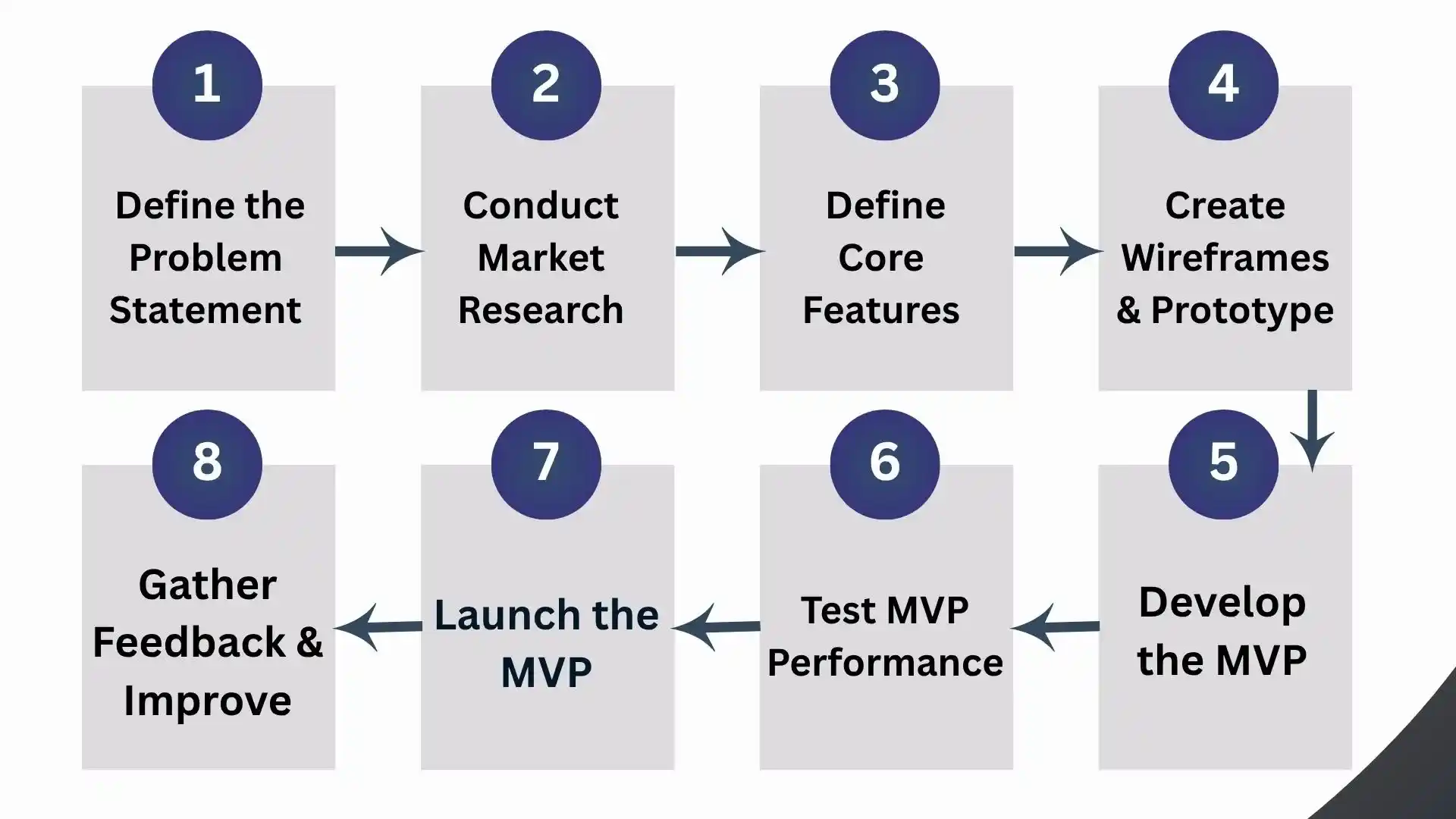
The product development process follows a structured framework that helps businesses create scalable and market-ready products efficiently.
Step 1: Define the Problem Statement
Businesses must identify the exact problem they aim to solve and understand the target audience.
Without a clearly defined problem, even technically advanced products may fail.
Step 2: Conduct Market Research
Research helps businesses understand competitors, customer pain points, and market gaps.
This phase is critical for successful product development because it ensures the product addresses genuine market demand.
Step 3: Define Core Features
Only the most essential functionalities should be included in the MVP.
Adding excessive features increases costs and delays product launches.
Step 4: Create Wireframes and Prototypes
At this stage, businesses often build prototypes to validate design structures and user journeys.
Step 5: Develop the MVP
Developers build the functional product with minimum essential features.
This is the core execution stage of the product development process.
Step 6: Test MVP Performance
Before launching publicly, businesses must carefully test MVP functionality, usability, performance, and security.
Testing helps identify bugs, technical issues, and usability concerns.
Step 7: Launch the MVP
After validation, the product is launched to a limited audience or target market.
Step 8: Gather Feedback and Improve
Customer feedback becomes the foundation for future product enhancements.
Successful businesses continuously improve products after they test MVP performance in real-world environments.
Why MVP Development is Critical for Startups
Modern startups operate in highly competitive and fast-changing markets. Building complete products without market validation can be extremely risky.
This is why product development has become a preferred strategy among entrepreneurs and technology companies.
Faster Validation
An MVP enables businesses to validate ideas quickly without waiting for full-scale development.
Budget Optimization
Startups often operate with limited funding. MVPs help optimize spending.
Customer-Centric Development
Products evolve based on actual customer behavior instead of assumptions.
Scalability Planning
Businesses can identify scalability requirements early in the product lifecycle.
Investor Attraction
Products with validated user interest are more attractive to investors.
For these reasons, many successful companies incorporate MVPs into their overall product development strategies.
Real-World Examples of MVP Success
Airbnb
Airbnb initially started as a simple website offering short-term air mattress rentals.
The founders used an MVP approach to validate demand before scaling globally.
Dropbox
Dropbox launched with a simple explainer video before building the full product.
This MVP strategy helped validate customer interest early.
Uber
Uber initially operated in limited locations with basic ride-booking functionality before expanding internationally.
Instagram started as a minimal photo-sharing application with limited features before evolving into a global social platform.
These examples demonstrate how effective product development can transform small ideas into billion-dollar businesses.
When to Use a Prototype, POC, or MVP
Choosing the correct validation strategy depends on business goals, product complexity, and development stage.
Use a Prototype When
- You need design validation
- Stakeholder visualization is required
- User experience testing is important
- Navigation flows must be optimized
Use a POC When
- Technical feasibility is uncertain
- Advanced technologies are involved
- Complex integrations must be validated
- Innovation risks are high
Use an MVP When
- You want real customer feedback
- Market validation is required
- You are preparing for product launch
- Revenue opportunities must be tested
Understanding POC vs MVP vs Prototype allows businesses to allocate resources more effectively and reduce development risks.
Common Mistakes Businesses Make
Many companies struggle during product creation because they misunderstand validation strategies.
Building Too Many Features
One of the most common mistakes in product development is adding unnecessary features too early.
This increases development time and costs.
Ignoring User Feedback
Some businesses fail to analyze customer feedback after they test MVP performance.
Ignoring feedback reduces product improvement opportunities.
Confusing POC with MVP
POCs validate technical feasibility, while MVPs validate market demand.
Treating them as interchangeable often creates strategic confusion.
Skipping the Prototype Stage
Without prototypes, businesses may encounter expensive user experience issues during later development stages.
Poor Market Research
Inadequate research can result in products that fail to solve actual customer problems.
The Role of Agile Development in MVP Creation
Agile methodologies play a major role in modern startup product development.
Agile frameworks enable teams to:
- Develop products incrementally
- Release updates faster
- Adapt quickly to feedback
- Improve collaboration
- Reduce project risks
Agile development aligns perfectly with the iterative nature of the MVP development process.
How Businesses Test MVP Effectively
Businesses should carefully test MVP performance before large-scale expansion.
Functional Testing
Ensures all features work correctly.
Usability Testing
Evaluates user experience and navigation quality.
Performance Testing
Measures product speed, responsiveness, and stability.
Security Testing
Identifies vulnerabilities and protects customer data.
Feedback Collection
Businesses gather insights through surveys, analytics, interviews, and behavioral tracking.
Effective testing is one of the most important stages of the product development process.
Future Trends in Product Validation
Technology advancements continue transforming how businesses approach validation and innovation.
AI-Powered Prototyping
AI tools now help businesses generate rapid design concepts and user interfaces.
No-Code MVP Development
No-code platforms allow startups to create MVPs quickly without extensive coding expertise.
Cloud-Native Development
Cloud technologies improve scalability and deployment flexibility.
Real-Time Analytics
Businesses can now monitor customer behavior instantly after they test MVP solutions.
Automation in Testing
Automated testing frameworks improve product quality and reduce launch delays.
These innovations are making product development faster, more affordable, and more efficient.
How Startups Can Combine All Three Approaches
Many successful businesses use prototypes, POCs, and MVPs together rather than choosing only one approach.
A structured workflow may include:
- Creating a prototype for design validation
- Building a POC for technical verification
- Launching an MVP for customer validation
This layered strategy improves product accuracy and minimizes both technical and market-related risks.
Businesses that understand POC vs MVP vs Prototype can create more scalable and user-focused products.
Conclusion
Understanding POC vs MVP vs Prototype is essential for businesses aiming to develop successful digital products in competitive markets. Each approach serves a different purpose in the product lifecycle, from design visualization and technical validation to market testing and customer feedback collection.
A prototype helps businesses refine user experience and design, while a Proof of Concept validates whether the core technology can function effectively. An MVP allows businesses to launch products faster, validate customer demand, and improve solutions through real-world feedback.
Modern product development strategies rely heavily on these approaches to minimize risks, optimize budgets, and improve scalability. Businesses that follow a structured development process can adapt more quickly to changing market trends and customer expectations.
Companies should also continuously test MVP performance to identify improvement opportunities and maintain long-term product success.
AIS Technolabs provides reliable product development and custom software development solutions for businesses looking to transform innovative ideas into scalable digital products.
FAQs
Ans.
A prototype focuses on design visualization, a POC validates technical feasibility, and an MVP tests market demand using a functional product.
Ans.
Product development helps startups launch products faster, validate customer demand, reduce risks, and optimize development costs.
Ans.
Yes, many businesses combine prototypes, POCs, and MVPs during startup product development to improve product quality and reduce uncertainty.
Ans.
Industries such as healthcare, AI, blockchain, FinTech, cybersecurity, and SaaS platforms frequently use POCs.
Ans.
The MVP development process can take several weeks or months depending on product complexity and feature requirements.
Ans.
Businesses should test MVP products to identify technical issues, improve usability, gather customer feedback, and optimize performance.
Ans.
Not always. Some prototypes are only visual models, while others include limited interactivity without full functionality.
Ans.
Yes, many MVPs are launched as functional products capable of generating early revenue while collecting user feedback.

Mary Smith
Mary Smith excels in crafting technical and non-technical content, demonstrating precision and clarity. With careful attention to detail and a love for clear communication, she skillfully handles difficult topics, making them into interesting stories. Mary's versatility and expertise shine through her ability to produce compelling content across various domains, ensuring impactful storytelling that resonates with diverse audiences.
 ASIA PACIFIC