Table of Content
(500 views)
Last Updated:18 Mar 2026 , 12:18 pm
Summary :
The 3D animation industry is ever-growing in terms of popularity and demand. As a result, businesses of all scales are looking forward to rich animation services that can help them achieve success. To make sure you break into the industry with a strong mark, here are some tips to follow. Also, it is of utmost importance to hire the best 3D animation company India to avail unparalleled services. In this post, we will share the shortcuts to enter into the animation industry and how you can hire the best animation company easily.
No wonder what type of product you want, the world of 3D setup revolves around each and everything. From watching a movie, buying a game for your kid to presenting a corporate presentation, everything looks great when it is visually richer and animated.
3D technology is prevalent in advertising, printing, architecture, automotive, computer games, and almost every industry you could think of. If you too wish to incorporate 3D technology in your website, apps, or business presentation, it is viable to learn the basics of 3D animation.
Here, you will learn the basics of 3D animation and how you may look for a company to get 3D work done from scratch.
Introduction
The 3D animation industry is rapidly booming. With the advent of Toy Story in 1995, it has become one of the most fulfilling arenas for creative professionals. From robots, animals to cartoon characters, animation can bring lift to any component of this world and beyond.
In lieu of perfection and uniqueness, big companies from all across the world always look for expert animators who can make 3D objects to breathe life. With the skyrocketing growth of the industry, the demand for 3D animators is increasing more than ever. If you too intend to build a fruitful career in 3D animation, here check important steps to follow right from our experts table!
How to Begin with 3D Animation?
A) Create a Story
The very first step to get involved into the animation industry is conceptualization of ideas. To give your ideas a united and interesting part, you need to create storyboards, which translate these ideas into a visually appealing form.
Creating a story means planning a storyboard, which is a sequence of illustrations, which display the digital story in two dimensions. It is first about what happens first, then afterwards, and later. The second dimension is voice over or the way you interact with the images.
The way visual effects and transitions help link together the images, the way voices over interact with musical soundtrack and interaction of any element with another one. Remember, your story must have a strong impact on your audience.
B) Visual Development
The next tip is visual development that involves creating the film that actually looks like. It includes designing various elements and characters, props, environment, backgrounds, and color pallets.
It gives a clean path to the team and director as they move forward into the production process so that they are aware of what the actual look of characters and scenes would be.
It also involves pre-visualization, which is the way artists work with the storyboards and script for creating the film in a 3-dimensional environment. It is the path to animation production and is about shaping and scaling the environment and characters.
C) Modeling and Character Animation
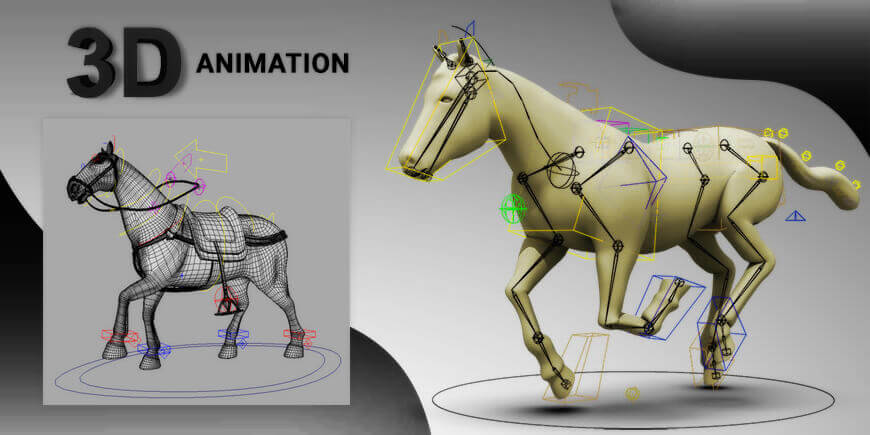
Modeling is almost similar to molding, which is giving 3D characters a specific shape. Mostly, it is about creating a 3D model from a simple object, known as primitive and extends or grows into a shape, which can be detailed and refined. These primitives grow from a single point known as a vertex, a curve, a two-dimensional line, and three-dimensional objects. When a model is created in 3D, one should be aware of the latest technologies and software.
Once a character takes a defined shape, it is time to animate it and make it move. Animation is done in different forms. The key frame animation is where the animator manipulates the objects on each frame.
D) FX, Music and Sound Design
After modeling and rendering, you need to give final edits, touch-ups and special effects to each character and entire scene. It is called compositing which includes special effects where things morph, evaporate, explode etc. From stage extension to environment creation to screen replacement, it is the art of taking live footage and blending it with computer-based footage.
In addition to this, the animation needs to be provided with music and Foley or sound effects to gain extra boost and depth. It increases the enjoyment part of the animation. A music composer creates music soundtracks and accompanies music for setting the mood. A Foley artist recreates sound effects for television, radio, and film production using distinct kinds of props and instruments.
E) Color Grading
It is the last stage of the entire production process. Though compositors and lighters work to deliver consistency, they often work only on a small part of the film.
Expert color graders make sure the picture quality remains consistent throughout each sequence and does not result in jarring changes in look or light.
How to Hire the Best 3D Animation Company?
Whether your project succeeds or fails, it all depends on your selection for the right 3D animation company. Not one company is suitable for all kinds of projects. Hence, it is better to take into account these key factors before you finalize your decision.
1. Check Portfolio
Pick a company with a comprehensive portfolio as this proves it has rich knowledge and experience in handling a variety of projects.
2. Look for In-House Team
A company with enough in-house staff is a better choice than one with a team of freelancers. Most of the freelancers are unreliable and fail to deliver on time. To avoid wasting your money, do check the staff support with the company.
3. Ask for Deliverables
A reliable and efficient company will never hide its milestone delivery. It is worth checking about the history and future avenues of a company.
4. Communication
The Company you hire must offer quick response and multiple modes of communication to maintain transparency.
5. Quotation
The quotation offered to you must make sense and the company must offer exact services you are looking for.
Why Choose AIS Technolabs for 3D Animation Services?
If you are struggling with any of the animation services or 3D animation processes, you can find talented experts and experienced professionals offering top-notch 3D animation services at AIS Technolabs to help. We ensure that our 3D animation services Our services can give your business a competitive edge and ultimately result in conversion. The prominent benefits you avail of hiring us:
Huge Cost Savings –
The primary reason to hire 3D animation experts is to land into a win-win situation, gain top-notch quality solutions by paying less.
Vast Talent Pool –
Our team of dedicated concept designers and animators has worked on several projects and are experts to efficiently meet your requirements.
Industry Experience –
Having years of experience in the industry, we have worked with a range of businesses, varying from small scale to well-established entities.
Transparent Development Process –
We follow an absolutely transparent development process where the customers hold complete freedom to indulge in the overall process.
Absolute Satisfaction
We vision to offer 100% customer satisfaction. We make sure to meet customer requirements at every step, no matter how complex the project is.
It is easy to submit the requirements and have personalized talent available to work on your project from today. We are just a call away!

Mary Smith
Mary Smith excels in crafting technical and non-technical content, demonstrating precision and clarity. With careful attention to detail and a love for clear communication, she skillfully handles difficult topics, making them into interesting stories. Mary's versatility and expertise shine through her ability to produce compelling content across various domains, ensuring impactful storytelling that resonates with diverse audiences.

Don't Just Plan Your Gaming Business. Build It.
Get the right technology to build and grow your iGaming business.
- Custom-Built Solutions
- Complete Technical Support
- Secure Architecture
Share your project requirements and discover the right iGaming solution for your business.
Connect with Our Experts ASIA PACIFIC