Table of Content
(503 views)
Published:May 7, 2026 at 1:38 pm
Last Updated:5 Jun 2026 , 10:13 am
Key takeaways:
Introduction
If you've been researching automation tools for your business, chances are you've come across both terms — AI agent and chatbot. They sound similar. They're both powered by artificial intelligence. But here's the truth: an AI agent vs. a chatbot is not a comparison of two similar tools. It's a comparison of two fundamentally different approaches to what AI can do for your business. Whether you're evaluating our AI Agent Development Services or exploring a chatbot solution, understanding this distinction is critical before you invest a single dollar in either.
One answers questions. The other gets things done.
Confusing the two leads to expensive mistakes — businesses that deploy a chatbot when they need an agent, or over-invest in an agent when a simple bot would have done the job in a fraction of the time and budget.
By 2026, understanding the difference between an AI agent and a chatbot isn't a nice-to-have for tech teams. It's a core business literacy skill. This guide gives you the complete, honest breakdown.
Key stats:
- 73% of enterprises plan to deploy AI agents by the end of 2026
- 4.2× ROI uplift from agentic workflows vs standalone chatbots
- $47B projected global conversational AI market by 2027
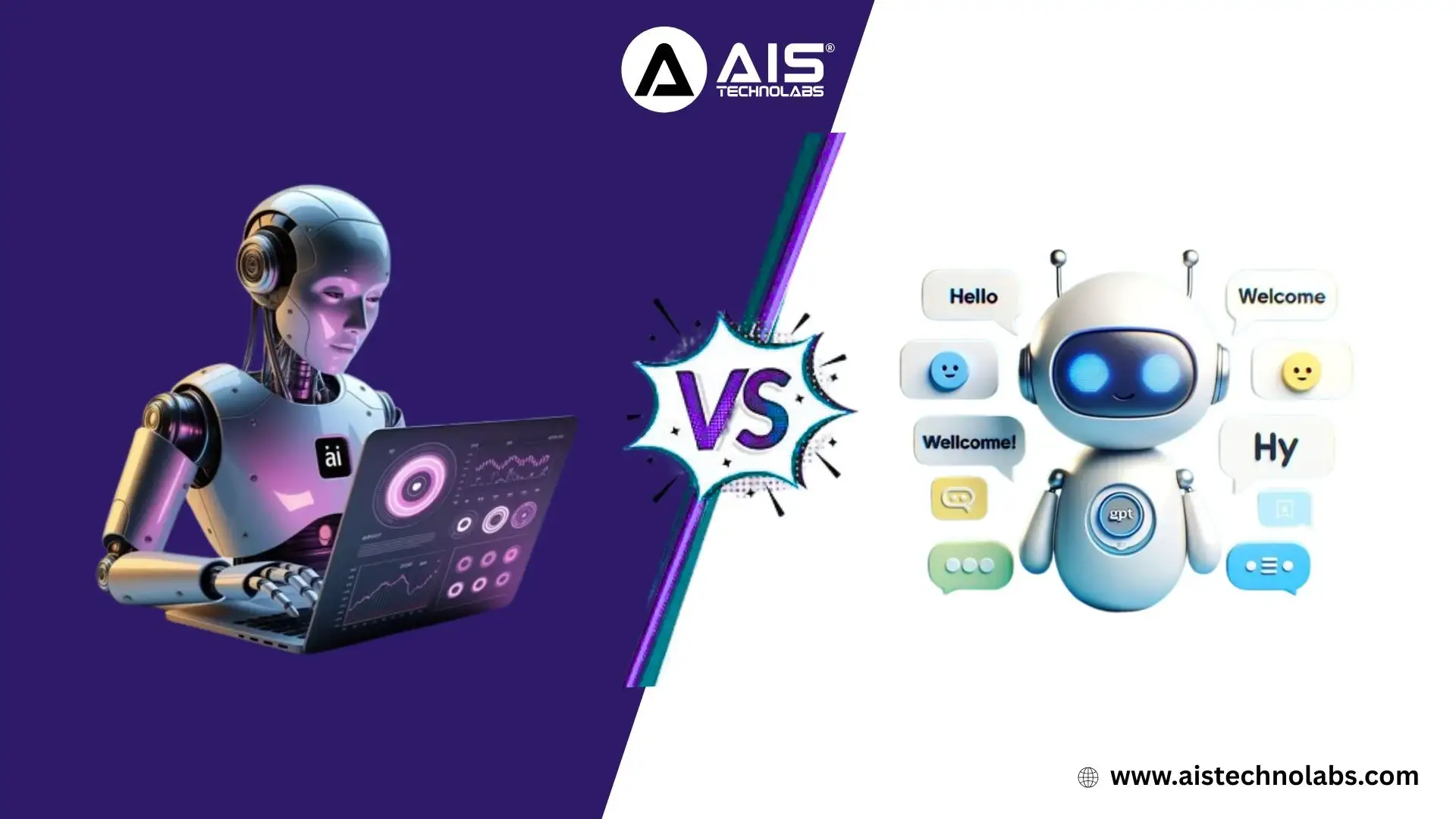
What Is an AI Chatbot?
A chatbot is an interactive artificial intelligence program created to communicate with a user via text or audio means. This technology works by listening to the user, understanding his/her intention, and providing a suitable response based on a database, decision tree, or natural language processing model. According to IBM's definition of chatbots, modern chatbots increasingly leverage machine learning development techniques to improve their accuracy and contextual understanding over time.
What makes a chatbot unique is its reactivity. That means the bot waits for a user trigger and responds appropriately, then forgets the entire exchange after the session.
Definition: An interactive tool that responds to user input with responses, data, or guided actions, all within one session at a time.
What a chatbot is good at:
- Answering FAQs at scale, 24/7
- Capturing and qualifying leads on landing pages
- Handling booking, scheduling, and order status queries
- Deflecting tier-1 support tickets before they reach a human agent
- Delivering consistent, on-brand responses every single time
A business that invests in professional AI chatbot development services can typically deflect 60–80% of repetitive support queries within weeks of going live. The economics are proven, and the ROI timeline is short — usually 30 to 60 days. To explore how AI & machine learning can further enhance intelligent systems, see our deep dive on How AI & Machine Learning Enhance Real-World Applications.
But the moment a task requires judgment, spans multiple tools, or needs the system to act rather than answer, a chatbot hits a hard wall. That's where AI agents come in.
What Is an AI Agent?
An AI agent is an autonomous, goal-driven software system that can plan, decide, and execute multi-step tasks — often across multiple tools and platforms — with little to no human involvement during execution. As IBM explains in its AI agent overview, agents don't just generate text — they take real actions inside live systems.
You don't just ask an agent a question. You give it a goal. It figures out the steps, uses the tools it has access to (APIs, databases, email, browsers, code runners), makes decisions along the way, and delivers a result.
Definition: An autonomous system capable of multi-step task execution, tool use, memory, and adaptive decision-making — able to operate proactively without constant human input.
What an AI agent is good at:
- Executing end-to-end workflows across CRM, email, and calendar
- Conducting research, synthesising data, and generating reports
- Running autonomous sales outreach and follow-up sequences
- Handling complex customer service actions — refunds, account changes, escalations
- Writing, testing, and iterating on code independently is ideal for modern AI-powered software development pipelines.
When businesses engage professional AI agent development services, they're not just adding another chat interface — they're deploying software that can replace entire manual workflows. An agent can monitor your sales pipeline overnight, identify stalled deals, draft personalised follow-up emails, and log every action in your CRM before your team sits down in the morning.
Powered by generative AI development at its core, a true AI agent combines language reasoning with real-world tool execution — making it a fundamentally different class of software from a chatbot.
That's not a chatbot. That's a system with agency.
AI Agent vs Chatbot — Head-to-Head Comparison
Understanding the AI agent vs chatbot distinction gets much clearer when you put them side by side across the criteria that actually matter for a business decision.
The difference between an AI agent and a chatbot isn't about which one is smarter in conversation — it's about what the system is designed to own. Chatbots own the conversation. Agents own the outcome.
When Your Business Needs a Chatbot
A chatbot is the right investment when your core problem is about speed and access — getting users fast, consistent answers at scale, without overloading your team. If your inbox is flooded with the same 40 questions every week, a chatbot solves that cleanly.
Best chatbot use cases:
- High-volume repetitive customer queries (returns, shipping, billing FAQs)
- Lead capture and qualification on your website or landing pages
- 24/7 support coverage without 24/7 staffing costs
- Appointment scheduling, order tracking, and simple booking flows
- Product onboarding flows for SaaS businesses
Signs you need a chatbot, not an agent:
- Your team answers the same questions repeatedly every day
- Interactions follow predictable, structured patterns
- You need fast time-to-value with a limited budget
- Your goal is coverage and consistency, not complex automation
There's no reason to over-engineer a solution here. If your workflows don't involve AI agentic workflows — multi-step, multi-system logic — a well-built chatbot is faster to deploy, cheaper to maintain, and proven in the market. It's the right tool for a well-defined, bounded problem.
When Your Business Needs an AI Agent
An AI agent earns its complexity when the task requires doing, not just answering. If finishing a job means pulling data from one system, making a judgment call, and then executing an action in another system, a chatbot simply cannot do that. You need an agent. As MIT Sloan's research on agentic AI explains, these systems don't just respond — they perceive, reason, and act on their own.
Best AI agent use cases:
- Workflows that span CRM, email, calendar, and database systems
- Automated research, competitor analysis, and report generation
- Autonomous sales outreach, follow-up sequences, and lead nurturing
- Complex customer service requiring system actions — issuing refunds, updating plans, flagging accounts
- Software development pipelines — writing, testing, and deploying code
Signs you need an agent, not a chatbot:
- Your workflows touch 3 or more tools or systems
- Tasks require decisions or judgment mid-execution
- You're trying to automate work currently done by experienced staff
- You want software that acts autonomously, not just responds
- You're scaling operations without scaling headcount
This is where working with a specialist AI development company becomes critical. Building robust AI agentic workflows requires expertise in prompt orchestration, tool design, error handling, and safe human-in-the-loop architecture. Our AI consulting services can help you assess whether an agent, a chatbot, or a hybrid is the right fit for your workflows before you commit to a build.
But done well, the returns are transformational. One well-designed agent can replace dozens of hours of manual work per week — permanently.
Can You Have Both? The Hybrid Approach
Absolutely — and this is exactly the architecture that leading businesses are deploying in 2026. The model is simple: a chatbot handles the front door, and an AI agent is triggered when the task demands it.
How the hybrid flow works:
User sends message → Chatbot identifies intent → Simple query? Chatbot responds • Complex task instantly? Chatbot hands off to AI agent → Agent executes across systems → Outcome delivered back to user
In practice, imagine a customer support system where the chatbot handles 80% of interactions — FAQs, order status, basic account queries. But when a user says, "I've been charged incorrectly three times, and I need a full account review and refund," the chatbot escalates to an agent. The agent pulls billing history, processes the refund, sends a resolution email, and flags the account for a customer success review — all without a human touching it.
This hybrid model is the sweet spot. You get the cost efficiency of a chatbot at scale, with the power of an agent for cases that need it. Successful hybrid deployments rely on solid AI integration services that connect your chatbot layer to your agent layer seamlessly — with smart handoff logic that knows precisely which triggers should escalate from bot to agent.
Most mature AI development services engagements in 2026 are designed exactly this way. The key to making it work is smart handoff logic — knowing precisely which triggers should escalate from bot to agent, and ensuring the agent has enough context to pick up seamlessly.
Conclusion
When you break it down, the AI agent vs chatbot question isn't really about technology — it's about scope. What do you need the system to own?
If your problem is volume — too many repetitive questions, too little team bandwidth, too many hours lost to simple tasks — a chatbot is your answer. It's fast to build, cost-effective to run, and proven across industries.
If your problem is complexity — workflows that span systems, tasks that require judgment, operations you want to run without human hands on every step — you need an AI agent. The investment is higher, but so is the ceiling on what you can automate.
And if you want both? The hybrid approach gives you a responsive front-end chatbot with a powerful agent running behind the scenes for anything complex.
The businesses scaling fastest right now aren't choosing between tools blindly. They understand the difference between an AI agent and a chatbot, match the right solution to the right problem, and build with a long-term architecture in mind. That's exactly what we help companies do.
Not Sure Which You Need?
Talk to our AI experts. We'll assess your workflows and recommend the right approach with honest advice on cost, timeline, and what will actually move the needle for your business. Reach out via our AI consulting services page to get started.
Talk to Our AI Experts
FAQs
Ans.
Not exactly. Traditional automation follows fixed rules — if X happens, do Y. An AI agent can reason, adapt, and handle situations it hasn't encountered before. Where a rule-based workflow breaks on an edge case, an agent figures out the next best step. It's automation with judgment built in.
Ans.
Yes — increasingly so. While custom-built agents developed through enterprise AI agent development services can run $50,000+, mid-market platforms now let smaller businesses deploy basic agents for $200–$2,000/month. The right entry point depends on your workflow complexity and how much customisation you need.
Ans.
Chatbots typically show measurable ROI within 30–60 days. AI agents take longer to tune but tend to deliver higher returns over 6–12 months, especially in sales automation and ops workflows where time savings compound over time.
Ans.
Yes, they can. Good agentic architecture includes human-in-the-loop checkpoints for high-stakes actions, confidence thresholds, and full audit logs. The more mature the system and the more experienced your AI development company, the lower the error rate — and the safer the deployment.
Ans.
Siri and Alexa are voice-first chatbots — they respond to commands but rarely execute multi-step tasks autonomously. A true AI agent is far more capable: it plans, uses tools, remembers context across sessions, and operates without being triggered for every individual step. The AI agent vs chatbot gap applies here too — Siri answers; an agent acts.

Harry Walsh
Harry Walsh, a dynamic technical innovator with 8 years of experience, thrives on pushing the boundaries of technology. His passion for innovation drives him to explore new avenues and create pioneering solutions that address complex technical problems with ingenuity and efficiency. Driven by a love for tackling problems and thinking creatively, he always looks for new and innovative answers to challenges.
 ASIA PACIFIC