Table of Content
(505 views)
Published:March 26, 2026 at 9:14 am
Last Updated:25 May 2026 , 11:18 am
Key Takeaways:
Introduction
Choosing the right backend framework is not just a technical decision. It shapes how your product behaves, how fast it runs, and how easy it is to grow later. If you are stuck between Django vs NodeJS, you are not alone. This comparison comes up in almost every development discussion.
Both are strong. Both are widely used. But they solve problems in different ways. Whether you are building in-house or want to hire Node.js developer for your next project, understanding the core differences between these two technologies will help you make a smarter staffing and architecture decision. This blog breaks things down clearly so you can decide what fits your project.
Understanding the Basics of Django and NodeJS
Before comparing performance, you need to understand what each one is. Django is a Python-based framework. If you are also evaluating Python alternatives, our Django vs Laravel guide covers how Django compares against another popular framework.
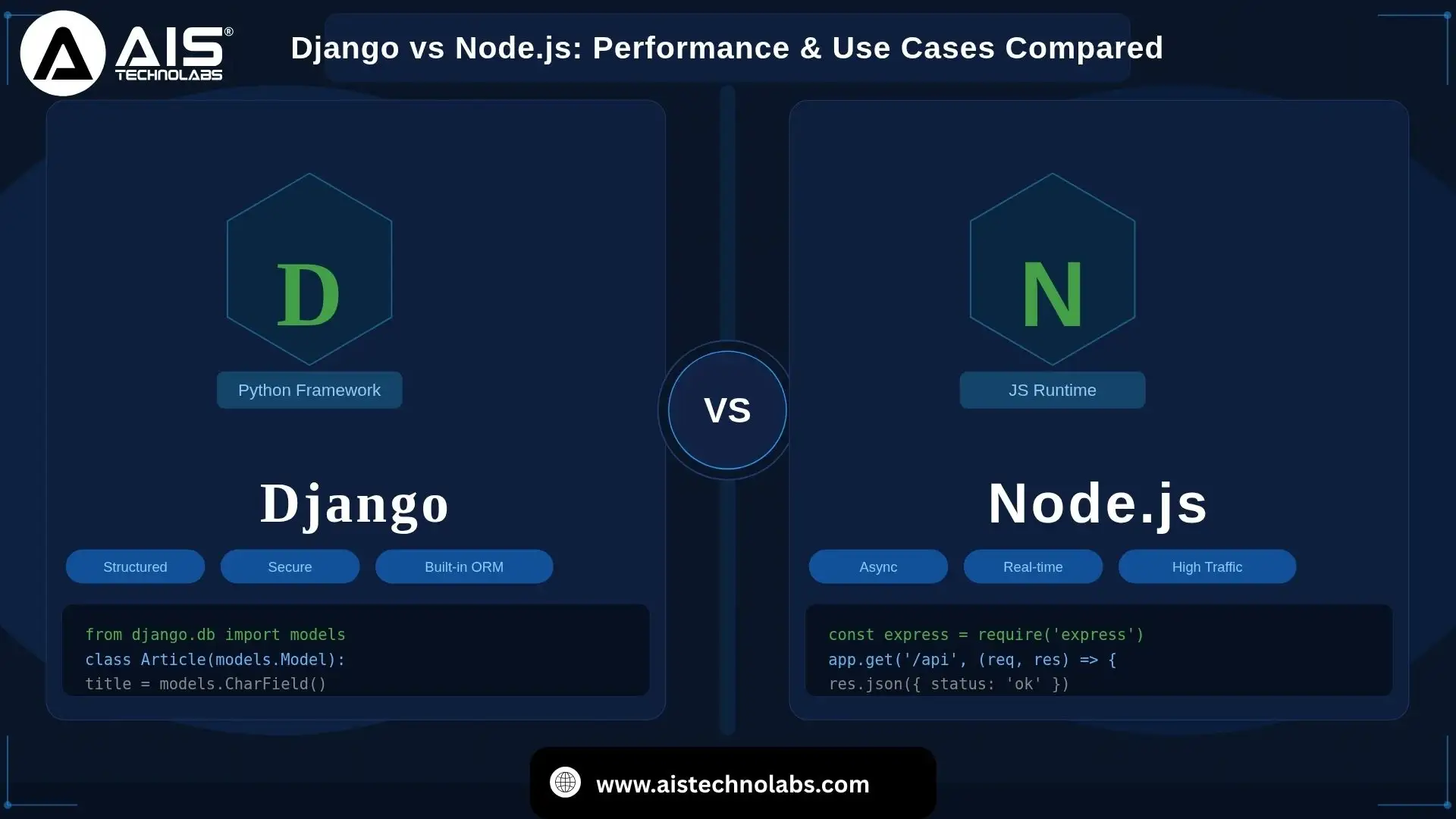
NodeJS is not a framework. It is a runtime environment. It allows JavaScript to run on the server. It works well with event-driven architecture and handles many requests at the same time. When you look at Django vs NodeJS, the difference starts right here. Django is opinionated. NodeJS is flexible.
How does Django work?
Django follows the Model-View-Template structure. It keeps code organized. It handles database operations through an ORM. You do not write raw SQL most of the time.
It also includes security features by default. Things like CSRF protection and input validation are already built in. Because of this structure, teams often prefer to Hire Django Developers when they want fast development with clear code patterns.
How NodeJS Works?
NodeJS uses an event driven model. It runs on a single thread but handles many requests through non-blocking operations. This makes it very efficient for tasks like real-time communication, APIs, and streaming.
Many businesses prefer to hire Node.js developer teams when they need speed and flexibility in handling concurrent users. The cost to hire Node.js developers varies depending on experience level, project complexity, and whether you choose freelancers, in-house staff, or a dedicated development partner.
Django vs NodeJS: Performance Comparison
Performance is one of the biggest factors when comparing Django vs NodeJS.
Request Handling
NodeJS handles multiple requests at once using asynchronous processing. It does not wait for one task to finish before starting another. Django follows a synchronous approach by default. Each request is handled one at a time unless you use additional tools. This makes NodeJS faster in handling high traffic.
Speed
NodeJS is generally faster for I/O-heavy tasks. This includes APIs, chat apps, and streaming services. Django is fast, too, but it performs better in data-heavy applications rather than real-time systems.
Scalability Approach
NodeJS handles many users efficiently without much overhead. Django can also handle growth, but it often needs more setup, like load balancing and caching. So, in Django vs NodeJS, NodeJS has an edge in handling concurrent users.
Development Speed and Ease
This is where Django stands out. Django provides ready-made components. You do not need to build everything from scratch. Authentication, admin panels, and routing are already included. This reduces development time.
NodeJS gives you freedom. But you need to choose libraries and structure everything yourself. This takes more time and planning. Many companies choose a Node.js development company when they want custom architecture instead of a fixed structure.
Learning Curve
Django is easier for beginners who know Python. It has clear documentation and a consistent way of doing things. NodeJS requires understanding asynchronous programming. This can be confusing at first. So, when comparing Django vs NodeJS, Django is easier to learn.
Use Cases of Django
Django works best when you need a structured backend with strong data handling. It follows clear patterns, which helps teams stay organized as the project grows. Its built-in tools reduce development effort and keep things consistent across the application.
Content-Based Platforms
Django is a strong fit for content-heavy websites such as blogs, publishing platforms, and CMS-driven portals. It includes an admin panel that makes content management simple. Teams can update, edit, and organize content without relying heavily on developers, which saves time during daily operations.
Data-Driven Applications
Applications that rely on large amounts of data benefit from Django’s ORM. It simplifies database interactions and keeps queries clean. This is useful for dashboards, analytics platforms, and reporting systems where structured data handling is important for accuracy and performance.
Secure Applications
Security is one of Django’s strongest areas. It comes with built-in protection against common threats like SQL injection, cross-site scripting, and CSRF attacks. This makes it a preferred option for applications where user data and transactions must remain protected at all times.
Rapid Development with Built-in Features
Django includes many ready-to-use components such as authentication, user management, and routing. This reduces the need to build features from scratch. Development becomes faster, and teams can focus more on business logic instead of basic setup.
Enterprise and Internal Tools
Many companies choose to Hire Django Developers for building internal systems, financial platforms, or healthcare applications. The framework’s structured approach ensures maintainability, while its reliability supports long-term usage without frequent issues.
Use Cases of NodeJS
NodeJS is ideal for applications that require speed, continuous data flow, and the ability to handle many users at once. Its event-driven approach makes it a strong choice for systems where performance and responsiveness matter.
Real-Time Applications
NodeJS works very well for real-time features such as chat apps, messaging platforms, and live collaboration tools. It can process multiple user interactions at the same time without delays, making communication feel instant and smooth.
Streaming Services
Applications that involve audio or video streaming benefit from NodeJS. It can handle data in small chunks, which allows users to start consuming content without waiting for the entire file to load. This improves user experience significantly.
APIs and Microservices
NodeJS is widely used for building APIs and microservices. Its lightweight nature helps in handling multiple requests efficiently. It is also easy to connect with front-end applications since both can use JavaScript, which keeps development more consistent.
High-Traffic Applications
Platforms that expect a large number of users at the same time perform well with NodeJS. It manages concurrent requests effectively, which helps maintain performance even during peak usage.
Flexible and Fast Development
NodeJS gives developers the freedom to choose tools and structure the application as needed. This flexibility makes it suitable for custom solutions. Many businesses prefer to hire node.js developer teams for projects that require speed, adaptability, and real-time capabilities.
Django vs NodeJS: Database Handling
- Django uses a built-in ORM that simplifies how developers interact with databases. You work with Python objects instead of writing complex SQL queries. This keeps the code clean and easy to manage. It also reduces the chances of errors, especially in large applications where database logic can get complicated.
- The ORM in Django supports common database operations like filtering, joining tables, and migrations. It also helps maintain consistency in how data is handled across the project. For teams working on structured applications, this makes development smoother and more predictable.
- NodeJS takes a different approach. It does not come with a default ORM. Developers can choose from many libraries like Sequelize, TypeORM, or Mongoose, depending on the database they prefer. This gives more freedom in designing how data is stored and accessed.
- Another key difference in Django vs NodeJS is how migrations and schema changes are handled. Django provides built-in tools for managing database changes. In NodeJS, this depends on the library being used, which can vary from project to project.
So, when comparing Django vs NodeJS, Django is a better choice if you want simplicity, built-in tools, and a clear structure for database management. NodeJS is better if you need flexibility, custom database setups, and support for different types of data models.
Security Comparison
Security is an important factor when comparing Django and NodeJS, especially for applications that handle sensitive data. Django includes built-in protection against common threats such as SQL injection, cross-site scripting, and CSRF attacks. These features are enabled by default, which reduces the risk of basic vulnerabilities.
NodeJS does not provide these protections out of the box. Developers need to handle security manually by using middleware and best practices. This gives more control, but it also increases responsibility. The overall security depends on how well the development team implements these measures.
Flexibility and Customization
Flexibility is one of the main strengths of NodeJS. It allows developers to build applications in their own way by choosing tools, libraries, and architecture styles. This makes it suitable for projects that require a custom approach or unique features.
Django follows a more structured pattern. While it limits freedom to some extent, it makes the code easier to manage and maintain. Teams that prefer clarity and consistency often find Django more reliable. For highly customized systems, working with a Node.js development company can help achieve the desired level of flexibility.
Django and NodeJS for Startups
Startups usually need quick development and simple maintenance in the early stages. Django helps speed up the launch process because many features are already built in. This reduces development time and allows teams to focus on the core idea.
NodeJS becomes a better choice if the startup is focused on real-time features such as messaging, live updates, or streaming. In Django vs NodeJS, the decision for startups depends on what the product actually needs to deliver.
Django and NodeJS for Enterprise Applications
Enterprise applications often deal with complex systems and large user bases. Django works well for platforms that require structured workflows and strong data handling. It is commonly used for internal tools and systems where stability is important.
NodeJS is a better fit for applications that need to handle many users at once or provide real-time interactions. Many organizations Hire Django Developers for backend-heavy systems, while they hire node.js developer teams for features that demand speed and responsiveness.
Cost of Development
Django can reduce development costs because of its ready-made features. NodeJS may require more development time, which increases cost. However, NodeJS can save costs in the long run for high-traffic systems. So, in Django vs NodeJS, the cost depends on the project type.
Below is a clear comparison table to help you understand the development cost in a better way:
Below is a clear comparison table to help you understand the development cost in a better way:
Django vs NodeJS: Performance Summary
Let’s simplify the performance comparison.
- NodeJS handles high traffic better
- Django manages data-heavy tasks better
- NodeJS is faster for real-time features
- Django is stable for structured applications
When to Choose Django?
Choose Django if:
- You need fast development
- Your project is data-heavy
- Security is a priority
- You want a structured framework
In such cases, it makes sense to hire Django Developers who understand the framework well.
When to Choose NodeJS?
Choose NodeJS if:
- Your app needs real-time features
- You expect high user traffic
- You need a flexible architecture
- You are building APIs or microservices
For this, many businesses prefer to hire node.js developer experts.
Conclusion
When comparing Django vs NodeJS, there is no single answer that fits all projects. Django offers simplicity, built-in tools, and strong security. NodeJS offers speed, flexibility, and better handling of concurrent users. Take time to understand your requirements. Think about your users, your features, and your future plans. Then choose the technology that supports your vision.
And if needed, work with the right experts. Whether you hire Django Developers, hire Node.js developer teams, or partner with a Node.js development company, the right team makes all the difference. AIS Technolabs helps businesses navigate these decisions with clarity, offering experienced Django and Node.js teams that align with your project goals, timeline, and budget.
FAQs
Ans.
Django is generally better for beginners. It follows a clear and structured pattern, comes with detailed documentation, and includes built-in tools that reduce the need to configure everything from scratch. Developers who already know Python will find Django easier to pick up. NodeJS requires an understanding of asynchronous programming, which can be confusing for those just starting out.
Ans.
Yes, they can. Some teams use Django to handle the backend data logic and admin features while using NodeJS to manage real-time features such as live chat or notifications. This approach is less common but works well for projects that need both structured data handling and fast concurrent processing in different parts of the application.
Ans.
NodeJS is widely preferred for building REST APIs. Its lightweight nature, fast response time, and event-driven model make it well-suited for handling multiple API requests simultaneously. However, Django also supports REST API development through the Django REST Framework, which is a strong choice when the API needs to connect with a data-heavy backend.
Ans.
Django has a clear advantage in built-in security. It includes default protection against common threats such as SQL injection, CSRF attacks, and cross-site scripting. NodeJS does not provide these protections out of the box. Developers working with NodeJS need to implement security measures manually using middleware and third-party libraries, which requires more experience and careful planning.
Ans.
The answer depends on what the startup is building. Django works well for startups that need to launch quickly with a structured backend, user authentication, and database management already in place. NodeJS is a better fit for startups focused on real-time features, high user traffic, or flexible API architecture. Both are cost-effective, but Django generally reduces early-stage development time due to its ready-made components.
Ans.
Not necessarily. NodeJS performs faster in I/O-heavy tasks such as real-time communication, streaming, and handling concurrent users. However, Django performs equally well or better in data-heavy applications where complex database queries, structured logic, and strong data integrity are the priority. The right choice depends on the specific performance needs of your project rather than a blanket speed comparison.

Harry Walsh
Harry Walsh, a dynamic technical innovator with 8 years of experience, thrives on pushing the boundaries of technology. His passion for innovation drives him to explore new avenues and create pioneering solutions that address complex technical problems with ingenuity and efficiency. Driven by a love for tackling problems and thinking creatively, he always looks for new and innovative answers to challenges.
 ASIA PACIFIC