Table of Content
(509 views)
Published:February 6, 2026 at 12:18 pm
Last Updated:25 May 2026 , 6:00 am
Key Takeaways:
- In this Blog Cover what Hybrid App Architecture is and how it helps businesses build one mobile app that works on both Android and iOS using a single codebase.
- It compares hybrid vs traditional (native) app development, showing how hybrid apps are faster to build, easier to maintain, and more cost-effective.
- It breaks down the core structure of hybrid apps, including frontend, native container, logic layer, backend systems, and API integration.
- It explains how hybrid apps work with backend architecture, APIs, scalability, performance, and security, and why they are becoming a popular choice for modern businesses.
Quick Overview
A few years ago, building a mobile app usually meant choosing sides, Android or iOS, and maintaining two separate development tracks. That worked, but it was expensive, slow, and often frustrating when features rolled out unevenly across platforms.
Today, things have changed. Businesses want speed, consistency, and flexibility. That’s where hybrid app architecture has quietly become one of the most practical solutions in modern mobile development.
Instead of reinventing the wheel twice, companies now build one application that works everywhere. But behind this simplicity sits a smart technical structure that balances web technologies, mobile performance, and scalable backend systems.
What is Hybrid App Architecture?
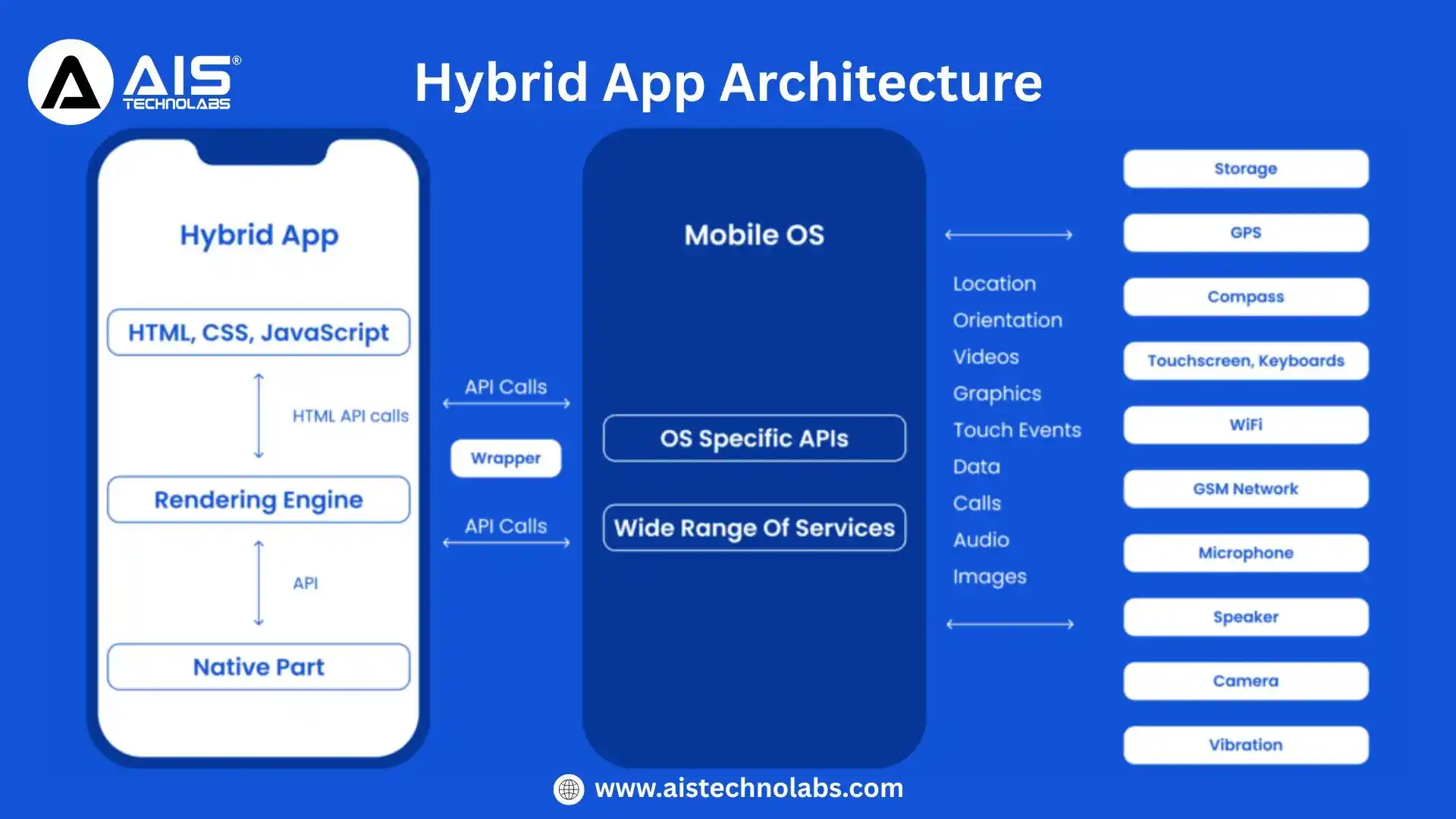
At its core, hybrid app architecture is a way of building mobile applications using web technologies and running them inside a native mobile shell. The interface you see is mostly built with HTML, CSS, and JavaScript, while the mobile device treats it like a normal app. When businesses utilize hybrid mobile app development services, they essentially create a website that lives inside your phone, but with the added power to access native features like the camera, GPS, and notifications.
The app doesn’t live fully on the web, and it’s not fully native either. It sits comfortably in between, using a WebView to display content and a bridge layer to talk to the mobile operating system.
This approach allows developers to:
- Write code once and deploy everywhere
- Push updates faster
- Reduce development and maintenance costs
- Maintain consistent design across platforms
Modern tools like Ionic, Cordova, Flutter hybrid setups, and React Native-based systems have made hybrid apps faster and more reliable than ever before.
Today’s hybrid app architecture is no longer a shortcut; it’s a strategic choice.
Hybrid App Architecture vs Traditional Mobile App Architecture
To understand why hybrid is gaining popularity, it helps to look at how traditional mobile app architecture works.
In a native setup, Android and iOS apps are built separately using different languages and tools. That usually means two development teams, two timelines, and double the testing efforts.
Native apps are powerful, but they require:
- More budget
- Longer launch cycles
- Higher long-term maintenance
Hybrid app architecture simplifies development by keeping most of the logic in one shared codebase. Instead of rebuilding features twice, developers update once and deploy everywhere. Bugs are fixed faster, features roll out together, and costs stay controlled. From a business perspective, hybrid offers a faster time to market without sacrificing user experience, especially when combined with strong backend systems. That’s why many startups, eCommerce platforms, and SaaS companies choose to hire hybrid mobile app developers to build their foundation, ensuring a seamless experience across all devices.
Core Components of Hybrid App Architecture
Behind every hybrid app sits a layered structure that works quietly in the background.
Frontend Layer
This is what users see and interact with. It’s built using web technologies and frameworks that handle layout, animations, and user interactions. It behaves like a mobile app but is powered by web code.
Native Container
The container is what allows the web-based interface to run inside the phone like a real app. It also handles communication between the app and device hardware.
When you take a photo, scan a QR code, or receive a push notification, the container makes it possible.
Logic Layer
This is where the app makes decisions. It handles user actions, workflows, validations, and data flow.
Well-organised logic keeps the app responsive and easy to update as new features are added.
Backend Infrastructure
No modern app survives without solid server-side support. This is where data lives, users authenticate, payments are processed, and analytics run.
This is also where app backend architecture plays a major role in performance and scalability.
API Integration and App Backend Architecture
Hybrid apps rely heavily on API integration to function smoothly.
Instead of storing everything inside the app, data flows back and forth between the frontend and backend servers using APIs.
Whenever a user:
- Logs in
- Places an order
- Updates a profile
- Syncs data
An API request is sent to the server, processed, and returned in real time. Good API integration keeps the app lightweight while giving it powerful capabilities.
On the backend side, modern app backend architecture usually includes:
- Cloud servers
- Microservices for different features
- Secure authentication layers
- Scalable databases
This structure allows apps to grow without crashing under heavy traffic.
If ten users join today or ten million next year, a well-designed backend can handle it.
Hybrid App Architecture Diagram and System Design Flow
If we simplify how everything connects, the system design looks something like this:
User → Hybrid App Interface → API Layer → Backend Services → Database
Here’s what happens in everyday use:
- You open the app and request information.
- The app sends that request through an API.
- The backend processes it.
- Data is retrieved or updated.
- The response comes back instantly.
This clean flow keeps each part independent. The frontend focuses on experience. The backend focuses on power and security.
Good system design means you can upgrade one part without breaking the rest.
Scalability, Performance, and Security in Hybrid App Architecture
One of the biggest myths about hybrid apps is that they don’t scale well. That used to be true years ago, but not anymore.
Scalability
When paired with cloud infrastructure and microservices, a hybrid app architecture scales extremely well.
Businesses can:
- Add new features without heavy rebuilds
- Handle traffic spikes easily
- Expand globally without rewriting apps
Performance
Modern hybrid frameworks use:
- Hardware acceleration
- Smart caching
- Optimised rendering engines
- Native plugin access
Most users can’t tell whether an app is hybrid or native.
The experience feels smooth when built properly.
Security
Security depends more on backend design than frontend technology.
Best practices include:
- Encrypted API communication
- Secure login tokens
- Data validation
- Regular updates
A well-structured app backend architecture keeps user information protected.
Why Hybrid App Architecture is Gaining Popularity
Several real-world factors are pushing businesses toward hybrid models.
- Mobile app Development costs continue to rise.
- Users expect faster updates.
- Companies want faster experimentation.
- Global reach is essential.
Hybrid app architecture allows businesses to move quickly without technical debt.
It fits perfectly with cloud-first strategies and modern agile development workflows.
That’s why many well-known apps today quietly use hybrid or semi-hybrid structures under the hood.
Conclusion
Hybrid app architecture has grown from a simple cost-saving approach into a powerful development strategy used across industries. By blending web technologies with native mobile capabilities, businesses get faster launches, easier updates, and consistent experiences across platforms.
When supported by strong API integration, scalable app backend architecture, and thoughtful system design, hybrid apps can match the performance and reliability of traditional native apps.
For companies aiming to build flexible, future-ready mobile solutions, hybrid architecture offers a smart balance between speed, cost, and quality.
Organisations like AIS Technolabs are helping businesses implement modern hybrid app systems that scale securely while delivering excellent user experiences.
FAQs
Ans.
Yes. They allow faster development, lower costs, and quicker market entry.
Ans.
With proper backend architecture and cloud scaling, they can support millions of users.
Ans.
Modern hybrid frameworks perform nearly as fast as native when optimized properly.
Ans.
Extremely important, it connects the frontend to backend services and powers most app features.
Ans.
Yes, when built with encrypted communication, authentication systems, and secure backend infrastructure.
Ans.
Many already do. It offers flexibility, scalability, and faster feature rollout.

Harry Walsh
Harry Walsh, a dynamic technical innovator with 8 years of experience, thrives on pushing the boundaries of technology. His passion for innovation drives him to explore new avenues and create pioneering solutions that address complex technical problems with ingenuity and efficiency. Driven by a love for tackling problems and thinking creatively, he always looks for new and innovative answers to challenges.
 ASIA PACIFIC