Table of Content
(503 views)
Published:December 19, 2025 at 7:28 am
Last Updated:30 Apr 2026 , 6:14 am
Introduction
Among all the decisions a developer or team of developers might face after creating an application, choosing the right stack (technology stack) is extremely important. The debate between MERN vs MEAN has become a hot topic among developers, driven by the growing popularity of JavaScript-based full-stack frameworks for complete, or "full-stack," development. The goal of each stack is to provide a complete solution for developers when creating their dynamic web applications. Most likely, the developers at both start-ups and established companies will select one of these tech stacks. Knowledge of the pros and cons of both stacks is essential for today's full-stack developer boot camps, especially for those entering the workforce through boot camps. The choice of the right tech stack will shape the developer's approach to engineering, scalability, performance, and the application's long-term support.
In this article, we will analyze the MERN and MEAN stacks, comparing their features and benefits to help determine which is best for each applicant's projects. The information indicated within this article will be valuable when making decisions about your upcoming career and current technical roadmap.
Understanding the Foundations: MERN and MEAN
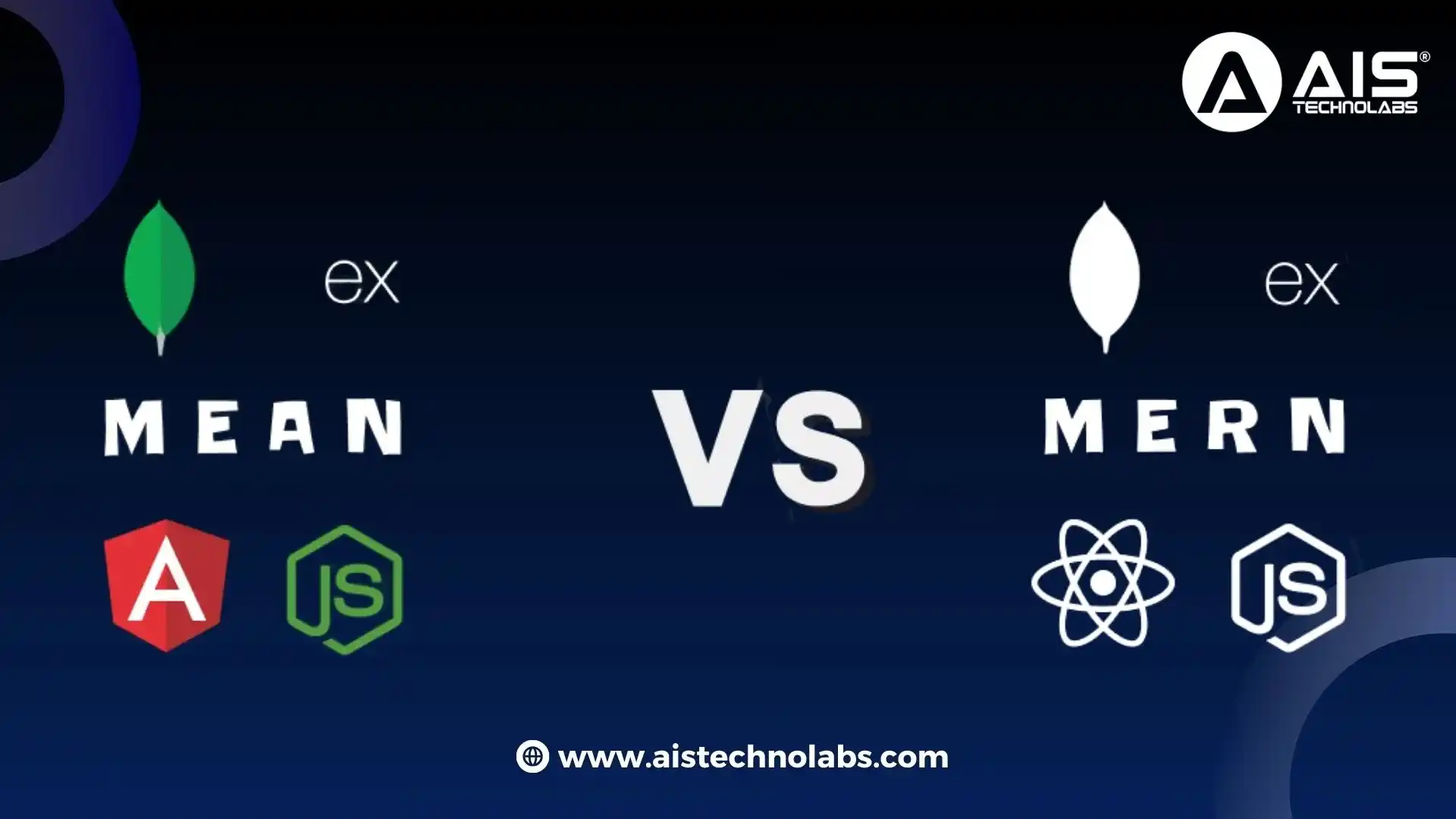
Despite using different front-end technologies, MERN vs MEAN share a JavaScript-based architecture that powers the entire workflow, from client to server.
What is the MEAN Stack?
MEAN includes:
- MongoDB
- Express.js
- Angular
- Node.js
This approach yields a controlled environment in which Angular takes the lead, using solid architectural patterns to build the front end. MEAN has been the preferred choice for large teams due to its consistency and the extensive set of features built directly into Angular.
What is the MERN Stack?
MERN is made up of:
- MongoDB
- Express.js
- React
- Node.js
The React full-stack framework has climbed the popularity ladder. It is now on par with Angular due to its lightweightness and strong commitment to a component-based architecture, enabling users to build applications with high design flexibility, customization, and reactivity. The powerful support of the React ecosystem and the capability of the developers to build complex, responsive, interactive UI elements with little overhead have made React very popular and widely accepted in recent years.
Why the MERN vs MEAN Debate Exists
Angular and React are both powerful full-stack frameworks, but they differ fundamentally in their core principles. This one difference causes a massive gap in:
- Application Architecture
- Learning
- Performance
- Flexibility
- Scaling
Developers usually choose the stack that suits their preferences for UI and code organization. Angular, for instance, is a complete full-stack framework with rigid rules, while React is a minimalist library that lets developers decide what to use.
Front-End Comparison: Angular vs React
Front-end development plays a decisive role in choosing between the MERN vs MEAN stacks, as UI/UX standards continue to rise. The front end determines how quickly features can be developed and what the user's overall experience will be.
Angular's Impact on the MEAN Stack
Angular provides solid design patterns that form the foundation of front-end Mean development. The key advantages of using Angular are:
- Uniform full-stack frameworks
- Neat code
- Handling of forms as a part of the application
- Expert routing
- Development with TypeScript
Because Angular is highly prescriptive, it guides developers toward certain practices, making it a good choice for teams that want to maintain uniformity across large applications.
React's Role in the MERN Stack
React takes a different route with its open-ended design philosophy, which highlights:
- Component reusability
- Implementation of Virtual DOM for display
- Libraries of third parties integrating with React effortlessly
- Quicker UI changes and user interactions
- Combining template and logic with JSX
This is precisely what makes MERN a very appealing option for cutting-edge projects that require the smoothest, fastest interface responses.
Performance: Which Stack Runs Faster?
The performance largely depends on the complexity of the application's user interactions. Both stacks, which are based on Node.js and use a non-blocking architecture, differ in performance, driven by the front-end's handling of state and UI updates.
Performance Characteristics of MEAN (Angular):
- Great for apps that come up to an enterprise-grade standard
- Robust architecture prevents long-term performance problems.
- Two-way data binding can slow down extremely dynamic UIs
- Built-in optimizations control the traffic better.
Performance Characteristics of MERN (React):
- Virtual DOM gives priority to fast rendering
- Most suitable for applications with a lot of interaction and in real-time
- Light and flexible approach, no unnecessary processing done
- Modular and fast because of the component-oriented architecture
React's architecture typically gives MERN a slight edge in dynamic contexts where UI updates occur frequently.
Learning Curve: MERN vs MEAN
The learning curve is a significant consideration when selecting a tech stack, especially for starters or those coming from other programming languages.
MEAN Learning Curve
Angular entails mastering:
- TypeScript
- Modules, decorators, services, and directives
- Angular CLI organization
- Injection of dependencies
- RxJS for reactive programming
This aspect of MEAN can seem complex at first; however, it provides a systematic full-stack framework that equips developers with a future-ready skill set.
MERN Learning Curve
React’s learning journey is quite a bit easier:
- JSX feels natural
- Component logic is pretty much understandable.
- The library-based model lessens the difficulty.
- The ecosystem admits gradual learning.
MERN is often the favoured starting point for students in a full-stack developer bootcamp because it allows creativity without excessive technical constraints.
Scalability: Which Stack Handles Growth Better?
Scalability refers not only to the ability to process a large number of users but also to managing growth in staff, code complexity, and feature count. A MEAN stack is capable of scaling vertically, while the MERN stack is capable of scaling horizontally.
MEAN Scalability Advantages
- Angular has strict rules that reduce the risk of architectural messes.
- TypeScript prevents the use of any type that is not defined.
- The large company teams take advantage of the established norms.
- It is an excellent choice for long-term maintenance.
MERN Scalability Advantages
- The scaling of React component Library is independent of one another.
- The flexible structure permits micro-frontends.
- There is easy integration with cloud-native architectures.
- The teams are free to select libraries that harmonize with their scaling strategy.
Each stack has its own advantages; MEAN is better suited to organizations that demand strict standards, while MERN is better suited to teams that prefer flexibility.
Backend and Database Similarities
Since the two stacks share the same technology stack, such as MongoDB, Express.js, and Node.js, they offer the same benefits in terms of better performance in the backend:
- Non-blocking I/O operations
- JSON-based data handling
- Horizontal scalability
- Strong community support
- Efficient handling of modern web traffic
Thus, the final decision should be based on the preferred front-end development method rather than on backend differences.
Use Cases: When to Choose MERN vs MEAN
MERN should be considered for the following project types:
- Real-time social media applications
- Single-page web applications
- Dynamic visualization tools
- Online streaming services
- Teamwork applications
- Extremely interactive front-end designs
On the other hand, MEAN is a better choice for:
- Corporate-level systems
- Comprehensive CRM or ERP solutions
- Financial and banking applications
- Public or medical institutions' software systems
- Projects demanding austere architecture
- Apps where an integrated structure is essential.
Career Impact: Which Stack Is Better for Developers?
The two tech stacks are excellent choices that will open doors to strong career opportunities. Nonetheless, market demand may vary by location and project type.
MERN Career Advantages
- Great React developer's demand
- More easier entry-level positions
- Startups, SaaS products, and tech giants use React.
- Suitability for freelancers and remote programmers
MEAN Career Advantages
- Choice for businesses and long-term projects
- Angular developers typically reach senior positions with higher salaries.
- Angular + TypeScript skills are in demand everywhere.
- Most suitable for corporate software development environments
If you are attending a full-stack developer bootcamp, it is often recommended to start with MERN and then study MEAN as a secondary stack.
Advantages of the MERN Stack
- Development of flexible front-ends
- The React Virtual DOM enables high-speed UI rendering
- A large community and a lot of libraries available
- Structure based on components.
- Not heavy and easy to integrate
- Most suited for interactive applications
- Not a steep learning curve
- Great for startups and medium-sized projects
- Lots of opportunities for React jobs
Advantages of the MEAN Stack
- Established enterprise framework
- Angular CLI accelerates setup and development.
- Powerful standards and organization
- Integrated tools minimize the need for external libraries.
- TypeScript guarantees neater code
- Great long-term maintainability
- Best for big corporate teams
- Uniform application architecture
Which Technology Should Full Stack Developers Start With?
For those comfortable with HTML/CSS and basic JavaScript, using MERN is a logical choice, as it's built on layers rather than traditional client-side rendering, such as ASP.NET MVC. The components of the MERN stack are relatively straightforward to learn and allow learners to quickly grasp how modern web apps work, back to your shoe store's front end—what happens behind the scenes is less critical to the MERN stack than it is in most Asynchronous JavaScript framework stacks—thereby preventing developers from getting lost in the complexity of full-stack frameworks like ASP.NET MVC.
Alternatively, learning MEAN will provide developers with foundational knowledge of software architecture and design, and Angular requires strict adherence to design patterns that scale to large teams and applications.
Conclusion
The choice between MERN vs MEAN depends on how you plan to build, manage, and scale your application. Each stack has its own strengths, and understanding how they fit into your development workflow is essential.
MERN is ideal for creating modern, interactive applications, offering flexibility and fast development with React’s powerful UI capabilities. MEAN, on the other hand, provides a more structured and stable environment with full Angular compatibility, making it suitable for projects that demand long-term scalability and consistency.
Both stacks deliver comparable benefits, and the right choice ultimately depends on your project goals and technical expertise. At AIS Technolabs, developers are encouraged to master both MERN and MEAN to confidently select the best stack for each project and deliver impactful digital experiences.
FAQs
Ans.
MERN uses React for the front-end, while MEAN uses Angular. This changes how apps are structured, built, and optimised.
Ans.
MERN is generally easier because React has a simpler learning curve. Angular requires learning TypeScript and more structured patterns.
Ans.
MERN scales well but is best suited to interactive, dynamic apps. For extensive enterprise systems, MEAN’s structure is often preferred.
Ans.
MEAN works best for applications that need strong architecture, consistency, and long-term maintainability, especially in enterprise teams.
Ans.
Both stacks are valuable, but MERN vs MEAN should be chosen based on project needs. MERN suits flexibility; MEAN supports structured development.

Harry Walsh
Harry Walsh, a dynamic technical innovator with 8 years of experience, thrives on pushing the boundaries of technology. His passion for innovation drives him to explore new avenues and create pioneering solutions that address complex technical problems with ingenuity and efficiency. Driven by a love for tackling problems and thinking creatively, he always looks for new and innovative answers to challenges.
 ASIA PACIFIC