Table of Content
(510 views)
Published:November 28, 2025 at 8:16 am
Last Updated:30 Apr 2026 , 6:24 am
.webp "Revolutionise Mobile App Development with AI and Low-Code Platforms")
Introduction
The past five years have witnessed a considerable transformation in the mobile app development industry, which is more than that of the previous decade in total. Code practice is no longer the only source of development that the organizations depend upon, and they are no longer waiting for an app to be ready in a few months. App builder tools and modern low-code systems have made the entire development process accessible toD all. As a result, today, businesses, startups, and even non-technical teams can more quickly, smartly, and less expensively turn their ideas into mobile apps than before.
This transformation is supported by two main factors—AI automation and the emergence of low-code app platform solutions, which lower the requirement of heavy manual coding. No longer, these two forces are reshaping the world of digital products.
Low-Code & No-Code Mobile App Development
Low-code and no-code technologies are changing the way teams develop and implement digital solutions. Users, rather than writing thousands of lines of code, are using visual tools, auto-generated components, and ready-made templates to create applications.
Low-code app platforms allow for minimal coding, while no code mobile app builders do not allow for any coding at all. Both methods accelerate development and allow more people to participate in digital innovation.
Why this approach works
- Simplifies development for both novices and experienced programmers.
- Allows business teams to create and refine solutions on their own.
- Assists organizations in getting apps up and running without hindering digital transformation.
- Guarantees quicker time-to-market by removing manual groundwork.
- Facilitates interaction between departments and developers.
AI-Assisted Mobile App Development
- AI is the main factor in the future of mobile app development because it brings intelligence, automation, and
- Smart optimization into the whole development lifecycle.
- The manual construction of screens, debugging problems, and
- Connecting workflows is not needed anymore, as AI has sped up the entire process.
AI-powered automation
- The automated system designs the to-do list, folders, and other everyday UI components.
- It creates workflows either by user requests or by adhering to company procedures.
- It understands application logic and makes connections where the logic is incomplete.
- The developers' repetitive work that usually takes hours is thus made possible for automation.
AI in UI/UX Design
- It creates adaptable layouts for different screen sizes
- It suggests the latest design trends based on the particular industry.
- Suggests fonts, colors, spacing, and accessibility changes.
- The application interface is made uniform through a careful management of all the elements.
Smart debugging & workflows
- The system finds issues even before the compilation process and recommends immediate remedies.
- It spots interruptions in workflow chains or wrong logical conditions.
- It gives suggestions for the application's speed and loading time optimization.
- It recreates user paths for the purpose of testing and correcting in real time.
Time-saving example (40–60%)
AI caulking the development timelines by:
- Screens and templates are auto-generated
- Manual coding is reduced by over 50%
- Hastening of debugging cycles
- UI/UX creation time is reduced due to intelligent design suggestions
In actual situations, companies can save 40–60% of total development time when they use AI along with low-code platforms, which in turn results in lower costs and faster delivery.
Advantages of a Low-Code App Platform
The use of a powerful low-code app platform not only provides visual development but also a whole range of benefits like structure, scalability, and efficiency applied to the entire app creation lifecycle.
Quick App Creation
Apps are made in a matter of weeks instead of months due to factors like
- Most of the building blocks have already been designed
- Tasks are done by machines instead of people
- Laying down the basics with the help of templates is a faster process
The gradual introduction of new features is provided by the fast cycle while quality is still being assured.
Drag-and-drop builder solutions
The majority of apps come with drag-and-drop builder solutions that are user-friendly, where the users can see how UI elements are put together. Modern mobile app development tools make it possible to design interfaces visually, meaning there is no longer a need for coding the layout. However, the drawbacks are that you get:
- A preview that shows what will be seen
- Very simple to change
- Very easy to move around and change location of the elements
Lower dependency on developers
This does not imply the complete removal of developers—yet, on the other hand, it makes their work more efficient.
- Business teams are able to take care of simple tasks by themselves
- Developers are dealing with advanced logic, integrations, and performance
- Fewer communications among departments
Faster prototyping & iteration
Low-code app platform options enable teams to rapidly create startup MVPs, gather feedback, and implement changes quickly. This approach is especially advantageous for startups testing new ideas or for companies revamping their internal systems.
Built-in integrations & scalability
A lot of platforms provide:
- Straightforward integrations with CRMs, ERPs, and payment gateways
- Dependable cloud hosting
- Top-notch security and performance
- Capacity to accommodate user traffic as the application expands, ensuring smooth, rapid app development even as the platform grows.
Top Features in Mobile App Builder Tools
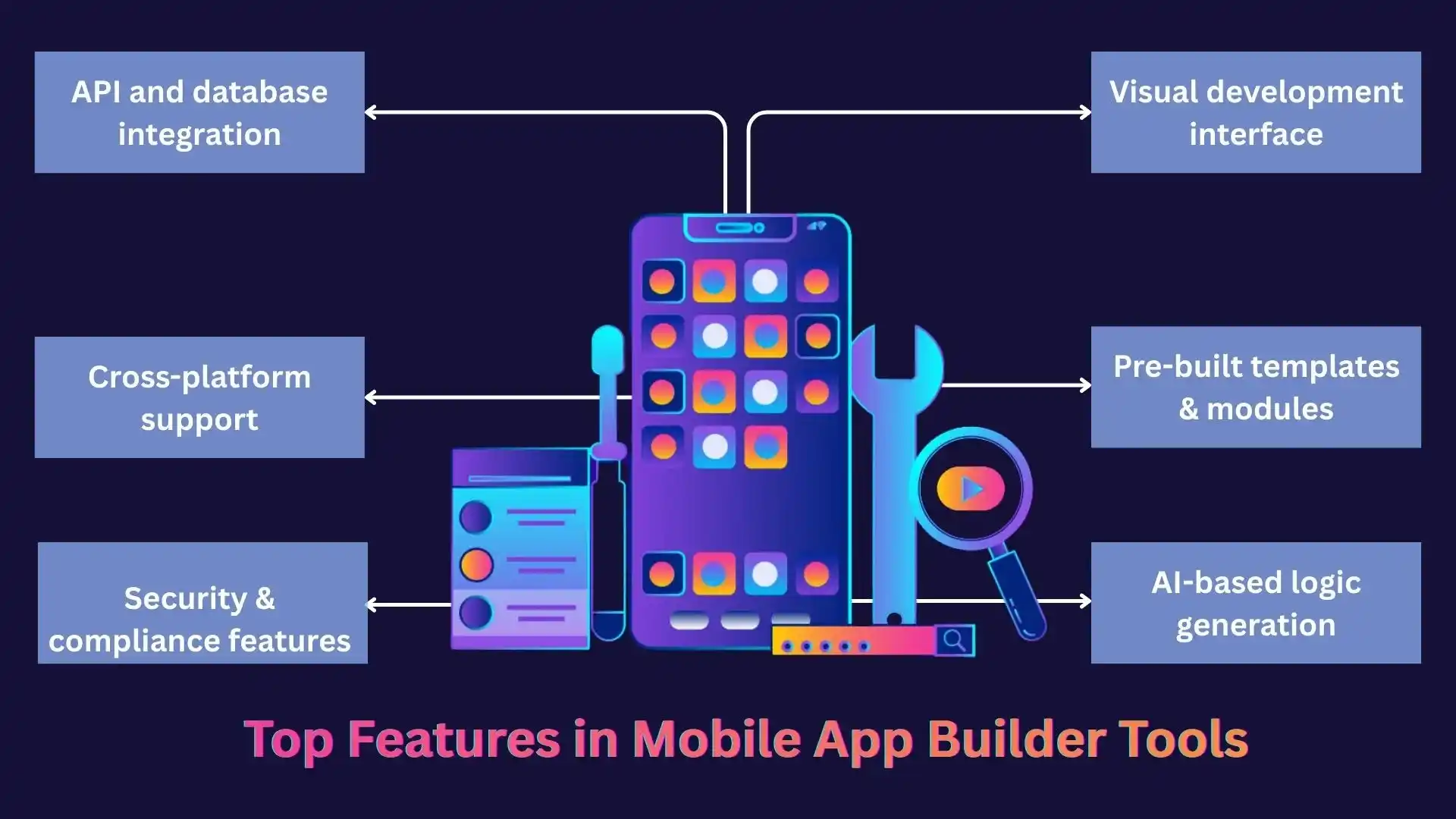
The advanced app builder tools are empowered with smart and easy-to-use functions, enabling even rookies to make first-rate mobile apps.
Visual development interface
- Drag-and-drop screens
- Visual logic builders
- Real-time testing and previews
Pre-built templates & modules
They save both time and labor for the developer community by offering ready-to-launch structures like
- E-commerce layouts
- Booking systems
- CRM dashboards
- Inventory modules
AI-based logic generation
- Auto-creates navigation flows
- Generates conditional logic
- Suggests automation based on user behavior
API and database integration
Low-code systems facilitate the use of up-to-date data technologies. They provide support for:
- REST APIs
- GraphQL
- Firebase
- SQL and NoSQL databases
Cross-platform support
Create one time and release on:
- Android
- iOS
- Web (multiple platforms)
Security and compliance features
- Data encryption
- Authentication and role-based access control
- Compliant with GDPR, HIPAA, and enterprise standards
Use Cases for No-Code Mobile Apps
A no-code mobile app constructor provides an unrestrained approach and can, thus, cater to multiple industries and business needs besides the intended ones.
E-commerce Mobile Applications
- Displaying products
- Shopping basket and payment process
- Methods of payment
- Messages and alerts via mobile
CRM & Workflow Applications
- Management of customer life cycle
- In the bank task and others
- Features for collaborating the team
- Reports and analytics in real time
On-demand Service Applications
- Booking of services
- Tracking through GPS
- Payments through the internet
- Giving feedback by scoring or writing a review
Mobile tools for inventory and ERP
- Tracking of stocks
- Managing of suppliers
- Orders for purchasing
- Operations in the warehouse
SaaS and startup MVPs
- Ready-to-market prototypes launch
- Business models testing done in short time
- Real user data for scaling
Mobile apps for enterprises’ internal use
- Approval by HR
- Finance processes
- Training and compliance apps
- Communication systems for employees
How to Build a Mobile App Using a Low-Code Platform
Creating an app with low-code technologies is efficient and structured. Here’s how the process typically works:
Define requirements
The first step is to get a clear idea of the users you want to target, the business objectives, and the indispensable functionalities of the app. This clear vision will help to create a solid base for the project.
Choose the right platform
Pick a platform that covers the following areas:
- AI capabilities
- Support for various devices
- Integration with APIs
- Security requirements
- Costs
Pick a template or start from scratch
Having a template at hand is a big plus, especially for standard type of apps, as it makes the rapid app development process faster.
Use drag-and-drop components
The designer tool allows for quick placement of visual elements, easy changes, and instant testing of the layout.
Apply AI-generated logic & flows
AI is there to help by proposing:
- Paths for navigating
- Rules for data
- Workflows that are automated
Connect APIs & databases
Link up with external systems such as Stripe, MySQL, Salesforce, or any other custom APIs.
Test with built-in tools
For precision, use simulators, previews, and real-device testing.
Publish to App Store / Play Store
Get the final build exported and follow the publishing steps to take the app live.
Low-Code vs Traditional Mobile App Development
This comparison helps businesses decide the right approach.
Common Myths About Low-Code & No-Code Development
“It’s just meant for simple apps.”
The contemporary platforms are capable of creating powerful business applications.
“It’s not secure.”
There are numerous platforms that offer great encryption and adhere to compliance regulations, even while enabling rapid app development for businesses of all sizes.
“It’s not scalable.”
Cloud-supported low-code solutions are capable of managing thousands of users seamlessly.
“Developers are not required anymore.”
Developers are still the ones who take care of complicated logic, integrations, and performance optimization.
Future Trends in Mobile App Development with AI and Low-Code
Hyper-automation
AI will handle everything from UI generation to testing and publishing.
AI that builds full screens
Entire app screens will be created automatically through prompts.
Predictive logic creation
AI will anticipate workflows before users define them, reducing manual effort and supporting truly rapid app development cycles.
Voice-based app creation
Users will build apps simply by speaking commands.
Outlook for 2025–2030
By 2030, most apps will be built using a combination of AI and low-code, making development accessible to everyone.
Conclusion
AI and low-code platforms have revolutionized the development of mobile applications. By using intelligent app builders, drag-and-drop design, and automated workflows, teams can undertake rapid app development very easily. The majority of the app development has been done through low-code tools, which form the backbone of the enterprise systems and MVPs for startups due to their speed, accessibility, and innovation.
AI will not only see the fusion but also the low-code application platform technology and intelligent automation as the leading force in the digital product evolution. This incorporation is a great facilitator for businesses that want to develop more intelligent applications, to test their ideas quicker, and to make development a non-issue. With support from trusted partners like AIS Technolabs, organizations can harness these tools more effectively and stay ahead of the curve. The early adopters of this approach will gain strong competitive advantages, delivering high-quality apps to the market quickly in an increasingly digital world
FAQs
Ans.
AI improves decision-making, automation, and user personalization in mobile app development. It helps teams build smarter, faster, and more efficient applications.
Ans.
Low-code tools simplify mobile app development by enabling drag-and-drop design and automated workflows. They reduce manual coding, saving time and development costs.
Ans.
Yes, AI-powered automation and low-code templates accelerate mobile app development. This allows teams to launch high-quality apps in shorter timeframes.
Ans.
Modern AI systems provide accurate predictions and automation and They also improve testing, optimization, and scalability.
Ans.
Startups, enterprises, and non-technical users benefit from simplified mobile app development. These tools make building apps faster, more flexible, and cost-efficient.

Harry Walsh
Harry Walsh, a dynamic technical innovator with 8 years of experience, thrives on pushing the boundaries of technology. His passion for innovation drives him to explore new avenues and create pioneering solutions that address complex technical problems with ingenuity and efficiency. Driven by a love for tackling problems and thinking creatively, he always looks for new and innovative answers to challenges.
 ASIA PACIFIC