Table of Content
(510 views)
Published:November 28, 2025 at 7:18 am
Last Updated:24 Apr 2026 , 8:58 am

Introduction
Building or scaling a software product is as much about people and process as it is about code.
When a company needs to move quickly, bring in specialised expertise, or keep delivery predictable, one of the smartest moves is to hire dedicated developers who function as an internal extension of your team.
In this blog, I’ll walk through how this model helps you grow faster, avoid common pitfalls, and get measurable returns, especially when you choose to hire dedicated developers in the right way.
What “dedicated” means in practice
When you decide to hire dedicated developers, you’re opting for engineers who are fully committed to your project, aligned with your roadmap and practices, and treated like part of your team.
This is markedly different from short-term hires (freelancers) or loose outsourcing, where scope and ownership shift every sprint.
A dedicated development team behaves like internal staff: they adopt your coding standards, sit in your sprint planning, share your backlog, and jointly own features and metrics.
That shift in mindset, from “external vendor” to “team member,” is what turns external talent into a growth lever.
Faster time-to-market and predictable hiring
One of the most powerful benefits when you hire dedicated developers is speed. Recruiting senior in-house engineers—especially for niche skills—often takes 30–45 days or more. By contrast, bringing in a group of seasoned developers who already work together allows you to integrate them into your workflow within just a couple of weeks.
This is a major advantage when your business needs to scale software team capacity quickly, for example, if you raise a new round or pivot to a new market. According to a recent industry survey, more than 75% of companies outsource IT functions to accelerate delivery and plug skill gaps.
Cost-effectiveness without sacrificing quality
Another major advantage of this model is improved cost efficiency. When you hire developers in-house, you bear salary, benefits, recruiting fees, equipment, onboarding overhead, and more.
Many companies find that working with external dedicated engineers lets them reduce the total cost of ownership while retaining senior-level talent.
For example, outsourcing or partnered development can reduce labor costs by up to 70% in favorable regions.
Of course, cost isn’t the only metric; quality, communication, and continuity matter. But when properly managed, the model of bringing in a committed external resource often yields better ROI than hiring purely in-house.
Filling skill gaps and accelerating product learning
As your product evolves, you often face new technical demands: DevOps, mobile-native apps, machine learning, large-scale architecture, security, etc. If your internal team lacks that expertise, waiting months to recruit can slow your progress.
Instead, you can hire a dedicated development team that brings in those missing pieces immediately. They integrate with your core bench, help execute features, and raise the skill level of your internal team through collaboration.
You’ll get shorter experiment cycles, fewer shortcuts, less technical debt, and a faster path to product maturity.
Shift focus to outcomes, not just resources
When leadership chooses to hire dedicated developers, the focus often shifts from ‘how many resumes processed’ to ‘how many features shipped’ and ‘how many customer problems solved.”
By engaging dedicated resources, you offload much of the people logistics (recruiting, contracting, and onboarding) and free your product leads to focus on strategy, user value, and measurable outcomes.
That shift, from managing HR tasks to delivering value, is a major reason many companies adopt the dedicated-developer model rather than treating external help as purely transactional.
On-Demand Elasticity
When you need to scale software team capacity for a major release, compliance rollout, or global launch, dedicated developers give you the elasticity you need. Unlike temporary contractors who may leave after a sprint, engineers on a dedicated model stay aligned, retain system knowledge, and meaningfully contribute over several sprints.
Continuity matters: the less churn and context loss you have, the faster your velocity. With dedicated development cost resources, you avoid repeated onboarding costs and maintain stable momentum.
Hybrid staffing
You don’t always have to choose “all in-house” or “100% outsourced.”
Many organizations adopt a hybrid model: a small in-house core for product leadership, architecture, and domain knowledge, supplemented by external engineers when you need to scale beyond your internal bench capacity.
In this pattern, you might hold your critical IP and core functions in-house but use dedicated developers for feature modules, integrations, specialised tasks, or new markets. When done well, this hybrid approach scales reliably while protecting culture and control.
How to choose the right partner and engagement model
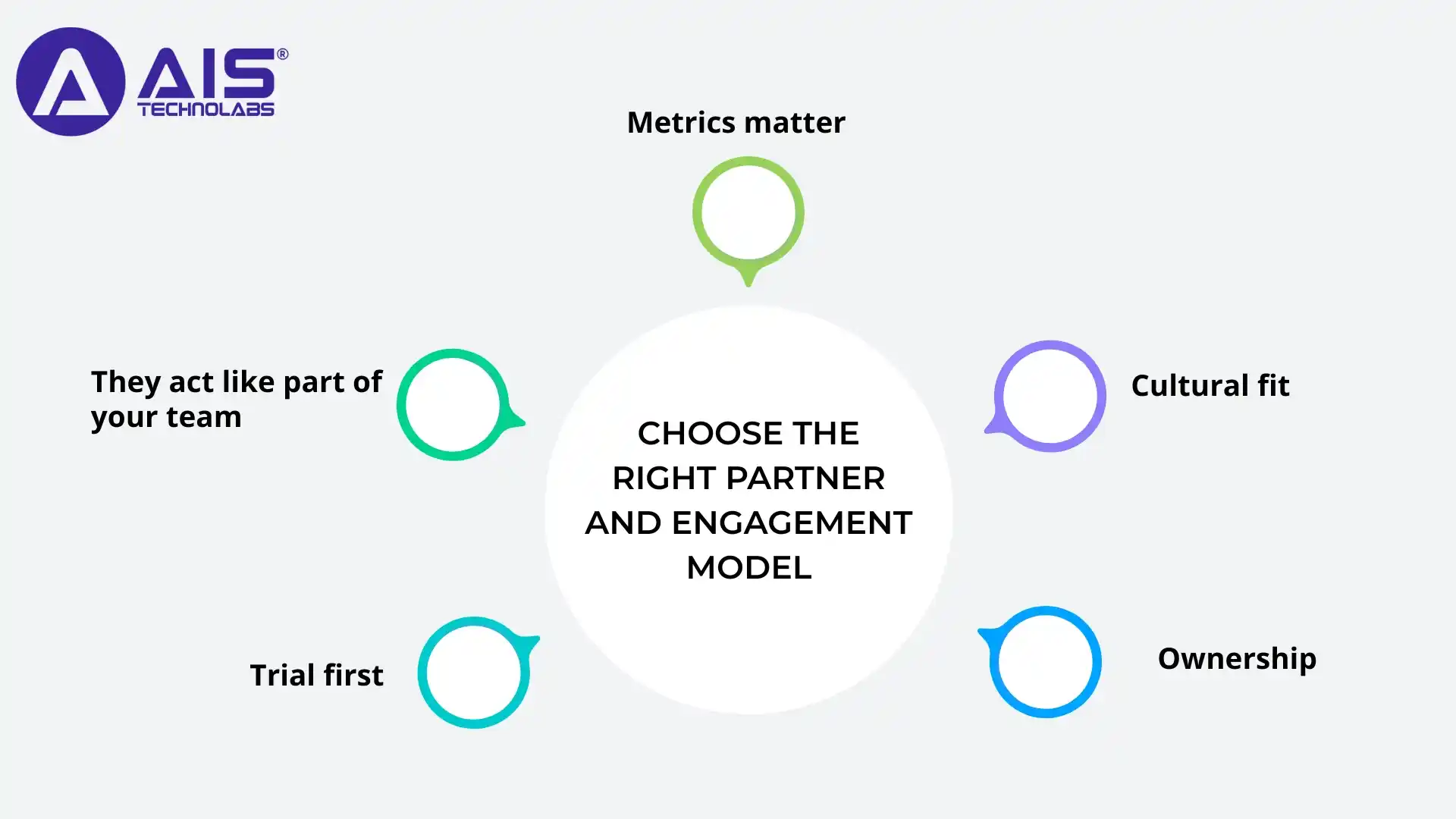
If you plan to hire dedicated developers, choosing the right partner and defining the right engagement is crucial.
- They act like part of your team: shared backlog, code access, sprint ceremonies, and transparency.
- Metrics matter: cycle time, pull-request throughput, and deployment frequency. Don’t just look at hours logged.
- Trial first: set a short trial sprint with clear deliverables to test communication, alignment, and velocity.
- Ownership: Make sure your external engineers own features end-to-end, not just outsource tasks.
- Cultural fit: Tools, timezone overlap, and language all matter. When communication is easy, productivity remains high.
Communication, tooling, and cultural alignment
One of the most common failure points when companies hire dedicated developers is that they treat the external team like a black box. Success comes when you treat them like internal members by giving them the same sprint rituals, code review norms, incident processes, and shared dashboards.
Suppose you ensure synchronous overlap hours (especially across time zones), shared project boards, and aligned acceptance criteria. In that case, the external team becomes part of your rhythm rather than a bucket of tasks. That cohesion dramatically increases speed, quality, and satisfaction.
Accelerate Your Software Growth — Start With a Dedicated Team
Risk management and IP protection
When a firm hires dedicated developers, some leaders worry about IP leakage, quality drift, or security.
Reasonable precautions mitigate these risks: enforce role-based access, use SSO and audited credentials, have NDAs and contractual IP ownership, establish secure development environments, and maintain full visibility into code and release pipelines.
With the right processes, you safeguard your assets while still benefiting from external velocity.
Expected outcomes and measurable KPIs
When companies embrace the model where they hire dedicated developers and integrate them well, several outcomes become visible:
- Shorter time-to-market: Some data shows organisations reduced development time by up to 25% when using external/outsourced models.
- Improved scalability: The ability to flex team size up & down without permanent hiring overhead.
- Better cost per feature: Because you avoid repeated onboarding, churn, training and idle time.
- Higher conversion of ideas-to-releases: Engineers already familiar with your stack ship more reliably.
A practical checklist
- Clarify your use case: module rebuild, new product line, maintenance lift, etc.
- Decide whether you need a few extra senior engineers or a full-blown dedicated development team.
- Prepare a two-week pilot sprint with clear goals and deliverables.
- Set measurable success criteria: e.g., “deploy first MVP feature in 4 weeks,” “feature cycle time under X days,” etc.
- Make tooling and onboarding ready: access to codebase, backlog tools, documentation, and dev environments.
- Monitor results monthly and iterate: if the external team is performing, gradually expand scope; if not, reassess.
If you need to hire software development team members, start with this pilot and build trust; don’t swap in people as disposable contractors. The longer-term value comes from treating external engineers as part of your core growth engine.
When the model might not be the best fit
There are cases when bringing in external dedicated help is not ideal. For example:
- At a very early idea stage, where you need rapid, live experimentation and you benefit from founding-team continuity rather than external hires.
- When your product or IP is extremely sensitive, and you lack the security or governance processes to manage external engineers safely.
- When you don’t yet have a stable architecture or road-map, and need internal deep-domain knowledge before scaling.
- In those situations, it may be better to build an initial core in-house and then, once stable, hire dedicated developers for non-core components.
Realistic timeline and expectations
In our experience, a solid ramp-up of an external dedicated unit takes about 4–8 weeks: during this period, you align culture, context, backlog, and tooling; the first feature goes live; and after that, the team reaches ‘steady velocity.’
This timeline is much faster than many full recruiting cycles for senior engineers. When you hire dedicated developers with proper onboarding, you’re up and running in weeks instead of months.
Final thoughts
If your goal is to move faster, lower risk, and scale predictably without creating unsustainable overhead, the best lever is to hire dedicated developers and integrate them as an extension of your team with support from AIS Technolabs.
Whether you’re looking to hire software development team members to cover a new skill-sets, boost delivery, or simply scale software team capacity for a launch, the dedicated model offers a repeatable, predictable growth path, provided you invest upfront in onboarding, measurement, and culture.
FAQs
Ans.
In most cases, you’ll see meaningful output in 4–8 weeks: the first feature release and steady velocity soon after.
Ans.
Not necessarily. The right model can reduce recruiting, onboarding, and overhead costs; what counts is the total cost of ownership, not just salary.
Ans.
Track feature lead time, deployment frequency, sprint predictability, defect rate, team retention, and integration level with your internal squad.
Ans.
If you need cross-discipline capacity and full sprint coverage, go for a full dedicated development team. For niche skill gaps or incremental capacity, you may hire individual dedicated developers.
Ans.
Use clear contracts/NDAs, access control, auditing, and secure dev environments, and treat them as team members with visibility so they align with your culture and standards.

Harry Walsh
Harry Walsh, a dynamic technical innovator with 8 years of experience, thrives on pushing the boundaries of technology. His passion for innovation drives him to explore new avenues and create pioneering solutions that address complex technical problems with ingenuity and efficiency. Driven by a love for tackling problems and thinking creatively, he always looks for new and innovative answers to challenges.
 ASIA PACIFIC