Table of Content
(501 views)
Published:February 27, 2026 at 8:56 am
Last Updated:13 May 2026 , 7:06 am
Key Takeaways:
Introduction
Launching an online poker platform requires far more than technical readiness. Legal compliance defines whether your platform can operate, scale, accept payments, and retain players long term. From licensing and business registration to AML, KYC, and data protection, each step must be handled carefully.
For operators seeking faster market entry, White Label Poker Software has become the preferred approach. It offers a pre-built, compliance-ready foundation—but legal responsibility always remains with the operator. This guide explains every legal requirement in detail so you can launch confidently and sustainably.
Understanding the Legal Landscape of Online Poker Platforms
Online poker regulation is shaped by how jurisdictions classify poker, where operators are licensed, and where players are located. Understanding this legal landscape helps avoid violations, fines, and forced shutdowns.
Is Online Poker Legal? A Country-by-Country Overview
Online poker legality differs across regions. Some countries allow licensed real-money poker, others permit only social or skill-based play, while some prohibit online gambling entirely. Many operators legally serve international players by obtaining offshore licenses while blocking restricted jurisdictions.
When using a white label poker software platform, operators must comply with both the licensing authority and local player laws. Geo-blocking and jurisdiction-based access controls are essential legal safeguards.
Skill vs Gambling Classification and Its Legal Impact
Poker combines probability and player decision-making. In some regions, it is legally recognized as a skill-based game, allowing lighter regulation for private clubs or social platforms. However, most regulators still treat real-money poker as gambling.
This distinction impacts licensing, taxation, and advertising rules. Even skill-based recognition rarely removes the need for licensing when real money is involved.
How Online Poker Laws Differ from Casino Gambling Laws
Poker is peer-to-peer, meaning players compete against each other rather than the house. Revenue is generated through rake or tournament fees, not odds-based outcomes. As a result, poker regulations focus heavily on fairness, anti-collusion systems, and transparency.
Casino gambling laws often impose stricter house-edge controls, while poker laws emphasize game integrity and player protection.
Key Licenses Required to Launch an Online Poker Platform
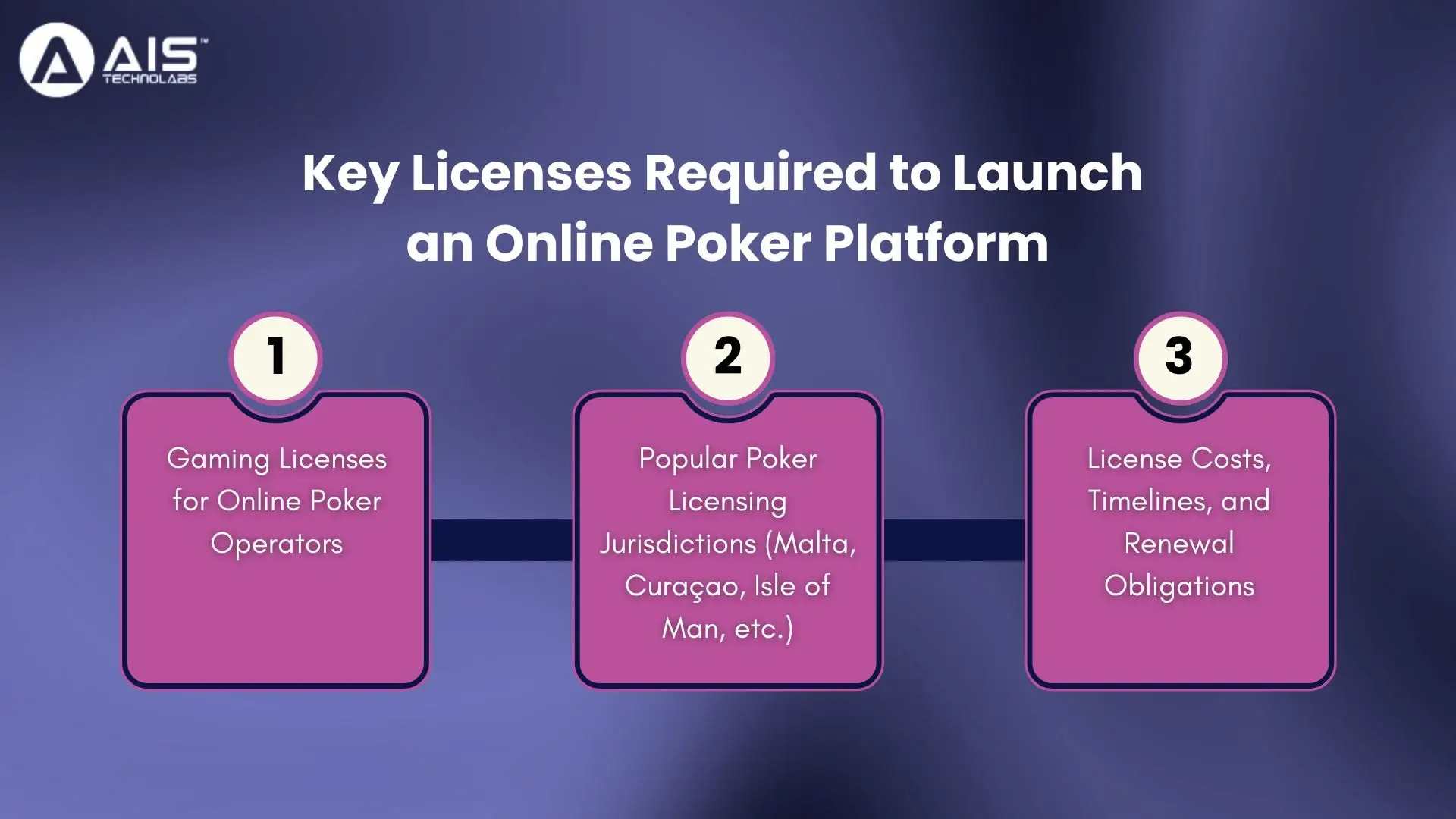
Licensing legitimizes your platform and enables access to payment providers, hosting services, and app marketplaces.
Gaming Licenses for Online Poker Operators
A remote gaming or online poker license is required for real-money operations. This applies even if the platform uses turnkey poker software or ready-made poker software.
The license holder is responsible for regulatory compliance, audits, and player protection—regardless of software provider involvement.
Popular Poker Licensing Jurisdictions (Malta, Curaçao, Isle of Man, etc.)
License Costs, Timelines, and Renewal Obligations
Licensing costs vary widely based on jurisdiction, typically ranging from $15,000 to over $150,000. Approval timelines range from four weeks to six months.
Licenses require annual renewals, periodic audits, compliance reporting, and ongoing fees. Non-compliance can result in suspension or revocation.
Business Registration and Corporate Structure Requirements
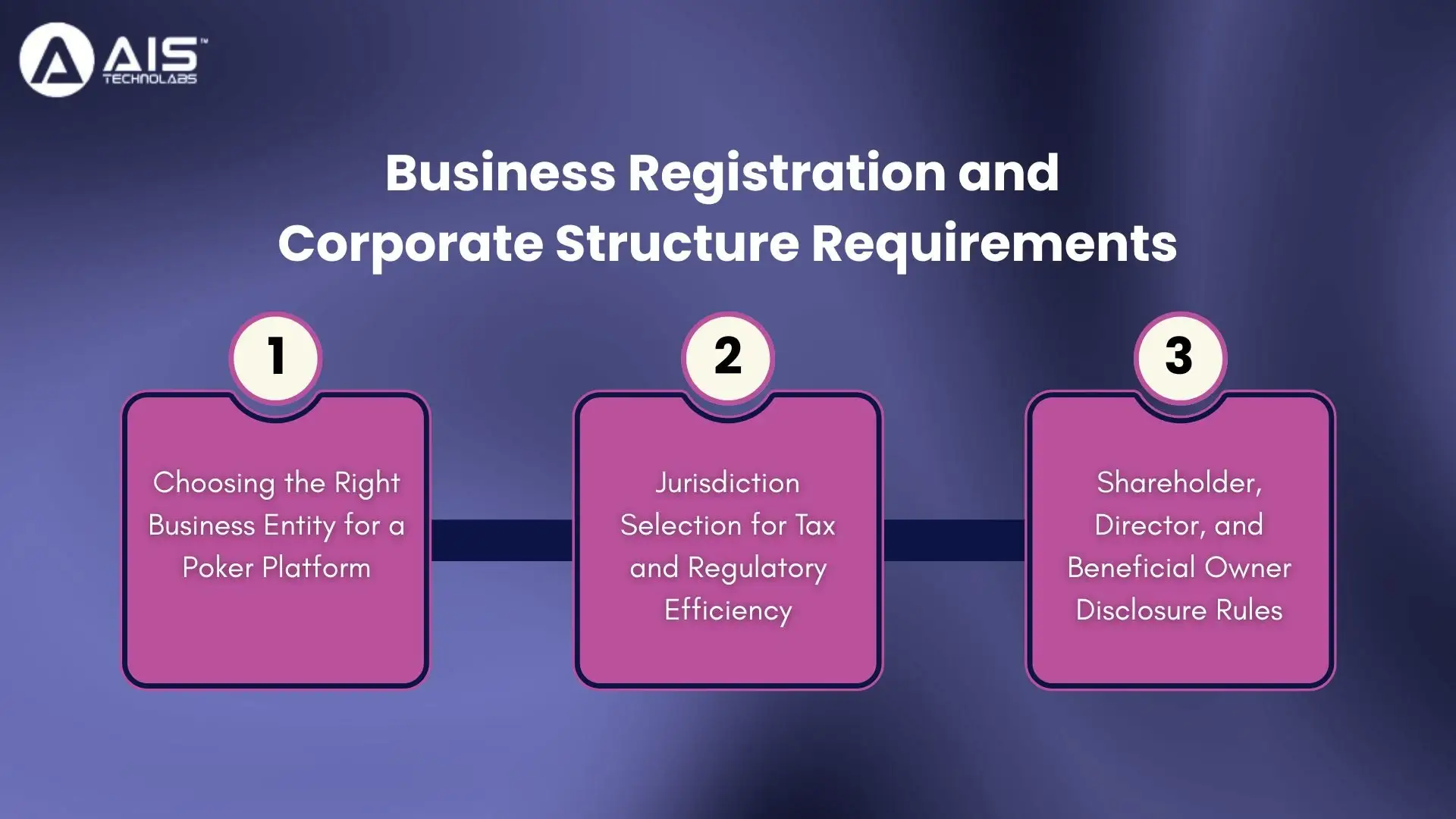
A legally sound business structure ensures transparency, tax efficiency, and regulatory approval.
Choosing the Right Business Entity for a Poker Platform
Most poker operators register as limited liability companies or gaming-focused entities. The structure must allow licensing, banking access, and ownership disclosure.
Operators running a poker platform for operators must ensure the entity can legally hold gaming licenses.
Jurisdiction Selection for Tax and Regulatory Efficiency
Jurisdiction affects taxation, operational costs, and regulatory oversight. Offshore jurisdictions may reduce tax burdens but can face stricter payment provider scrutiny.
Regulated jurisdictions enhance credibility and investor confidence.
Shareholder, Director, and Beneficial Owner Disclosure Rules
Gaming regulators require full disclosure of shareholders, directors, and beneficial owners. Background checks and source-of-funds verification are standard.
These requirements apply even when using poker software white label solutions.
Compliance with Anti-Money Laundering (AML) and KYC Regulations
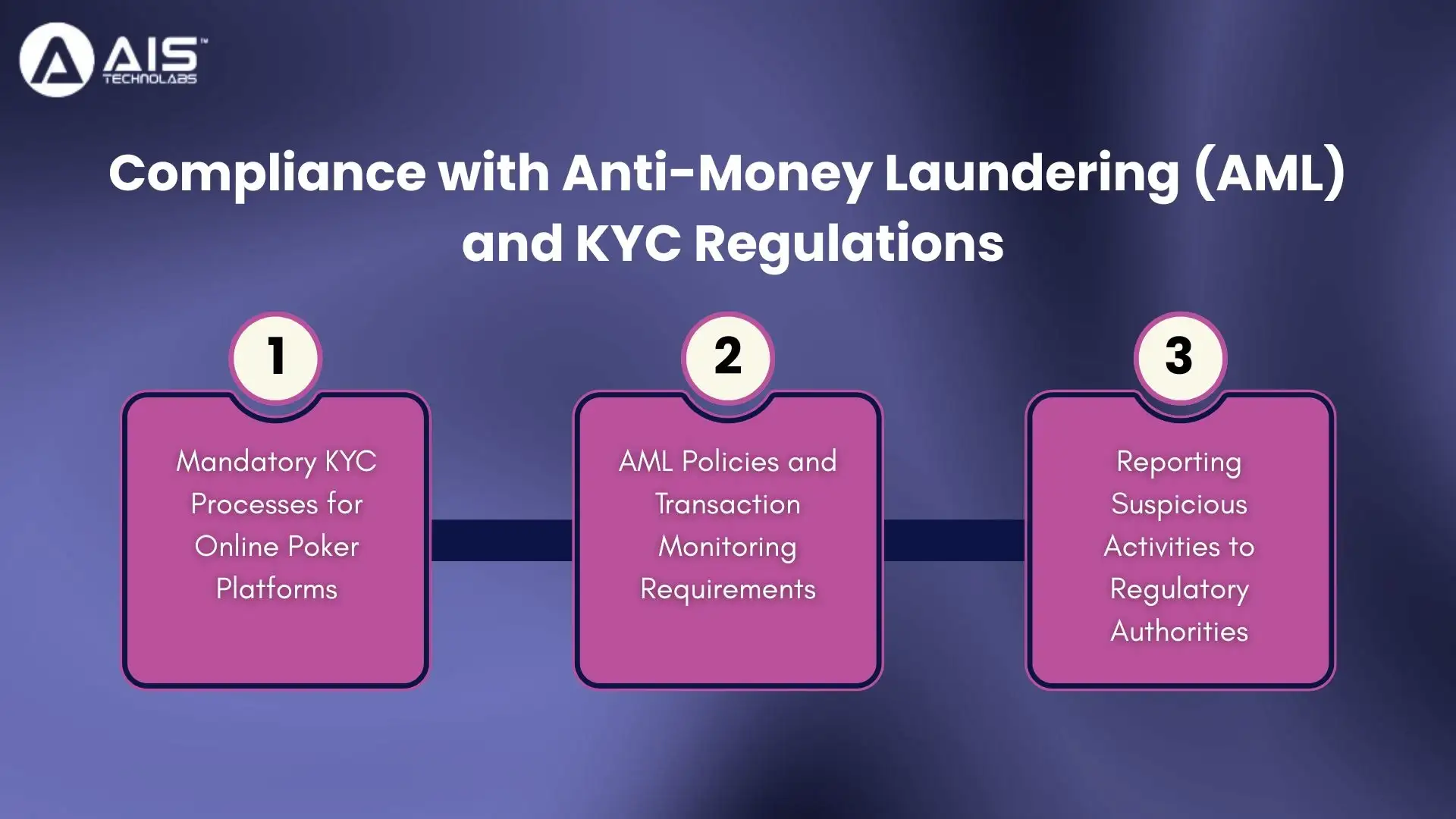
AML and KYC frameworks prevent financial crime and protect platform integrity.
Mandatory KYC Processes for Online Poker Platforms
KYC requires players to verify identity, age, and location. Document checks are often required before withdrawals or account activation.
Most white label online poker software platforms integrate automated KYC tools.
AML Policies and Transaction Monitoring Requirements
AML systems monitor deposits, withdrawals, and betting behavior for suspicious patterns. Operators must maintain written AML policies approved by regulators.
Reporting Suspicious Activities to Regulatory Authorities
Suspicious transactions must be reported within regulatory timelines. Failure to report can lead to fines or license suspension.
Payment, Banking and Financial Compliance Requirements
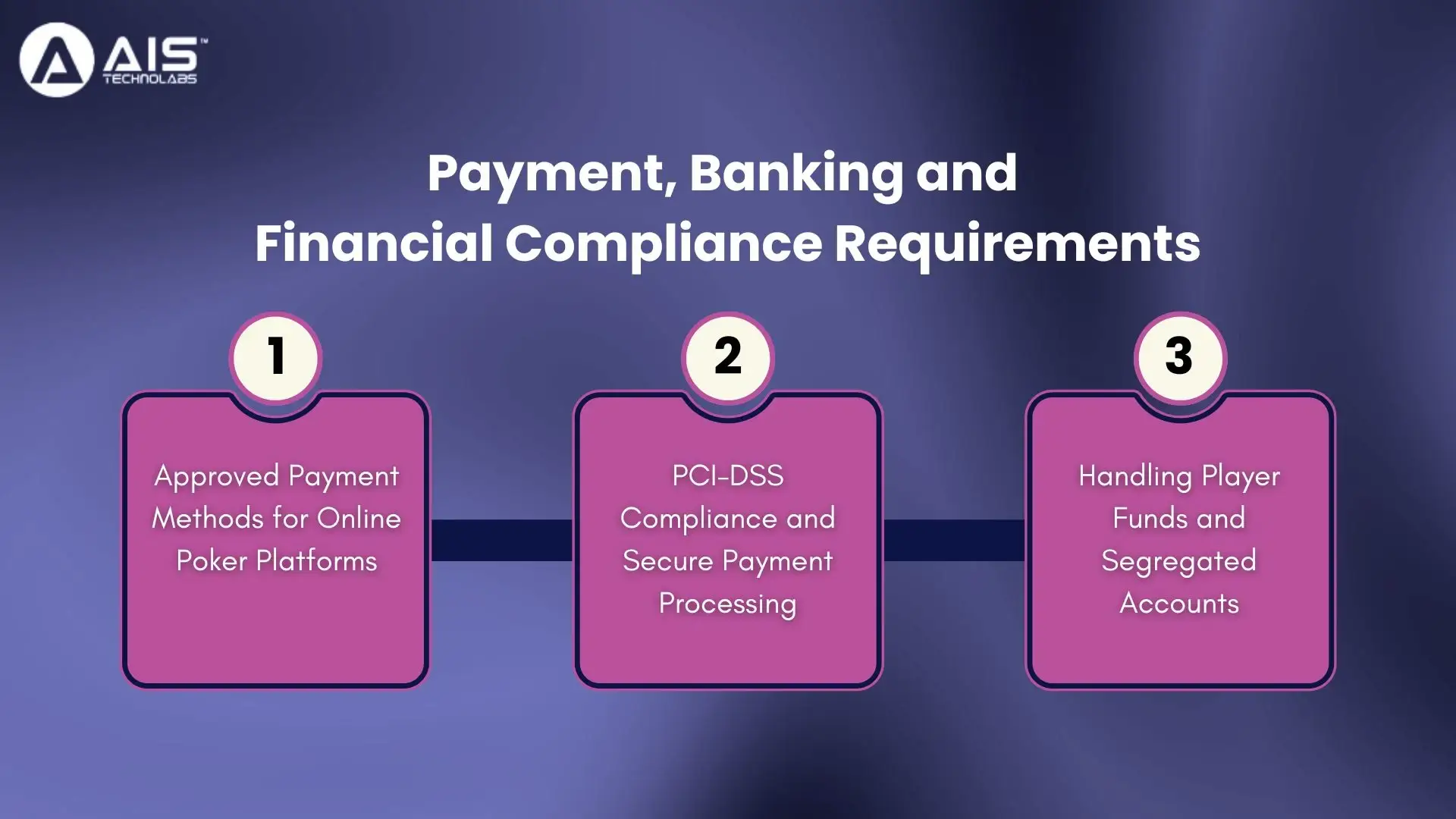
Payment and banking compliance ensures that an online poker platform can legally accept deposits, process withdrawals, and protect player funds. Regulators closely monitor financial operations to prevent fraud, money laundering, and misuse of player balances. Even when using white label poker software, operators remain fully responsible for financial compliance.
Approved Payment Methods for Online Poker Platforms
Online poker platforms may only use payment methods approved by regulators and banking partners. Common options include credit and debit cards, bank transfers, digital wallets, and region-specific payment solutions.
Each payment provider performs its own compliance checks, requiring proof of licensing, AML policies, and operational transparency. Platforms must also restrict payment access in jurisdictions where online poker is not permitted.
PCI-DSS Compliance and Secure Payment Processing
PCI-DSS compliance is mandatory for any platform handling cardholder data. This standard governs how payment information is stored, transmitted, and processed.
Most modern poker platforms rely on tokenization and encrypted gateways to avoid storing sensitive card data. Failure to comply with PCI-DSS requirements can result in fines, payment processor termination, and legal action.
Handling Player Funds and Segregated Accounts
Regulators require player funds to be held in segregated accounts, separate from operational finances. This protects players in the event of insolvency or disputes.
Segregation ensures transparency, simplifies audits, and builds trust with regulators and players. Improper fund handling is one of the fastest ways to lose a gaming license.
Data Protection and Player Privacy Laws
Data protection laws govern how player information is collected, stored, and used. Poker platforms handle sensitive personal and financial data, making privacy compliance a core legal obligation rather than an optional feature.
GDPR and Global Data Protection Regulations
Platforms serving players in regulated markets must comply with GDPR or equivalent global data protection laws. These regulations require lawful data collection, explicit user consent, and clear disclosure of how data is used.
Operators must also provide players with rights to access, correct, or delete their data upon request.
Secure Storage of Player and Financial Data
All player data must be encrypted both at rest and in transit. Access controls, role-based permissions, and audit logs are required to prevent unauthorized access.
Cloud infrastructure must meet recognized security standards, and regular vulnerability testing is expected by regulators.
Privacy Policies and User Consent Management
Every poker platform must publish a clear and accessible privacy policy. This document explains what data is collected, why it is collected, and how long it is retained.
User consent must be recorded, stored, and auditable. Any changes to data usage require renewed consent.
Fair Play, Game Integrity, and RNG Certification
Fair play requirements ensure that all players compete on equal terms and that game outcomes are not manipulated. Regulators treat game integrity as a core condition for licensing approval.
Random Number Generator (RNG) Certification Requirements
RNG certification verifies that card dealing and game outcomes are truly random. Independent testing laboratories evaluate the poker engine and issue certification reports.
Licensed platforms must maintain valid RNG certification and submit updated reports during audits or software updates.
Anti-Collusion and Anti-Fraud Measures
Poker platforms must actively prevent collusion, bot usage, and chip dumping. This involves monitoring player behavior, betting patterns, and gameplay interactions.
Advanced platforms use automated detection systems combined with manual reviews to identify and act on suspicious activity.
Third-Party Audits and Fair Play Validation
Regulators often require third-party audits to validate fairness, security, and compliance. These audits examine game logic, financial records, and operational controls.
Audit results must be submitted periodically and retained for regulatory review.
Responsible Gaming and Player Protection Obligations
Responsible gaming obligations are designed to protect players from harm and promote ethical platform operations. These requirements apply to both social and real-money poker platforms.
Age Verification and Player Eligibility Rules
Platforms must verify that all players meet the legal minimum age and are located in permitted jurisdictions. Automated age checks and geo-location tools are commonly required.
Failure to enforce eligibility rules can result in severe regulatory penalties.
Self-Exclusion, Deposit Limits, and Player Controls
Players must have access to tools that allow them to control their activity. These include deposit limits, session time limits, and self-exclusion options.
Once activated, self-exclusion requests must be enforced without exception.
Responsible Gaming Certifications and Policies
Many regulators require formal responsible gaming policies and encourage certification through recognized programs. These certifications demonstrate a platform’s commitment to player safety.
Responsible gaming measures are often reviewed during license renewals and audits.
Advertising, Marketing, and Promotion Legal Guidelines
Marketing online poker platforms is heavily regulated to prevent misleading claims and protect vulnerable users. Advertising violations can lead to fines or license suspension.
Legal Restrictions on Online Poker Advertising
Poker advertising must not target minors or imply guaranteed winnings. Messaging must be factual, responsible, and compliant with local advertising standards.
Some jurisdictions restrict where and how poker ads can appear, including digital and affiliate channels.
Bonus and Promotion Compliance Rules
Bonuses and promotions must include clear terms and conditions. Wagering requirements, eligibility rules, and expiration dates must be transparent.
Misleading bonus offers are a common cause of regulatory complaints and enforcement actions.
Affiliate Marketing Regulations for Poker Platforms
Operators are legally responsible for their affiliates’ actions. Affiliates must follow the same advertising rules as the platform itself.
Regular monitoring and written affiliate agreements are essential for compliance.
Ongoing Legal Compliance and Regulatory Audits
Legal compliance does not end at launch. Regulators expect continuous adherence to licensing conditions and evolving legal standards.
Periodic Audits and Compliance Reporting
Operators must submit regular financial, technical, and compliance reports. Audits may cover player funds, AML controls, and system security.
Failure to meet reporting deadlines can trigger investigations.
License Renewals and Regulatory Updates
Gaming licenses must be renewed periodically. Renewal reviews often reassess operational compliance, financial stability, and responsible gaming practices.
Platforms must also adapt quickly to regulatory changes.
Penalties for Non-Compliance and Legal Risks
Penalties range from financial fines to license suspension or permanent revocation. Payment providers may also terminate services following compliance failures.
Reputational damage from non-compliance can be irreversible.
Common Legal Mistakes to Avoid When Launching an Online Poker Platform
Many poker platforms fail not due to technology issues, but because of preventable legal mistakes made during launch or expansion.
Operating Without Proper Licensing
Launching without a valid license is one of the most serious violations. Unlicensed platforms face immediate shutdowns, blocked payments, and legal action.
Ignoring Local Player Jurisdiction Laws
Even with an offshore license, operators must respect local player laws. Serving restricted regions can invalidate a license.
Geo-blocking and jurisdiction controls are essential.
Weak KYC, AML, and Data Security Practices
Inadequate identity verification or data protection exposes platforms to fraud and regulatory sanctions. Weak controls undermine trust and long-term viability.
How to Launch a Legally Compliant Online Poker Platform
Launching a compliant poker platform requires careful planning, expert guidance, and technology designed for regulation from day one.
Working with Legal Advisors and Poker Software Providers
Legal advisors help interpret regulations, choose licensing jurisdictions, and prepare compliance documentation. Experienced poker software providers offer platforms built with regulatory requirements in mind.
This combination reduces risk and accelerates time to market.
Compliance-Ready Poker Software Infrastructure
A compliance-ready poker platform includes built-in KYC, AML, RNG certification support, payment security, and reporting tools.
This infrastructure simplifies audits and reduces operational overhead.
Pre-Launch Legal Checklist for Poker Operators
Before launch, operators must confirm licensing approval, payment integration, data protection measures, responsible gaming tools, and audit readiness.
Skipping any step can delay launch or trigger regulatory issues.
Conclusion
Launching an online poker platform is as much a legal project as it is a technical one. From licensing and compliance to data protection and responsible gaming, every requirement protects your players and your business. By choosing the right white label poker software provider and working with experienced legal advisors, operators can launch faster, safer, and with confidence.
At AIS Technolabs, we help businesses build compliant, scalable poker platforms with enterprise-grade security and regulatory readiness. If you’re planning to start or scale your poker business, contact us to explore a future-proof solution.
Disclaimer:
This blog is intended for informational and educational purposes only. We do not promote or facilitate gambling activities in any country where it is considered illegal. Our content is focused solely on providing knowledge about legal and regulated markets. We only work with operators and platforms that are licensed and comply with the laws of jurisdictions where casino gaming is permitted. We do not operate or endorse any form of gambling in restricted regions. In countries where only skill-based games are allowed, our involvement is strictly limited to those games.
We believe gambling should be an entertaining and responsible activity. Our goal is to ensure that the platforms we review uphold the highest standards of fairness, transparency, and player safety.
FAQs
Ans.
Most real-money poker platforms require a remote gaming or online poker license from a recognized jurisdiction.
Ans.
No. Some regions classify poker as a game of skill, but real-money play usually still requires licensing.
Ans.
Yes. Even social platforms must follow age verification, data protection, and consumer protection laws.
Ans.
Yes, provided the operator holds the required licenses and complies with all regulatory obligations.
Ans.
Penalties may include fines, payment blocking, license suspension, or permanent shutdown.

Mary Smith
Mary Smith excels in crafting technical and non-technical content, demonstrating precision and clarity. With careful attention to detail and a love for clear communication, she skillfully handles difficult topics, making them into interesting stories. Mary's versatility and expertise shine through her ability to produce compelling content across various domains, ensuring impactful storytelling that resonates with diverse audiences.
 ASIA PACIFIC