Table of Content
(500 views)
Published:June 12, 2026 at 6:22 am
Last Updated:12 Jun 2026 , 7:17 am
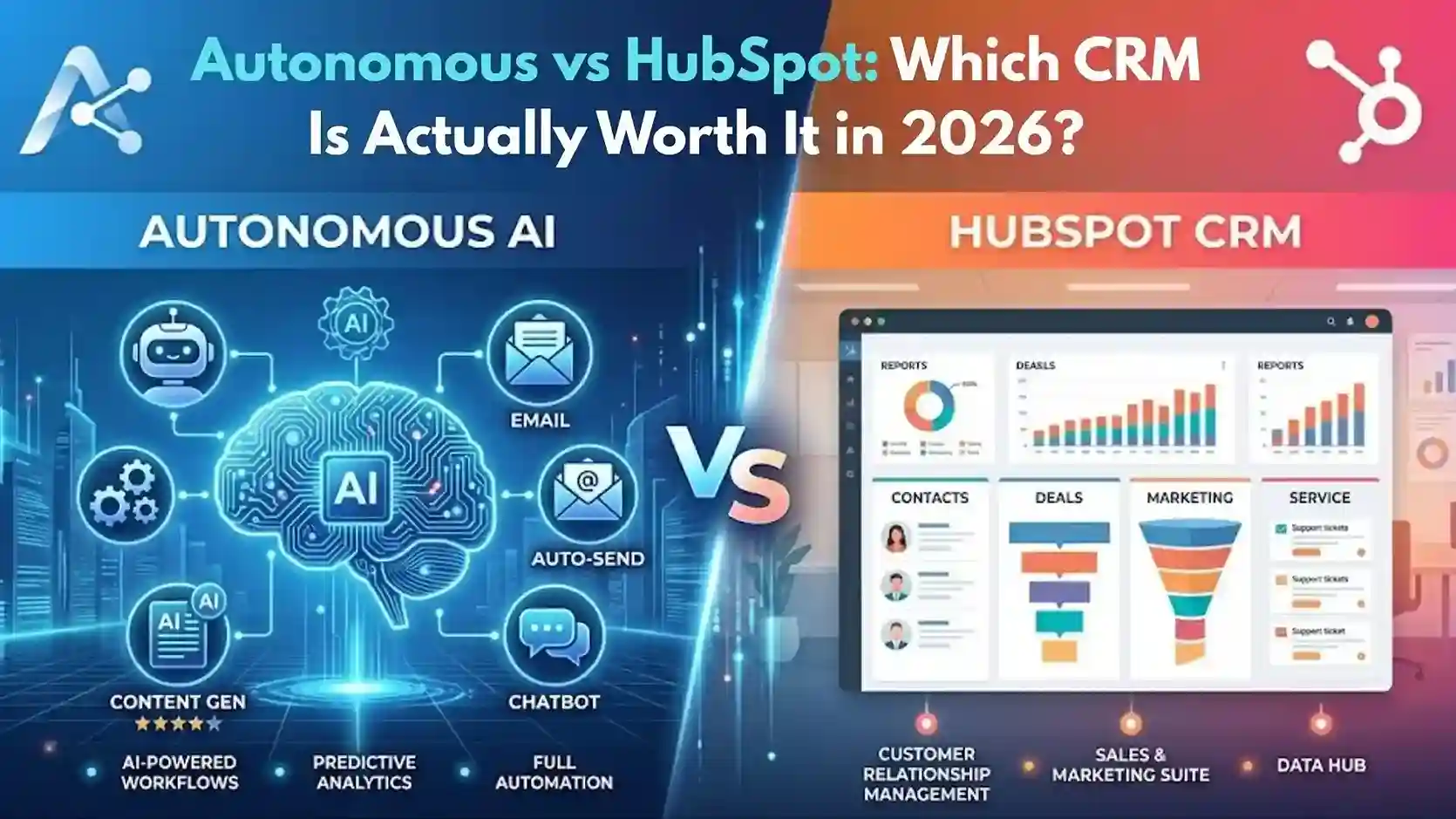
Key Takeaways:
- Autonomous CRM vs HubSpot serves two different buyers — HubSpot suits enterprise sales teams, while Autonomous is built for agencies, coaches, and service businesses replacing multiple tools.
- Autonomous AI automation goes beyond assistance — its Voice AI, Conversation AI, and Agent Studio autonomously handle inbound calls, lead qualification, and appointment booking 24/7.
- HubSpot pricing in 2026 reaches $2,000–$4,000/month at the Professional tier, while Autonomous offers a bundled all-in-one plan that replaces ClickFunnels, Mailchimp, Calendly, and more.
- White-label CRM for agencies is a core feature of Autonomous — agencies can fully rebrand and resell the platform to clients. HubSpot offers no equivalent white-label SaaS capability.
- HubSpot CRM reporting and integrations remain best-in-class for enterprise — with advanced forecasting, multi-touch attribution, and thousands of native app connections that Autonomous is still building toward.
- Multi-channel CRM communication is where Autonomous wins — unifying SMS, WhatsApp, Instagram DMs, TikTok, Google Business Profile, and web chat in one inbox, far beyond HubSpot's email and chat coverage.
- Best CRM for small businesses in 2026 depends on your needs — choose HubSpot for a proven sales CRM, or Autonomous if you want an all-in-one business platform with AI, funnels, and white-labeling built in.
Who These Platforms Are Actually Built For
Before comparing features, it's worth being direct about the audience each platform serves — because a lot of confusion in the Autonomous vs HubSpot debate comes from comparing tools that weren't designed for the same buyer.
HubSpot was built from the ground up for inbound marketing and sales teams inside growing companies. Its sweet spot is a business with a dedicated sales team, an existing software stack, and the need for a reliable CRM backbone that everything else plugs into. Large organizations, enterprise sales floors, and companies already deep in the HubSpot ecosystem are where it performs best.
Autonomous targets a different buyer: Digital marketing agencies, coaches, consultants, course creators, and service businesses that need an operating system — not just a CRM. The platform is built around the idea that its users are paying for ClickFunnels, Mailchimp, Calendly, Kajabi, Birdeye, and a CRM separately, and would rather replace all of them with one subscription. Its white-label SaaS mode also makes it a serious option for agencies that want to resell the platform to their own clients.
Neither approach is wrong. They're just solving different problems.
Feature Comparison: What Each Platform Actually Offers
CRM and Contact Management
Both platforms handle the fundamentals competently. HubSpot's contact management is clean, familiar to most sales professionals, and requires minimal onboarding. Deal stages, activity timelines, and company records work the way you'd expect.
Autonomous covers the same ground — unlimited contacts across all plans, custom fields and objects, pipeline management, opportunity tracking, and company-level records for B2B. It also includes call recording with automatic logging to contact records and a missed-call text-back feature that automatically sends an SMS when a call goes unanswered. That last detail sounds small, but it matters significantly for service businesses that lose leads to voicemail.
The honest difference here isn't features — it's familiarity. If your sales team has used HubSpot before, they'll be productive in days. Autonomous will require more onboarding time simply because there's more to configure.
Marketing Automation
HubSpot's workflow builder is mature, well-documented, and widely trusted. You can build lead nurturing sequences, score contacts, trigger internal notifications, and automate deal updates without much friction.
Autonomous takes a broader approach. Its workflow builder spans email, SMS, voice calls, voicemail drops, Facebook Messenger, Instagram DMs, WhatsApp, and web chat — all within a single automation. It also includes a Workflow AI Builder: describe what you want the automation to do in plain English, and the system generates the entire workflow — triggers, conditions, branching logic included. For agencies building the same types of sequences repeatedly for different clients, this is a genuine time saver.
One feature worth calling out: Trigger Links, which track clicks on specific URLs to segment contacts and fire workflow actions automatically. This level of behavioral targeting is available in HubSpot but typically requires higher-tier plans.
Sales Pipeline Management
This is HubSpot's strongest category. Its deal tracking, forecasting tools, sequence automation, and sales reporting are battle-tested across thousands of organizations. Large sales teams with quota tracking, territory management, and complex pipeline stages will feel at home here.
Autonomous provides drag-and-drop pipeline management, opportunity tracking with assigned values and close date probability, task assignment, and call tracking. It handles sales workflows well for small-to-mid-size teams. Where it doesn't match HubSpot is in the enterprise-level depth: multi-region reporting, advanced forecasting models, and the breadth of native CRM integrations that enterprise sales stacks require.
AI Capabilities
This is where the Autonomous vs HubSpot comparison shifts most noticeably in 2026.
HubSpot has added AI across its platform — content generation, reporting summaries, and automation enhancements — but these function as assistants to existing workflows. You still manage the process; AI speeds up individual tasks.
Autonomous has built what it calls an AI Employee Suite, and the framing is deliberate. These aren't tools that help you do things faster — they're designed to handle tasks without you:
- Voice AI (Inbound): Answers calls, qualifies leads, collects contact information, and books appointments with sub-600ms response latency. It operates 24/7 without human intervention.
- Voice AI (Outbound): Triggers outbound calls from workflows — for abandoned checkouts, stale leads, or form follow-ups — without a human dialing.
- Conversation AI: Manages chat across SMS, web chat, Facebook, Instagram, and WhatsApp with contextual memory, so conversations don't feel robotic when someone returns after a gap.
- Agent Studio: Lets you configure multiple AI agents with distinct personas, knowledge bases, and assigned phone numbers for different departments or services.
- Custom Knowledge Bases: Train AI agents on your specific FAQs, services, and pricing so responses are accurate to your business.
To put the AI gap in context: according to Salesforce's State of Sales report, sales reps spend only 28% of their week actually selling — the rest is administrative work. McKinsey research indicates that AI-assisted sales workflows close deals 20–30% faster. The question isn't whether AI matters in 2026 — it's whether the AI you're paying for actually removes work or just assists with it.
Funnel and Website Building
HubSpot's Content Hub handles landing pages, blogs, and website content well. It's polished, beginner-friendly, and deeply integrated with its CRM.
Autonomous includes a full website and funnel builder — multi-step funnels, checkout pages, upsell flows, A/B testing, a built-in image editor, custom domains with automatic SSL, and AI-generated funnel layouts from text prompts. For businesses that currently pay for a separate funnel tool (ClickFunnels runs $97–$297/month), this is a direct replacement.
Communication and Unified Inbox
HubSpot handles email, live chat, and customer service workflows. For most traditional sales and support operations, that's sufficient.
Autonomous consolidates every communication channel into a single inbox: SMS, email, phone, Facebook Messenger, Instagram DMs, WhatsApp, TikTok DMs and comments, Google Business Profile messaging, and web chat. Service Level Agreement (SLA) settings let you define response time goals by channel with real-time alerts when thresholds are missed.
For service businesses receiving inquiries from multiple sources every day, managing these from separate platforms creates real operational friction. A unified inbox that includes TikTok and Google Business Profile messaging — not just email and chat — reflects how communication actually works in 2026.
Reporting and Analytics
HubSpot is the clear winner here. Its reporting is mature, highly customizable, and trusted by enterprise organizations for attribution, campaign performance, and revenue forecasting. If your business needs board-level reporting or complex multi-touch attribution, HubSpot's analytics are more developed.
Autonomous includes customizable dashboards, call reporting, revenue tracking, appointment analytics, ad campaign tracking across Facebook, Google, and TikTok, and conversion attribution. The reporting is functional and sufficient for most small-to-mid-size operations — but it doesn't match HubSpot's depth for organizations where analytics is a strategic function.
Integrations and Ecosystem
HubSpot's marketplace is one of its biggest competitive advantages. Thousands of native integrations mean most businesses can connect their existing software stack without custom development.
Autonomous offers a public REST API, Zapier, Stripe, PayPal and Venmo (OAuth), Google and Facebook Ads, TikTok, WordPress management, Printify for e-commerce fulfillment, Twilio for telephony, and webhooks for custom integration work. The integration library is functional but smaller. If your organization runs on NetSuite, Salesforce data, Intercom, or enterprise BI tools, HubSpot connects more reliably.
Agency and White-Label Features
This category isn't a competition. HubSpot has limited agency-specific tooling. Autonomous was built with agencies as a primary use case.
The white-label SaaS platform mode lets agencies rebrand the entire platform — logos, colors, domains, login pages — and resell it to clients under their own brand with custom pricing tiers. Sub-account management allows unlimited client accounts with individual settings and feature access. Usage rebilling lets agencies mark up SMS, call, email, and AI costs per client. There's even a built-in prospecting tool with lead status tracking and one-click sub-account creation for won deals.
For an agency that wants to build a recurring SaaS revenue stream on top of a client services business, this is a meaningful differentiator.
Pricing: What You Actually Pay
This is where generic comparisons mislead the most. The right question isn't "which platform is cheaper" — it's "what does each platform replace."
HubSpot pricing (approximate, as of 2026):
- Free CRM: Basic contact management, no time limit
- Starter: ~$20/month
- Marketing Hub Professional: ~$890/month
- Sales Hub Professional: ~$500/month
- Enterprise tiers: $3,600+/month per hub
The free CRM is genuinely useful for small teams with basic needs. The problem is that most businesses that need marketing automation, sequences, reporting, and advanced features are in Professional territory — and running Marketing, Sales, and Service Hub at the Professional level puts monthly spend at $2,000–$4,000 before seat-based add-ons.
Autonomous pricing: Autonomous uses a bundled model rather than charging per hub or feature tier. The full platform — CRM, automation, AI suite, funnels, SMS, reputation management, scheduling, memberships, and white-label tools — is available in a single subscription.
For businesses currently paying separately for:
- ClickFunnels: $97–$297/month
- ActiveCampaign: $49–$149/month
- Birdeye or Podium (reputation management): $300–$400/month
- Calendly: $16–$48/month
- Kajabi (courses/communities): $149–$399/month
the combined spend reaches $600–$1,300/month before adding a CRM. For those businesses, Autonomous frequently costs less in total even if the headline price seems comparable.
For businesses that only need a CRM and basic marketing tools, HubSpot's free or Starter tier will almost always be cheaper.
What Autonomous Does Not Do Well
No honest comparison ends without this section.
- Integration depth: If your business is built on Salesforce data, enterprise BI platforms, or a complex existing software stack, HubSpot connects more reliably. Autonomous's marketplace is growing but smaller, and some mission-critical integrations that exist natively in HubSpot require Zapier workarounds in Autonomous.
- Onboarding and partner network: HubSpot has fifteen years of certified implementation partners, extensive documentation, community forums, and HubSpot Academy. Autonomous support is more hands-on but less standardized at scale. For large organizations that need a structured implementation process, this gap is material.
- Enterprise sales tooling: Complex territory management, multi-region quota tracking, and advanced sales forecasting are more mature in HubSpot's Sales Hub Enterprise. Autonomous is a strong fit for building and consolidating — it's a harder sell for scaling an already complex, multi-system enterprise sales operation.
- Brand recognition: When you're demoing software to a skeptical CFO, "we use HubSpot" lands differently than a platform they haven't heard of. For some organizations, vendor credibility is a real procurement factor.
Autonomous vs HubSpot: Feature Comparison
Who Should Choose Each Platform
Choose HubSpot if:
- You have a structured sales team that needs mature pipeline and forecasting tools
- You're an enterprise or large organization with a complex software ecosystem
- You only need CRM and basic marketing — the free plan genuinely covers your needs
- Your team has used HubSpot before, and re-training isn't an option
- You need proven vendor support with a large certified partner network
Choose Autonomous if:
- You're a marketing agency looking to consolidate client tooling and add a SaaS revenue stream through white-labeling
- You're currently paying for 4–6 separate tools (funnel builder, email platform, scheduler, reputation tool, CRM) and want to reduce that to one
- AI that handles calls, books appointments, and manages conversations without human oversight is a business priority
- You serve local service businesses, coaches, or consultants who need SMS, reputation management, and multi-channel communication alongside CRM
- You want to host courses, build member communities, or run a paid community — none of which HubSpot supports natively.
Final Verdict
The Autonomous vs HubSpot decision isn't really about which platform has more features. It's about what problem you're trying to solve.
HubSpot is the right choice when you need a proven, deeply integrated CRM with enterprise-grade sales tools and a large ecosystem. It's the safer organizational choice for companies where vendor stability, established support structures, and AI integration breadth matter more than feature consolidation.
Autonomous is the right choice when you're running a lean operation that needs to replace multiple tools, deliver AI-driven automation that actually removes labor, or build an agency business with a white-label SaaS Platform component on top. For that buyer, it offers substantially more value per dollar.
The honest summary: if you need a CRM, consider HubSpot. If you need a business operating system that includes a CRM, Autonomous is the more complete answer in 2026.
FAQs
Ans.
The free CRM is genuinely useful for basic contact and deal management. Most growing businesses, however, need Marketing Hub Professional (~$890/month) or Sales Hub Professional (~$500/month) for serious automation and reporting. Running multiple hubs together at the Professional tier typically costs $2,000–$4,000/month before seat pricing.
Ans.
Yes, Autonomous includes WordPress management with site performance reports, custom HTML pages, and custom value insertion. It also integrates with Zapier, Stripe, PayPal, Google Ads, Facebook Ads, and TikTok. Its native integration library is smaller than HubSpot's, so businesses with complex existing software stacks should verify specific integrations before committing.
Ans.
Both platforms target similar audiences - agencies, consultants, and service businesses — and share significant feature overlap: white-label capabilities, funnel builders, multi-channel communication, and CRM. The key differentiators are Autonomous's AI Employee Suite depth, the Agent Studio for managing multiple AI agents, and the membership and community hosting features. For agencies evaluating the switch, the most important comparison points are client sub-account management structure and AI capability maturity.
Ans.
It depends on the type of small business. A startup that only needs basic contact management and email is probably better served by HubSpot's free tier. A local service business, coach, or consultant who needs SMS, appointment booking, reputation management, and a funnel alongside their CRM will get more practical value from Autonomous even at an earlier stage - because they're replacing tools they'd need to pay for anyway.
Ans.
HubSpot has well-documented migration tools and a large network of certified partners for businesses switching from Salesforce, Zoho, or Pipedrive. Autonomous migration is more hands-on. Either way, a realistic CRM migration for a mid-size business typically takes four to twelve weeks from data export to full team adoption - and that timeline rarely changes based on which platform you're migrating to.
Ans.
Yes. HIPAA-compliant data handling and communication are available for healthcare businesses within the Autonomous platform.

Mary Smith
Mary Smith excels in crafting technical and non-technical content, demonstrating precision and clarity. With careful attention to detail and a love for clear communication, she skillfully handles difficult topics, making them into interesting stories. Mary's versatility and expertise shine through her ability to produce compelling content across various domains, ensuring impactful storytelling that resonates with diverse audiences.
 ASIA PACIFIC